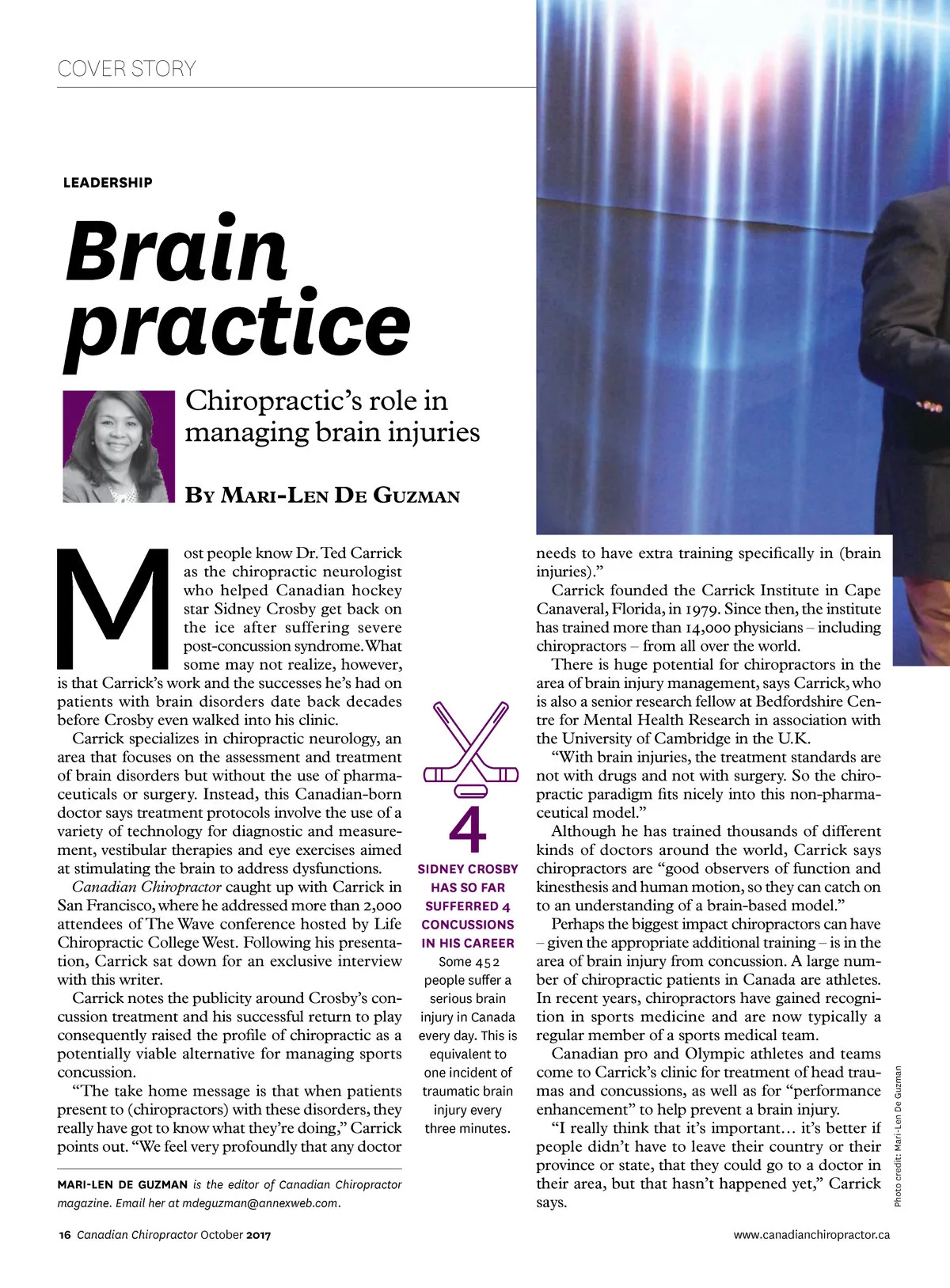
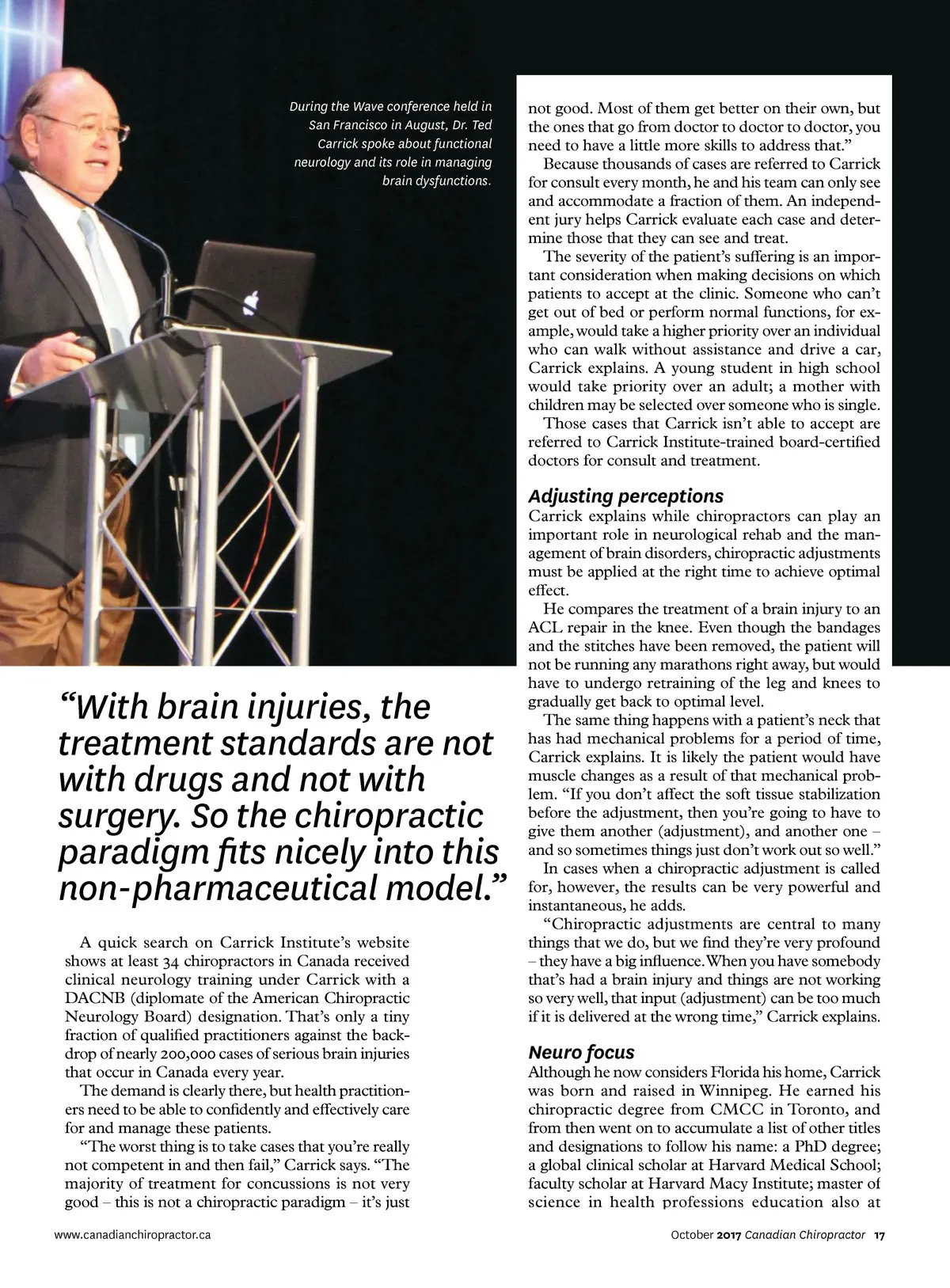
COVER STORY LEADERSHIP Brain practice Chiropractic’s role in managing brain injuries M B y M ari -L en D e G uzMan needs to have extra training specifically in (brain injuries).” Carrick founded the Carrick Institute in Cape Canaveral, Florida, in 1979. Since then, the institute has trained more than 14,000 physicians – including chiropractors – from all over the world. There is huge potential for chiropractors in the area of brain injury management, says Carrick, who is also a senior research fellow at Bedfordshire Cen-tre for Mental Health Research in association with the University of Cambridge in the U.K. “With brain injuries, the treatment standards are not with drugs and not with surgery. So the chiro-practic paradigm fits nicely into this non-pharma-ceutical model.” Although he has trained thousands of different kinds of doctors around the world, Carrick says chiropractors are “good observers of function and kinesthesis and human motion, so they can catch on to an understanding of a brain-based model.” Perhaps the biggest impact chiropractors can have – given the appropriate additional training – is in the area of brain injury from concussion. A large num-ber of chiropractic patients in Canada are athletes. In recent years, chiropractors have gained recogni-tion in sports medicine and are now typically a regular member of a sports medical team. Canadian pro and Olympic athletes and teams come to Carrick’s clinic for treatment of head trau-mas and concussions, as well as for “performance enhancement” to help prevent a brain injury. “I really think that it’s important… it’s better if people didn’t have to leave their country or their province or state, that they could go to a doctor in their area, but that hasn’t happened yet,” Carrick says. www.canadianchiropractor.ca MARI-LEN DE GUZMAN is the editor of Canadian Chiropractor magazine. Email her at [email protected]. 16 Canadian Chiropractor October 2017 Photo credit: Mari-Len De Guzman ost people know Dr. Ted Carrick as the chiropractic neurologist who helped Canadian hockey star Sidney Crosby get back on the ice after suffering severe post-concussion syndrome. What some may not realize, however, is that Carrick’s work and the successes he’s had on patients with brain disorders date back decades before Crosby even walked into his clinic. Carrick specializes in chiropractic neurology, an area that focuses on the assessment and treatment of brain disorders but without the use of pharma-ceuticals or surgery. Instead, this Canadian-born doctor says treatment protocols involve the use of a variety of technology for diagnostic and measure-ment, vestibular therapies and eye exercises aimed SIDNEY CROSBY at stimulating the brain to address dysfunctions. HAS SO FAR Canadian Chiropractor caught up with Carrick in San Francisco, where he addressed more than 2,000 SUFFERRED 4 attendees of The Wave conference hosted by Life CONCUSSIONS Chiropractic College West. Following his presenta-IN HIS CAREER Some 452 tion, Carrick sat down for an exclusive interview people suffer a with this writer. serious brain Carrick notes the publicity around Crosby’s con-cussion treatment and his successful return to play injury in Canada consequently raised the profile of chiropractic as a every day. This is equivalent to potentially viable alternative for managing sports one incident of concussion. “The take home message is that when patients traumatic brain injury every present to (chiropractors) with these disorders, they really have got to know what they’re doing,” Carrick three minutes. points out. “We feel very profoundly that any doctor 4
Chiropractic + Naturopathic Doctor October 2017: Page 16