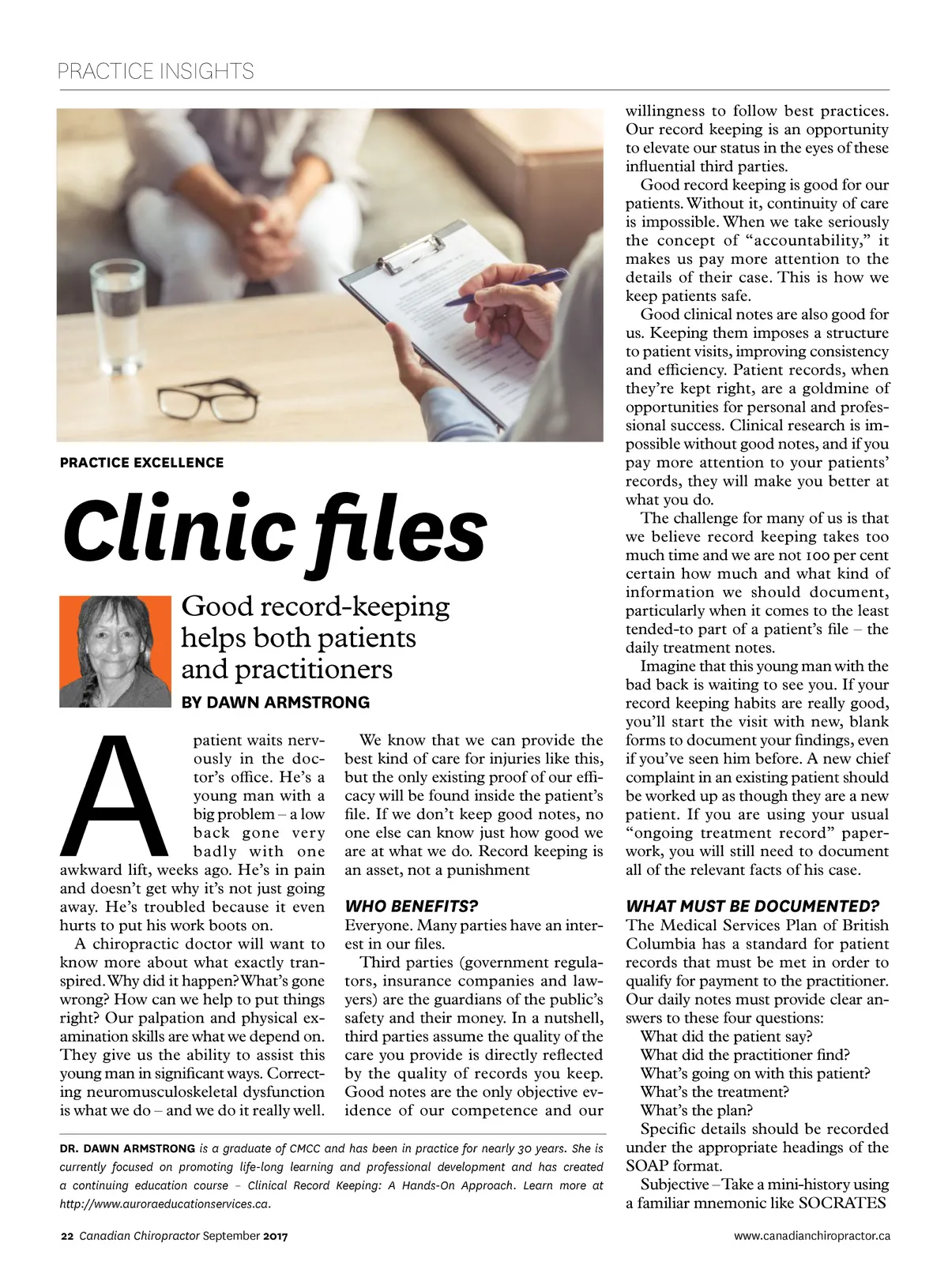
PRACTICE INSIGHTS willingness to follow best practices. Our record keeping is an opportunity to elevate our status in the eyes of these influential third parties. Good record keeping is good for our patients. Without it, continuity of care is impossible. When we take seriously the concept of “accountability,” it makes us pay more attention to the details of their case. This is how we keep patients safe. Good clinical notes are also good for us. Keeping them imposes a structure to patient visits, improving consistency and efficiency. Patient records, when they’re kept right, are a goldmine of opportunities for personal and profes-sional success. Clinical research is im-possible without good notes, and if you pay more attention to your patients’ records, they will make you better at what you do. The challenge for many of us is that we believe record keeping takes too much time and we are not 100 per cent certain how much and what kind of information we should document, particularly when it comes to the least tended-to part of a patient’s file – the daily treatment notes. Imagine that this young man with the bad back is waiting to see you. If your record keeping habits are really good, you’ll start the visit with new, blank forms to document your findings, even if you’ve seen him before. A new chief complaint in an existing patient should be worked up as though they are a new patient. If you are using your usual “ongoing treatment record” paper-work, you will still need to document all of the relevant facts of his case. PRACTICE EXCELLENCE Clinic files A Good record-keeping helps both patients and practitioners BY DAWN ARMSTRONG We know that we can provide the best kind of care for injuries like this, but the only existing proof of our effi-cacy will be found inside the patient’s file. If we don’t keep good notes, no one else can know just how good we are at what we do. Record keeping is an asset, not a punishment patient waits nerv-ously in the doc-tor’s office. He’s a young man with a big problem – a low back gone very badly with one awkward lift, weeks ago. He’s in pain and doesn’t get why it’s not just going away. He’s troubled because it even hurts to put his work boots on. A chiropractic doctor will want to know more about what exactly tran-spired. Why did it happen? What’s gone wrong? How can we help to put things right? Our palpation and physical ex-amination skills are what we depend on. They give us the ability to assist this young man in significant ways. Correct-ing neuromusculoskeletal dysfunction is what we do – and we do it really well. WHO BENEFITS? Everyone. Many parties have an inter-est in our files. Third parties (government regula-tors, insurance companies and law-yers) are the guardians of the public’s safety and their money. In a nutshell, third parties assume the quality of the care you provide is directly reflected by the quality of records you keep. Good notes are the only objective ev-idence of our competence and our WHAT MUST BE DOCUMENTED? DR. DAWN ARMSTRONG is a graduate of CMCC and has been in practice for nearly 30 years. She is currently focused on promoting life-long learning and professional development and has created a continuing education course – Clinical Record Keeping: A Hands-On Approach. Learn more at http://www.auroraeducationservices.ca. 22 Canadian Chiropractor September 2017 The Medical Services Plan of British Columbia has a standard for patient records that must be met in order to qualify for payment to the practitioner. Our daily notes must provide clear an-swers to these four questions: What did the patient say? What did the practitioner find? What’s going on with this patient? What’s the treatment? What’s the plan? Specific details should be recorded under the appropriate headings of the SOAP format. Subjective – Take a mini-history using a familiar mnemonic like SOCRATES www.canadianchiropractor.ca
Chiropractic + Naturopathic Doctor September 2017: Page 22