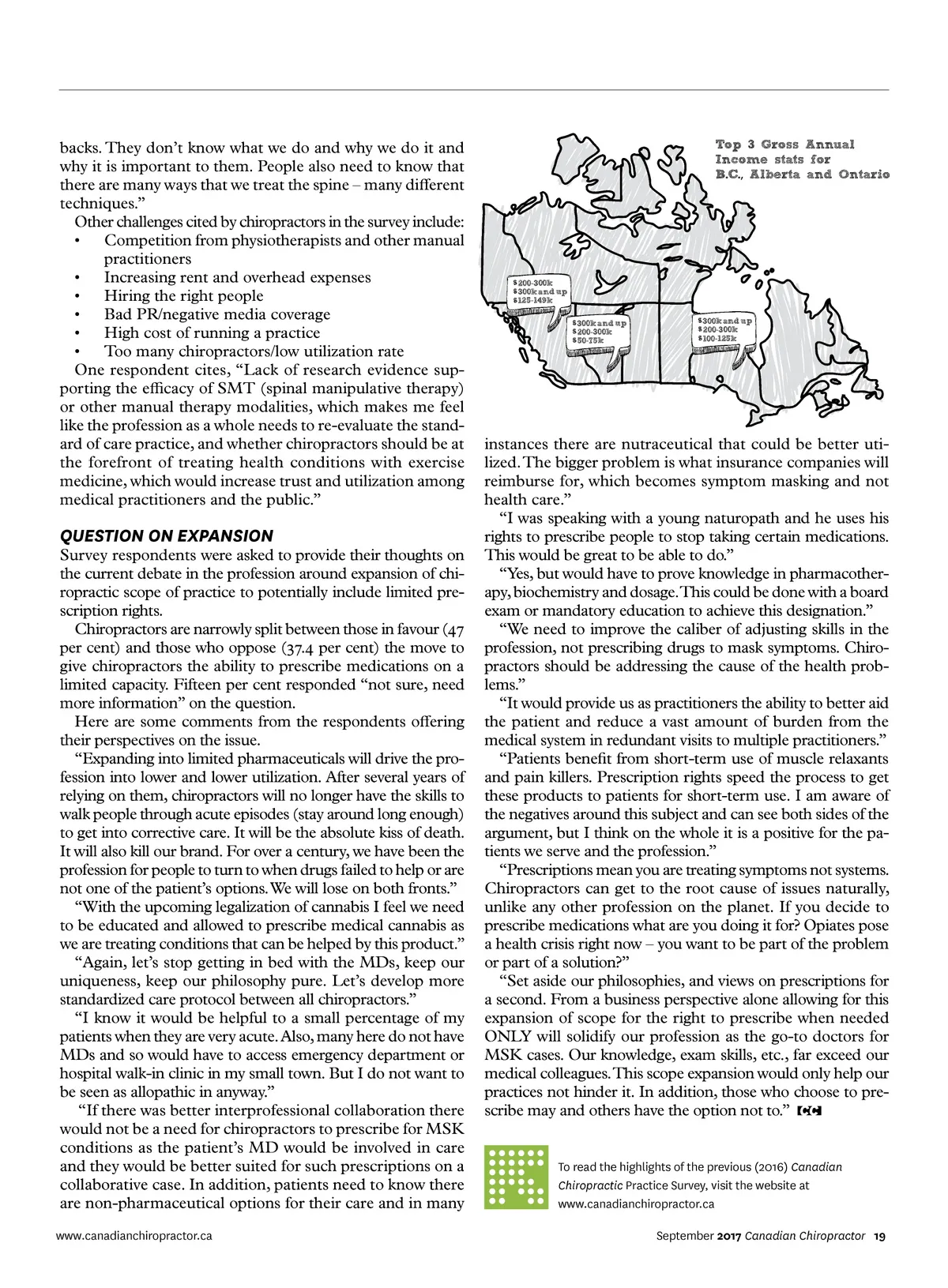
backs. They don’t know what we do and why we do it and why it is important to them. People also need to know that there are many ways that we treat the spine – many different techniques.” Other challenges cited by chiropractors in the survey include: • Competition from physiotherapists and other manual practitioners • Increasing rent and overhead expenses • Hiring the right people • Bad PR/negative media coverage • High cost of running a practice • Too many chiropractors/low utilization rate One respondent cites, “Lack of research evidence sup-porting the efficacy of SMT (spinal manipulative therapy) or other manual therapy modalities, which makes me feel like the profession as a whole needs to re-evaluate the stand-ard of care practice, and whether chiropractors should be at the forefront of treating health conditions with exercise medicine, which would increase trust and utilization among medical practitioners and the public.” Top 3 Gross Annual Income stats for B.C. , Alberta and Ontario 200 -300k 300k and up 125 -149k 300k and up 200 -300k 50 -75k 300k and up 200 -300k 100 -125k QUESTION ON EXPANSION Survey respondents were asked to provide their thoughts on the current debate in the profession around expansion of chi-ropractic scope of practice to potentially include limited pre-scription rights. Chiropractors are narrowly split between those in favour (47 per cent) and those who oppose (37.4 per cent) the move to give chiropractors the ability to prescribe medications on a limited capacity. Fifteen per cent responded “not sure, need more information” on the question. Here are some comments from the respondents offering their perspectives on the issue. “Expanding into limited pharmaceuticals will drive the pro-fession into lower and lower utilization. After several years of relying on them, chiropractors will no longer have the skills to walk people through acute episodes (stay around long enough) to get into corrective care. It will be the absolute kiss of death. It will also kill our brand. For over a century, we have been the profession for people to turn to when drugs failed to help or are not one of the patient’s options. We will lose on both fronts.” “With the upcoming legalization of cannabis I feel we need to be educated and allowed to prescribe medical cannabis as we are treating conditions that can be helped by this product.” “Again, let’s stop getting in bed with the MDs, keep our uniqueness, keep our philosophy pure. Let’s develop more standardized care protocol between all chiropractors.” “I know it would be helpful to a small percentage of my patients when they are very acute. Also, many here do not have MDs and so would have to access emergency department or hospital walk-in clinic in my small town. But I do not want to be seen as allopathic in anyway.” “If there was better interprofessional collaboration there would not be a need for chiropractors to prescribe for MSK conditions as the patient’s MD would be involved in care and they would be better suited for such prescriptions on a collaborative case. In addition, patients need to know there are non-pharmaceutical options for their care and in many www.canadianchiropractor.ca instances there are nutraceutical that could be better uti-lized. The bigger problem is what insurance companies will reimburse for, which becomes symptom masking and not health care.” “I was speaking with a young naturopath and he uses his rights to prescribe people to stop taking certain medications. This would be great to be able to do.” “Yes, but would have to prove knowledge in pharmacother-apy, biochemistry and dosage. This could be done with a board exam or mandatory education to achieve this designation.” “We need to improve the caliber of adjusting skills in the profession, not prescribing drugs to mask symptoms. Chiro-practors should be addressing the cause of the health prob-lems.” “It would provide us as practitioners the ability to better aid the patient and reduce a vast amount of burden from the medical system in redundant visits to multiple practitioners.” “Patients benefit from short-term use of muscle relaxants and pain killers. Prescription rights speed the process to get these products to patients for short-term use. I am aware of the negatives around this subject and can see both sides of the argument, but I think on the whole it is a positive for the pa-tients we serve and the profession.” “Prescriptions mean you are treating symptoms not systems. Chiropractors can get to the root cause of issues naturally, unlike any other profession on the planet. If you decide to prescribe medications what are you doing it for? Opiates pose a health crisis right now – you want to be part of the problem or part of a solution?” “Set aside our philosophies, and views on prescriptions for a second. From a business perspective alone allowing for this expansion of scope for the right to prescribe when needed ONLY will solidify our profession as the go-to doctors for MSK cases. Our knowledge, exam skills, etc., far exceed our medical colleagues. This scope expansion would only help our practices not hinder it. In addition, those who choose to pre-scribe may and others have the option not to.” To read the highlights of the previous (2016) Canadian Chiropractic Practice Survey, visit the website at www.canadianchiropractor.ca September 2017 Canadian Chiropractor 19
Chiropractic + Naturopathic Doctor September 2017: Page 19