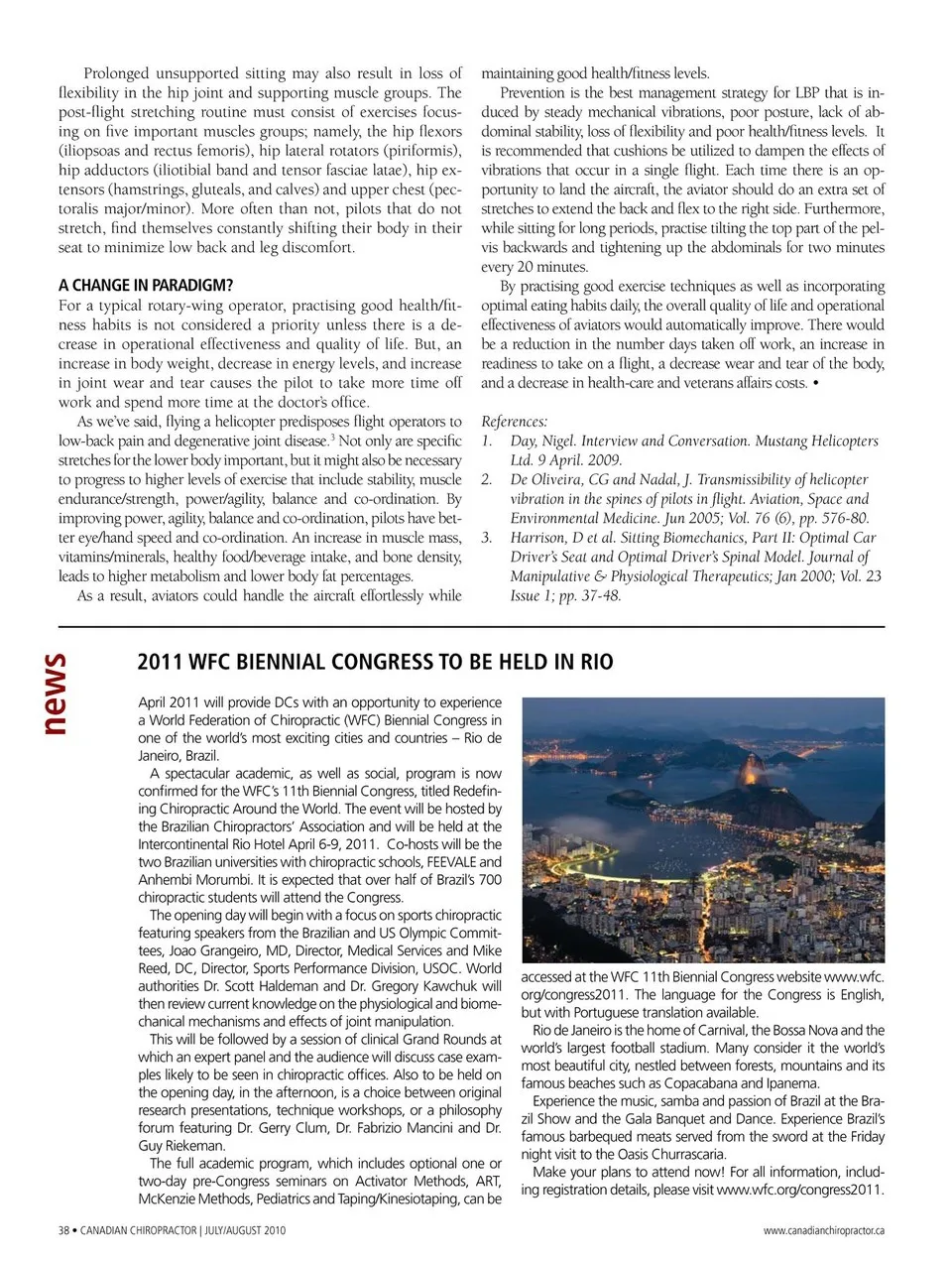
Prolonged unsupported sitting may also result in loss of flexibility in the hip joint and supporting muscle groups. The post-flight stretching routine must consist of exercises focus-ing on five important muscles groups; namely, the hip flexors (iliopsoas and rectus femoris), hip lateral rotators (piriformis), hip adductors (iliotibial band and tensor fasciae latae), hip ex-tensors (hamstrings, gluteals, and calves) and upper chest (pec-toralis major/minor). More often than not, pilots that do not stretch, find themselves constantly shifting their body in their seat to minimize low back and leg discomfort. A CHANGE IN PARADIGM? For a typical rotary-wing operator, practising good health/fit-ness habits is not considered a priority unless there is a de-crease in operational effectiveness and quality of life. But, an increase in body weight, decrease in energy levels, and increase in joint wear and tear causes the pilot to take more time off work and spend more time at the doctor’s office. As we’ve said, flying a helicopter predisposes flight operators to low-back pain and degenerative joint disease.3 Not only are specific stretches for the lower body important, but it might also be necessary to progress to higher levels of exercise that include stability, muscle endurance/strength, power/agility, balance and co-ordination. By improving power, agility, balance and co-ordination, pilots have bet-ter eye/hand speed and co-ordination. An increase in muscle mass, vitamins/minerals, healthy food/beverage intake, and bone density, leads to higher metabolism and lower body fat percentages. As a result, aviators could handle the aircraft effortlessly while maintaining good health/fitness levels. Prevention is the best management strategy for LBP that is in-duced by steady mechanical vibrations, poor posture, lack of ab-dominal stability, loss of flexibility and poor health/fitness levels. It is recommended that cushions be utilized to dampen the effects of vibrations that occur in a single flight. Each time there is an op-portunity to land the aircraft, the aviator should do an extra set of stretches to extend the back and flex to the right side. Furthermore, while sitting for long periods, practise tilting the top part of the pel-vis backwards and tightening up the abdominals for two minutes every 20 minutes. By practising good exercise techniques as well as incorporating optimal eating habits daily, the overall quality of life and operational effectiveness of aviators would automatically improve. There would be a reduction in the number days taken off work, an increase in readiness to take on a flight, a decrease wear and tear of the body, and a decrease in health-care and veterans affairs costs. • References: 1. Day, Nigel. Interview and Conversation. Mustang Helicopters Ltd. 9 April. 2009. 2. De Oliveira, CG and Nadal, J. Transmissibility of helicopter vibration in the spines of pilots in flight. Aviation, Space and Environmental Medicine. Jun 2005; Vol. 76 (6), pp. 576-80. 3. Harrison, D et al. Sitting Biomechanics, Part II: Optimal Car Driver’s Seat and Optimal Driver’s Spinal Model. Journal of Manipulative & Physiological Therapeutics; Jan 2000; Vol. 23 Issue 1; pp. 37-48. 2011 WFC BIENNIAL CONGRESS TO BE HELD IN RIO April 2011 will provide DCs with an opportunity to experience a World Federation of Chiropractic (WFC) Biennial Congress in one of the world’s most exciting cities and countries – Rio de Janeiro, Brazil. A spectacular academic, as well as social, program is now confirmed for the WFC’s 11th Biennial Congress, titled Redefin-ing Chiropractic Around the World. The event will be hosted by the Brazilian Chiropractors’ Association and will be held at the Intercontinental Rio Hotel April 6-9, 2011. Co-hosts will be the two Brazilian universities with chiropractic schools, FEEVALE and Anhembi Morumbi. It is expected that over half of Brazil’s 700 chiropractic students will attend the Congress. The opening day will begin with a focus on sports chiropractic featuring speakers from the Brazilian and US Olympic Commit-tees, Joao Grangeiro, MD, Director, Medical Services and Mike Reed, DC, Director, Sports Performance Division, USOC. World authorities Dr. Scott Haldeman and Dr. Gregory Kawchuk will then review current knowledge on the physiological and biome-chanical mechanisms and effects of joint manipulation. This will be followed by a session of clinical Grand Rounds at which an expert panel and the audience will discuss case exam-ples likely to be seen in chiropractic offices. Also to be held on the opening day, in the afternoon, is a choice between original research presentations, technique workshops, or a philosophy forum featuring Dr. Gerry Clum, Dr. Fabrizio Mancini and Dr. Guy Riekeman. The full academic program, which includes optional one or two-day pre-Congress seminars on Activator Methods, ART, McKenzie Methods, Pediatrics and Taping/Kinesiotaping, can be 38 • CANADIAN CHIROPRACTOR | JULY/AUGUST 2010 accessed at the WFC 11th Biennial Congress website www.wfc. org/congress2011. The language for the Congress is English, but with Portuguese translation available. Rio de Janeiro is the home of Carnival, the Bossa Nova and the world’s largest football stadium. Many consider it the world’s most beautiful city, nestled between forests, mountains and its famous beaches such as Copacabana and Ipanema. Experience the music, samba and passion of Brazil at the Bra-zil Show and the Gala Banquet and Dance. Experience Brazil’s famous barbequed meats served from the sword at the Friday night visit to the Oasis Churrascaria. Make your plans to attend now! For all information, includ-ing registration details, please visit www.wfc.org/congress2011. www.canadianchiropractor.ca news
Chiropractic + Naturopathic Doctor July/August 2010: Page 38