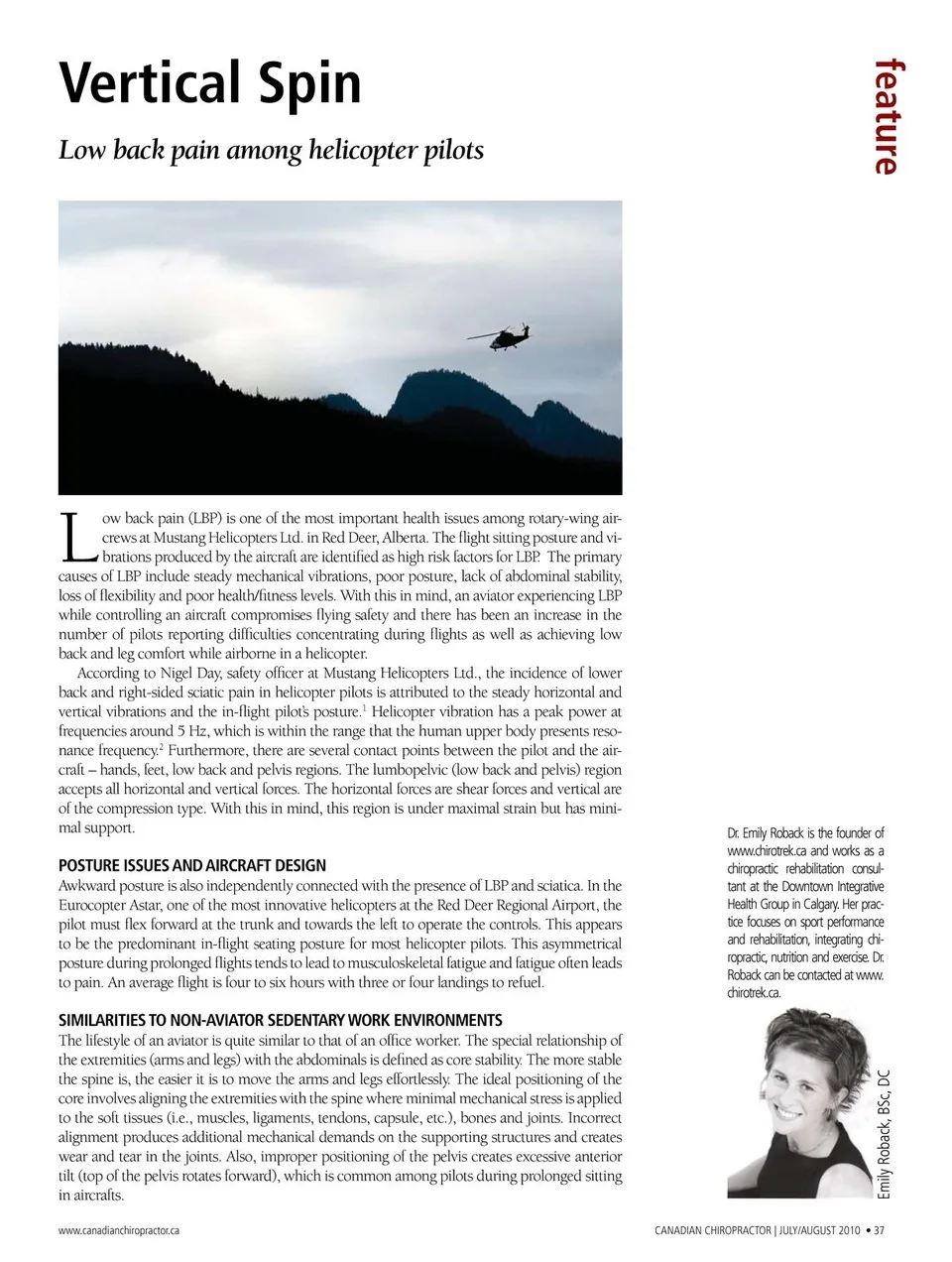
Vertical Spin Low back pain among helicopter pilots ow back pain (LBP) is one of the most important health issues among rotary-wing air-crews at Mustang Helicopters Ltd. in Red Deer, Alberta. The flight sitting posture and vi-brations produced by the aircraft are identified as high risk factors for LBP. The primary causes of LBP include steady mechanical vibrations, poor posture, lack of abdominal stability, loss of flexibility and poor health/fitness levels. With this in mind, an aviator experiencing LBP while controlling an aircraft compromises flying safety and there has been an increase in the number of pilots reporting difficulties concentrating during flights as well as achieving low back and leg comfort while airborne in a helicopter. According to Nigel Day, safety officer at Mustang Helicopters Ltd., the incidence of lower back and right-sided sciatic pain in helicopter pilots is attributed to the steady horizontal and vertical vibrations and the in-flight pilot’s posture.1 L Helicopter vibration has a peak power at frequencies around 5 Hz, which is within the range that the human upper body presents reso-nance frequency.2 Furthermore, there are several contact points between the pilot and the air-craft – hands, feet, low back and pelvis regions. The lumbopelvic (low back and pelvis) region accepts all horizontal and vertical forces. The horizontal forces are shear forces and vertical are of the compression type. With this in mind, this region is under maximal strain but has mini-mal support. POSTURE ISSUES AND AIRCRAFT DESIGN Awkward posture is also independently connected with the presence of LBP and sciatica. In the Eurocopter Astar, one of the most innovative helicopters at the Red Deer Regional Airport, the pilot must flex forward at the trunk and towards the left to operate the controls. This appears to be the predominant in-flight seating posture for most helicopter pilots. This asymmetrical posture during prolonged flights tends to lead to musculoskeletal fatigue and fatigue often leads to pain. An average flight is four to six hours with three or four landings to refuel. SIMILARITIES TO NON-AVIATOR SEDENTARY WORK ENVIRONMENTS The lifestyle of an aviator is quite similar to that of an office worker. The special relationship of the extremities (arms and legs) with the abdominals is defined as core stability. The more stable the spine is, the easier it is to move the arms and legs effortlessly. The ideal positioning of the core involves aligning the extremities with the spine where minimal mechanical stress is applied to the soft tissues (i.e., muscles, ligaments, tendons, capsule, etc.), bones and joints. Incorrect alignment produces additional mechanical demands on the supporting structures and creates wear and tear in the joints. Also, improper positioning of the pelvis creates excessive anterior tilt (top of the pelvis rotates forward), which is common among pilots during prolonged sitting in aircrafts. www.canadianchiropractor.ca CANADIAN CHIROPRACTOR | JULY/AUGUST 2010 • 37 Dr. Emily Roback is the founder of www.chirotrek.ca and works as a chiropractic rehabilitation consul-tant at the Downtown Integrative Health Group in Calgary. Her prac-tice focuses on sport performance and rehabilitation, integrating chi-ropractic, nutrition and exercise. Dr. Roback can be contacted at www. chirotrek.ca. feature Emily Roback, BSc, DC
Chiropractic + Naturopathic Doctor July/August 2010: Page 37