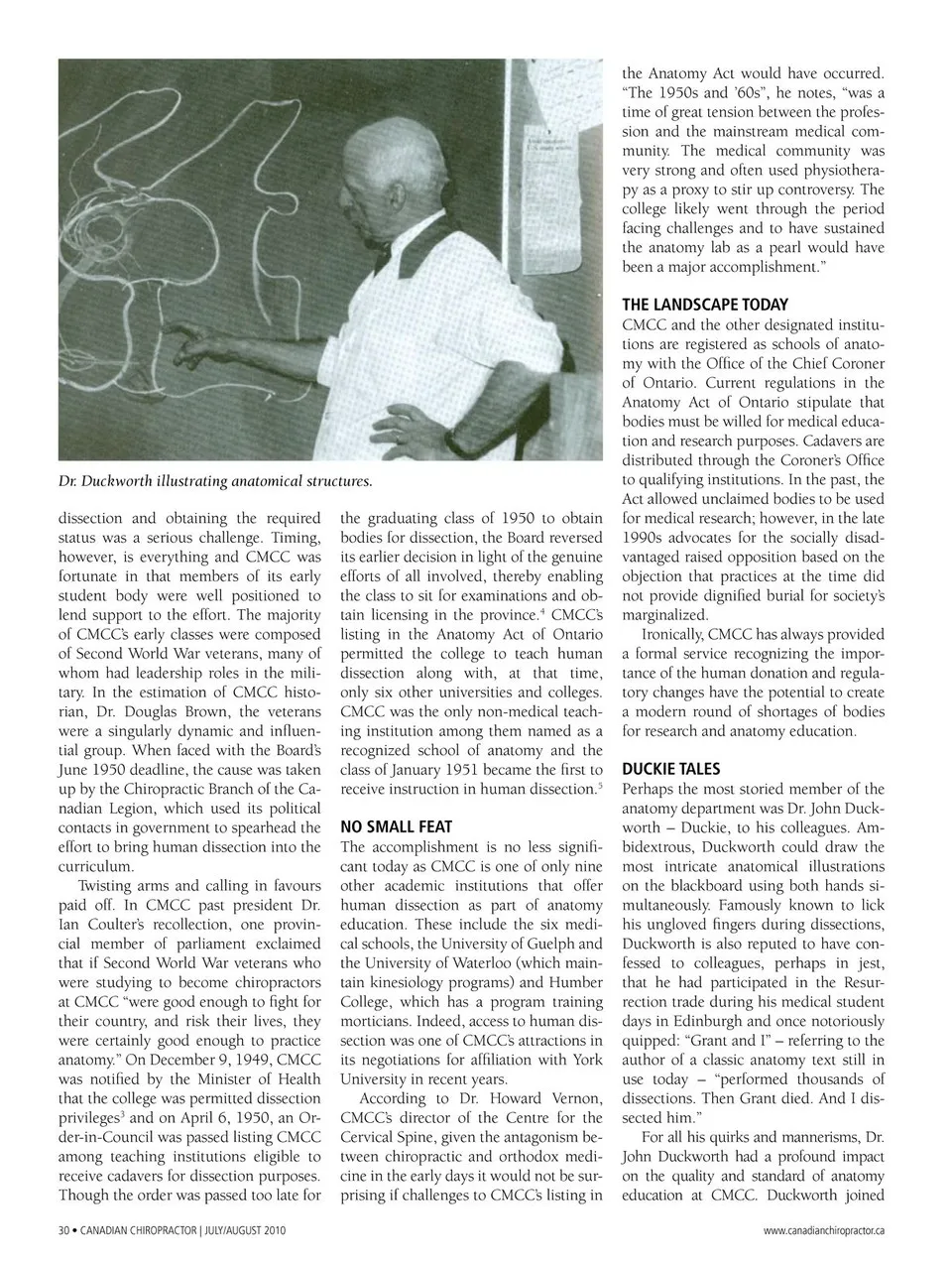
the Anatomy Act would have occurred. “The 1950s and ’60s”, he notes, “was a time of great tension between the profes-sion and the mainstream medical com-munity. The medical community was very strong and often used physiothera-py as a proxy to stir up controversy. The college likely went through the period facing challenges and to have sustained the anatomy lab as a pearl would have been a major accomplishment.” THE LANDSCAPE TODAY Dr. Duckworth illustrating anatomical structures. dissection and obtaining the required status was a serious challenge. Timing, however, is everything and CMCC was fortunate in that members of its early student body were well positioned to lend support to the effort. The majority of CMCC’s early classes were composed of Second World War veterans, many of whom had leadership roles in the mili-tary. In the estimation of CMCC histo-rian, Dr. Douglas Brown, the veterans were a singularly dynamic and influen-tial group. When faced with the Board’s June 1950 deadline, the cause was taken up by the Chiropractic Branch of the Ca-nadian Legion, which used its political contacts in government to spearhead the effort to bring human dissection into the curriculum. Twisting arms and calling in favours paid off. In CMCC past president Dr. Ian Coulter’s recollection, one provin-cial member of parliament exclaimed that if Second World War veterans who were studying to become chiropractors at CMCC “were good enough to fight for their country, and risk their lives, they were certainly good enough to practice anatomy.” On December 9, 1949, CMCC was notified by the Minister of Health that the college was permitted dissection privileges3 and on April 6, 1950, an Or-der-in-Council was passed listing CMCC among teaching institutions eligible to receive cadavers for dissection purposes. Though the order was passed too late for 30 • CANADIAN CHIROPRACTOR | JULY/AUGUST 2010 the graduating class of 1950 to obtain bodies for dissection, the Board reversed its earlier decision in light of the genuine efforts of all involved, thereby enabling the class to sit for examinations and ob-tain licensing in the province.4 CMCC’s listing in the Anatomy Act of Ontario permitted the college to teach human dissection along with, at that time, only six other universities and colleges. CMCC was the only non-medical teach-ing institution among them named as a recognized school of anatomy and the class of January 1951 became the first to receive instruction in human dissection.5 NO SMALL FEAT The accomplishment is no less signifi-cant today as CMCC is one of only nine other academic institutions that offer human dissection as part of anatomy education. These include the six medi-cal schools, the University of Guelph and the University of Waterloo (which main-tain kinesiology programs) and Humber College, which has a program training morticians. Indeed, access to human dis-section was one of CMCC’s attractions in its negotiations for affiliation with York University in recent years. According to Dr. Howard Vernon, CMCC’s director of the Centre for the Cervical Spine, given the antagonism be-tween chiropractic and orthodox medi-cine in the early days it would not be sur-prising if challenges to CMCC’s listing in CMCC and the other designated institu-tions are registered as schools of anato-my with the Office of the Chief Coroner of Ontario. Current regulations in the Anatomy Act of Ontario stipulate that bodies must be willed for medical educa-tion and research purposes. Cadavers are distributed through the Coroner’s Office to qualifying institutions. In the past, the Act allowed unclaimed bodies to be used for medical research; however, in the late 1990s advocates for the socially disad-vantaged raised opposition based on the objection that practices at the time did not provide dignified burial for society’s marginalized. Ironically, CMCC has always provided a formal service recognizing the impor-tance of the human donation and regula-tory changes have the potential to create a modern round of shortages of bodies for research and anatomy education. DUCKIE TALES Perhaps the most storied member of the anatomy department was Dr. John Duck-worth – Duckie, to his colleagues. Am-bidextrous, Duckworth could draw the most intricate anatomical illustrations on the blackboard using both hands si-multaneously. Famously known to lick his ungloved fingers during dissections, Duckworth is also reputed to have con-fessed to colleagues, perhaps in jest, that he had participated in the Resur-rection trade during his medical student days in Edinburgh and once notoriously quipped: “Grant and I” – referring to the author of a classic anatomy text still in use today – “performed thousands of dissections. Then Grant died. And I dis-sected him.” For all his quirks and mannerisms, Dr. John Duckworth had a profound impact on the quality and standard of anatomy education at CMCC. Duckworth joined www.canadianchiropractor.ca
Chiropractic + Naturopathic Doctor July/August 2010: Page 30