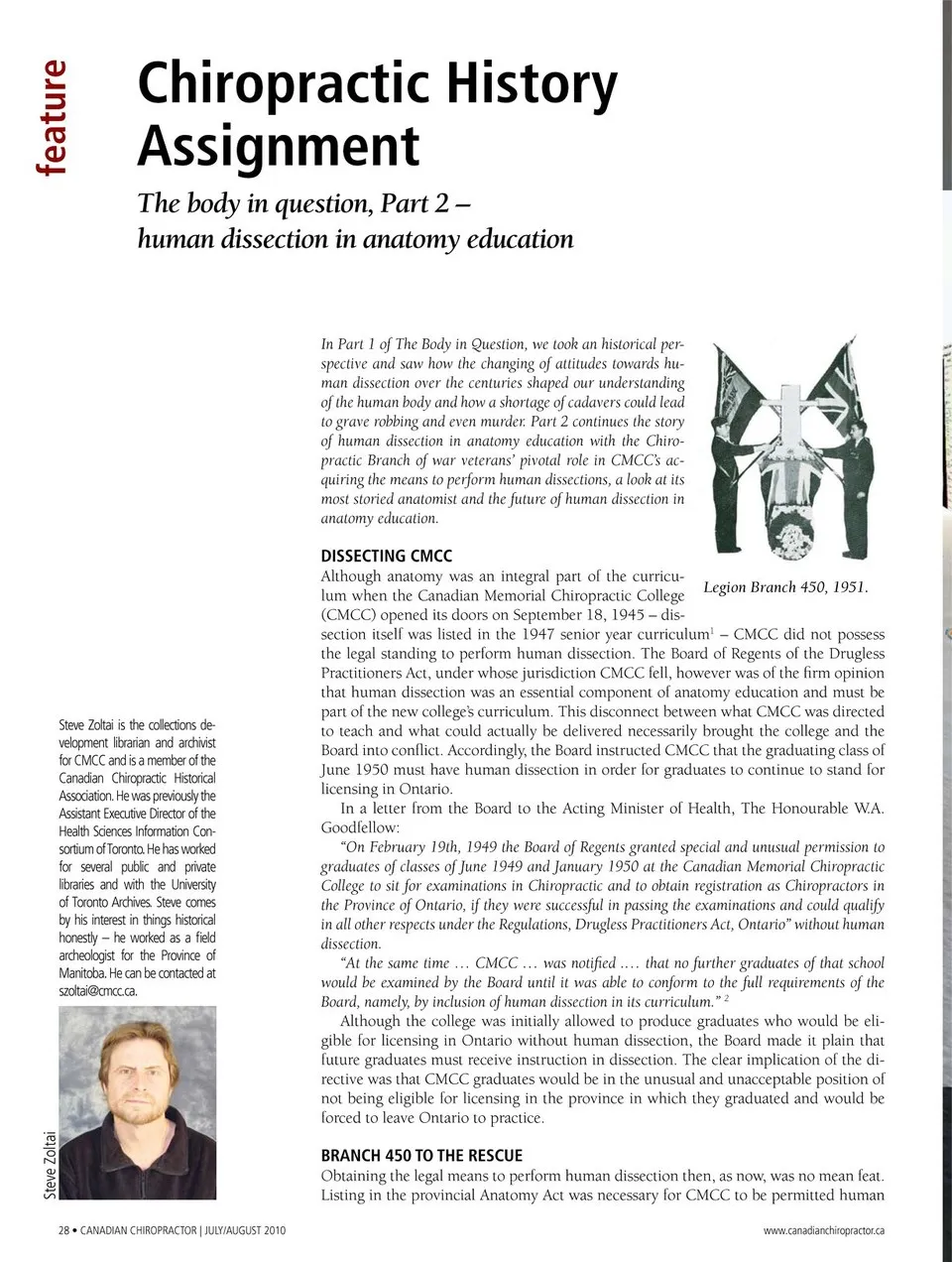
Chiropractic History Assignment The body in question, Part 2 – human dissection in anatomy education In Part 1 of The Body in Question, we took an historical per-spective and saw how the changing of attitudes towards hu-man dissection over the centuries shaped our understanding of the human body and how a shortage of cadavers could lead to grave robbing and even murder. Part 2 continues the story of human dissection in anatomy education with the Chiro-practic Branch of war veterans’ pivotal role in CMCC’s ac-quiring the means to perform human dissections, a look at its most storied anatomist and the future of human dissection in anatomy education. DISSECTING CMCC Although anatomy was an integral part of the curricu-lum when the Canadian Memorial Chiropractic College (CMCC) opened its doors on September 18, 1945 – dis-section itself was listed in the 1947 senior year curriculum1 Legion Branch 450, 1951. – CMCC did not possess Steve Zoltai is the collections de-velopment librarian and archivist for CMCC and is a member of the Canadian Chiropractic Historical Association.He was previously the Assistant Executive Director of the Health Sciences Information Con-sortium of Toronto.He has worked for several public and private libraries and with the University of Toronto Archives. Steve comes by his interest in things historical honestly – he worked as a field archeologist for the Province of Manitoba.He can be contacted at [email protected]. the legal standing to perform human dissection. The Board of Regents of the Drugless Practitioners Act, under whose jurisdiction CMCC fell, however was of the firm opinion that human dissection was an essential component of anatomy education and must be part of the new college’s curriculum. This disconnect between what CMCC was directed to teach and what could actually be delivered necessarily brought the college and the Board into conflict. Accordingly, the Board instructed CMCC that the graduating class of June 1950 must have human dissection in order for graduates to continue to stand for licensing in Ontario. In a letter from the Board to the Acting Minister of Health, The Honourable W.A. Goodfellow: “On February 19th, 1949 the Board of Regents granted special and unusual permission to graduates of classes of June 1949 and January 1950 at the Canadian Memorial Chiropractic College to sit for examinations in Chiropractic and to obtain registration as Chiropractors in the Province of Ontario, if they were successful in passing the examinations and could qualify in all other respects under the Regulations, Drugless Practitioners Act, Ontario” without human dissection. “At the same time … CMCC … was notified .… that no further graduates of that school would be examined by the Board until it was able to conform to the full requirements of the Board, namely, by inclusion of human dissection in its curriculum.” 2 Although the college was initially allowed to produce graduates who would be eli-gible for licensing in Ontario without human dissection, the Board made it plain that future graduates must receive instruction in dissection. The clear implication of the di-rective was that CMCC graduates would be in the unusual and unacceptable position of not being eligible for licensing in the province in which they graduated and would be forced to leave Ontario to practice. BRANCH 450 TO THE RESCUE Obtaining the legal means to perform human dissection then, as now, was no mean feat. Listing in the provincial Anatomy Act was necessary for CMCC to be permitted human 28 • CANADIAN CHIROPRACTOR | JULY/AUGUST 2010 www.canadianchiropractor.ca Steve Zoltai feature
Chiropractic + Naturopathic Doctor July/August 2010: Page 28