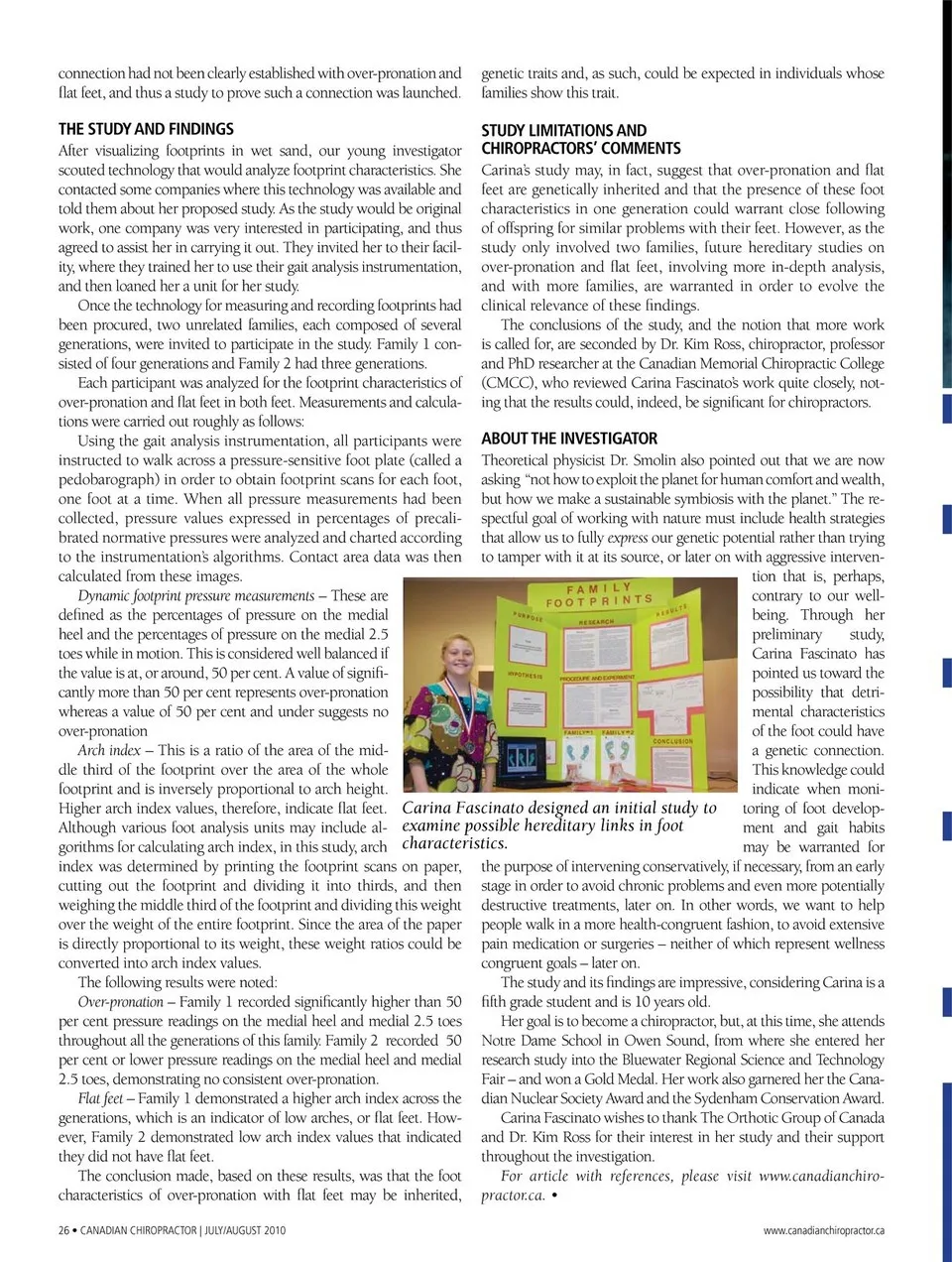
connection had not been clearly established with over-pronation and flat feet, and thus a study to prove such a connection was launched. THE STUDY AND FINDINGS After visualizing footprints in wet sand, our young investigator scouted technology that would analyze footprint characteristics. She contacted some companies where this technology was available and told them about her proposed study. As the study would be original work, one company was very interested in participating, and thus agreed to assist her in carrying it out. They invited her to their facil-ity, where they trained her to use their gait analysis instrumentation, and then loaned her a unit for her study. Once the technology for measuring and recording footprints had been procured, two unrelated families, each composed of several generations, were invited to participate in the study. Family 1 con-sisted of four generations and Family 2 had three generations. Each participant was analyzed for the footprint characteristics of over-pronation and flat feet in both feet. Measurements and calcula-tions were carried out roughly as follows: Using the gait analysis instrumentation, all participants were instructed to walk across a pressure-sensitive foot plate (called a pedobarograph) in order to obtain footprint scans for each foot, one foot at a time. When all pressure measurements had been collected, pressure values expressed in percentages of precali-brated normative pressures were analyzed and charted according to the instrumentation’s algorithms. Contact area data was then calculated from these images. Dynamic footprint pressure measurements – These are defined as the percentages of pressure on the medial heel and the percentages of pressure on the medial 2.5 toes while in motion. This is considered well balanced if the value is at, or around, 50 per cent. A value of signifi-cantly more than 50 per cent represents over-pronation whereas a value of 50 per cent and under suggests no over-pronation Arch index – This is a ratio of the area of the mid-dle third of the footprint over the area of the whole footprint and is inversely proportional to arch height. Higher arch index values, therefore, indicate flat feet. Although various foot analysis units may include al-gorithms for calculating arch index, in this study, arch index was determined by printing the footprint scans on paper, cutting out the footprint and dividing it into thirds, and then weighing the middle third of the footprint and dividing this weight over the weight of the entire footprint. Since the area of the paper is directly proportional to its weight, these weight ratios could be converted into arch index values. The following results were noted: Over-pronation – Family 1 recorded significantly higher than 50 per cent pressure readings on the medial heel and medial 2.5 toes throughout all the generations of this family. Family 2 recorded 50 per cent or lower pressure readings on the medial heel and medial 2.5 toes, demonstrating no consistent over-pronation. Flat feet – Family 1 demonstrated a higher arch index across the generations, which is an indicator of low arches, or flat feet. How-ever, Family 2 demonstrated low arch index values that indicated they did not have flat feet. The conclusion made, based on these results, was that the foot characteristics of over-pronation with flat feet may be inherited, 26 • CANADIAN CHIROPRACTOR | JULY/AUGUST 2010 genetic traits and, as such, could be expected in individuals whose families show this trait. STUDY LIMITATIONS AND CHIROPRACTORS’ COMMENTS Carina’s study may, in fact, suggest that over-pronation and flat feet are genetically inherited and that the presence of these foot characteristics in one generation could warrant close following of offspring for similar problems with their feet. However, as the study only involved two families, future hereditary studies on over-pronation and flat feet, involving more in-depth analysis, and with more families, are warranted in order to evolve the clinical relevance of these findings. The conclusions of the study, and the notion that more work is called for, are seconded by Dr. Kim Ross, chiropractor, professor and PhD researcher at the Canadian Memorial Chiropractic College (CMCC), who reviewed Carina Fascinato’s work quite closely, not-ing that the results could, indeed, be significant for chiropractors. Carina Fascinato designed an initial study to examine possible hereditary links in foot characteristics. ABOUT THE INVESTIGATOR Theoretical physicist Dr. Smolin also pointed out that we are now asking “not how to exploit the planet for human comfort and wealth, but how we make a sustainable symbiosis with the planet.” The re-spectful goal of working with nature must include health strategies that allow us to fully express our genetic potential rather than trying to tamper with it at its source, or later on with aggressive interven-tion that is, perhaps, contrary to our well-being. Through her preliminary study, Carina Fascinato has pointed us toward the possibility that detri-mental characteristics of the foot could have a genetic connection. This knowledge could indicate when moni-toring of foot develop-ment and gait habits may be warranted for the purpose of intervening conservatively, if necessary, from an early stage in order to avoid chronic problems and even more potentially destructive treatments, later on. In other words, we want to help people walk in a more health-congruent fashion, to avoid extensive pain medication or surgeries – neither of which represent wellness congruent goals – later on. The study and its findings are impressive, considering Carina is a fifth grade student and is 10 years old. Her goal is to become a chiropractor, but, at this time, she attends Notre Dame School in Owen Sound, from where she entered her research study into the Bluewater Regional Science and Technology Fair – and won a Gold Medal. Her work also garnered her the Cana-dian Nuclear Society Award and the Sydenham Conservation Award. Carina Fascinato wishes to thank The Orthotic Group of Canada and Dr. Kim Ross for their interest in her study and their support throughout the investigation. For article with references, please visit www.canadianchiro-practor.ca. • www.canadianchiropractor.ca
Chiropractic + Naturopathic Doctor July/August 2010: Page 26