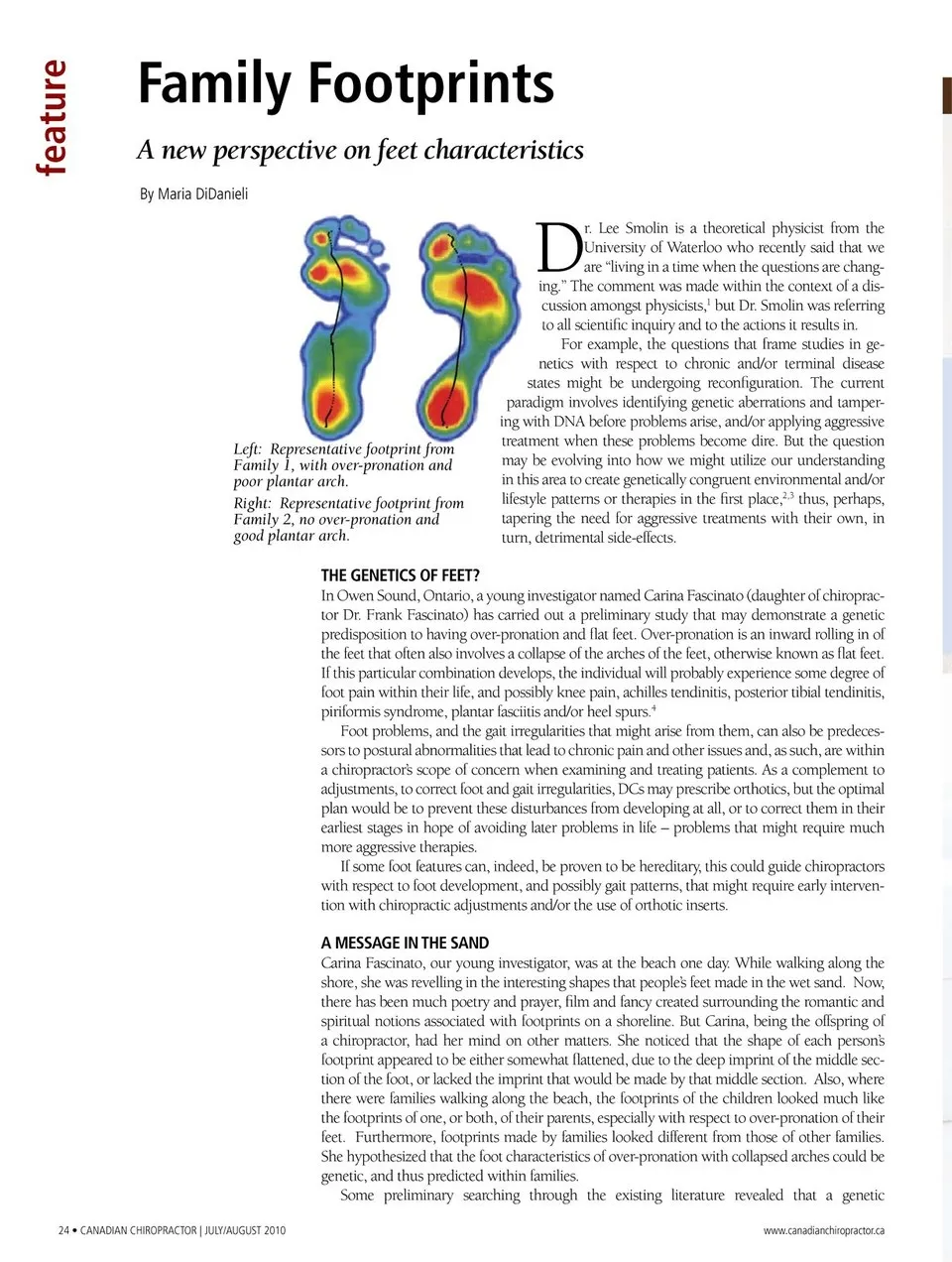
Family Footprints A new perspective on feet characteristics By Maria DiDanieli D Left: Representative footprint from Family 1, with over-pronation and poor plantar arch. Right: Representative footprint from Family 2, no over-pronation and good plantar arch. THE GENETICS OF FEET? In Owen Sound, Ontario, a young investigator named Carina Fascinato (daughter of chiroprac-tor Dr. Frank Fascinato) has carried out a preliminary study that may demonstrate a genetic predisposition to having over-pronation and flat feet. Over-pronation is an inward rolling in of the feet that often also involves a collapse of the arches of the feet, otherwise known as flat feet. If this particular combination develops, the individual will probably experience some degree of foot pain within their life, and possibly knee pain, achilles tendinitis, posterior tibial tendinitis, piriformis syndrome, plantar fasciitis and/or heel spurs.4 Foot problems, and the gait irregularities that might arise from them, can also be predeces-sors to postural abnormalities that lead to chronic pain and other issues and, as such, are within a chiropractor’s scope of concern when examining and treating patients. As a complement to adjustments, to correct foot and gait irregularities, DCs may prescribe orthotics, but the optimal plan would be to prevent these disturbances from developing at all, or to correct them in their earliest stages in hope of avoiding later problems in life – problems that might require much more aggressive therapies. If some foot features can, indeed, be proven to be hereditary, this could guide chiropractors with respect to foot development, and possibly gait patterns, that might require early interven-tion with chiropractic adjustments and/or the use of orthotic inserts. A MESSAGE IN THE SAND Carina Fascinato, our young investigator, was at the beach one day. While walking along the shore, she was revelling in the interesting shapes that people’s feet made in the wet sand. Now, there has been much poetry and prayer, film and fancy created surrounding the romantic and spiritual notions associated with footprints on a shoreline. But Carina, being the offspring of a chiropractor, had her mind on other matters. She noticed that the shape of each person’s footprint appeared to be either somewhat flattened, due to the deep imprint of the middle sec-tion of the foot, or lacked the imprint that would be made by that middle section. Also, where there were families walking along the beach, the footprints of the children looked much like the footprints of one, or both, of their parents, especially with respect to over-pronation of their feet. Furthermore, footprints made by families looked different from those of other families. She hypothesized that the foot characteristics of over-pronation with collapsed arches could be genetic, and thus predicted within families. Some preliminary searching through the existing literature revealed that a genetic 24 • CANADIAN CHIROPRACTOR | JULY/AUGUST 2010 www.canadianchiropractor.ca r. Lee Smolin is a theoretical physicist from the University of Waterloo who recently said that we are “living in a time when the questions are chang-ing.” The comment was made within the context of a dis-cussion amongst physicists,1 but Dr. Smolin was referring to all scientific inquiry and to the actions it results in. For example, the questions that frame studies in ge-netics with respect to chronic and/or terminal disease states might be undergoing reconfiguration. The current paradigm involves identifying genetic aberrations and tamper-ing with DNA before problems arise, and/or applying aggressive treatment when these problems become dire. But the question may be evolving into how we might utilize our understanding in this area to create genetically congruent environmental and/or lifestyle patterns or therapies in the first place,2,3 thus, perhaps, tapering the need for aggressive treatments with their own, in turn, detrimental side-effects. feature
Chiropractic + Naturopathic Doctor July/August 2010: Page 24