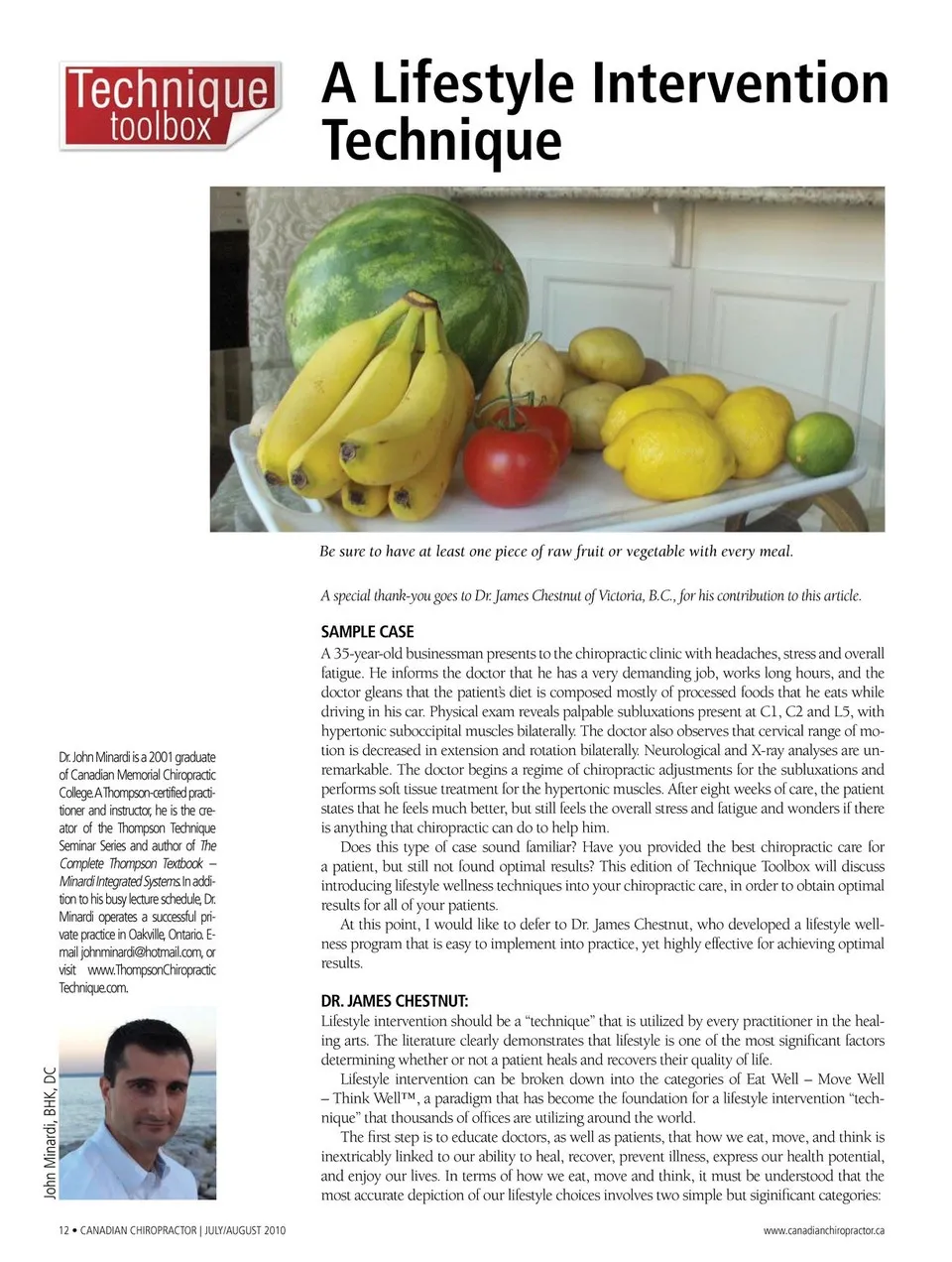
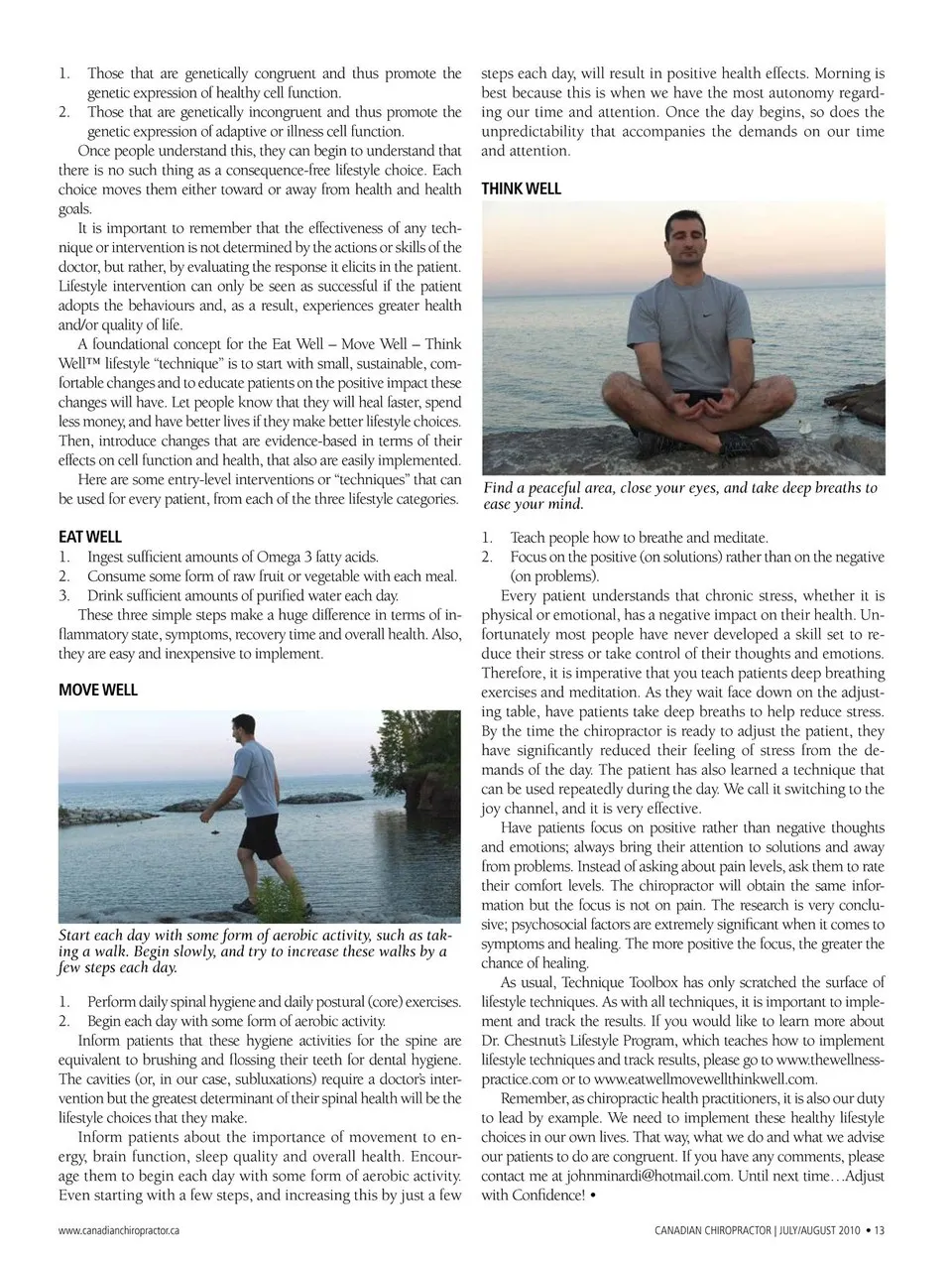
1. Those that are genetically congruent and thus promote the genetic expression of healthy cell function. 2. Those that are genetically incongruent and thus promote the genetic expression of adaptive or illness cell function. Once people understand this, they can begin to understand that there is no such thing as a consequence-free lifestyle choice. Each choice moves them either toward or away from health and health goals. It is important to remember that the effectiveness of any tech-nique or intervention is not determined by the actions or skills of the doctor, but rather, by evaluating the response it elicits in the patient. Lifestyle intervention can only be seen as successful if the patient adopts the behaviours and, as a result, experiences greater health and/or quality of life. A foundational concept for the Eat Well – Move Well – Think Well™ lifestyle “technique” is to start with small, sustainable, com-fortable changes and to educate patients on the positive impact these changes will have. Let people know that they will heal faster, spend less money, and have better lives if they make better lifestyle choices. Then, introduce changes that are evidence-based in terms of their effects on cell function and health, that also are easily implemented. Here are some entry-level interventions or “techniques” that can be used for every patient, from each of the three lifestyle categories. EAT WELL 1. Ingest sufficient amounts of Omega 3 fatty acids. 2. Consume some form of raw fruit or vegetable with each meal. 3. Drink sufficient amounts of purified water each day. These three simple steps make a huge difference in terms of in-flammatory state, symptoms, recovery time and overall health. Also, they are easy and inexpensive to implement. MOVE WELL steps each day, will result in positive health effects. Morning is best because this is when we have the most autonomy regard-ing our time and attention. Once the day begins, so does the unpredictability that accompanies the demands on our time and attention. THINK WELL Find a peaceful area, close your eyes, and take deep breaths to ease your mind. 1. Teach people how to breathe and meditate. 2. Focus on the positive (on solutions) rather than on the negative (on problems). Every patient understands that chronic stress, whether it is physical or emotional, has a negative impact on their health. Un-fortunately most people have never developed a skill set to re-duce their stress or take control of their thoughts and emotions. Therefore, it is imperative that you teach patients deep breathing exercises and meditation. As they wait face down on the adjust-ing table, have patients take deep breaths to help reduce stress. By the time the chiropractor is ready to adjust the patient, they have significantly reduced their feeling of stress from the de-mands of the day. The patient has also learned a technique that can be used repeatedly during the day. We call it switching to the joy channel, and it is very effective. Start each day with some form of aerobic activity, such as tak-ing a walk. Begin slowly, and try to increase these walks by a few steps each day. 1. Perform daily spinal hygiene and daily postural (core) exercises. 2. Begin each day with some form of aerobic activity. Inform patients that these hygiene activities for the spine are equivalent to brushing and flossing their teeth for dental hygiene. The cavities (or, in our case, subluxations) require a doctor’s inter-vention but the greatest determinant of their spinal health will be the lifestyle choices that they make. Inform patients about the importance of movement to en-ergy, brain function, sleep quality and overall health. Encour-age them to begin each day with some form of aerobic activity. Even starting with a few steps, and increasing this by just a few www.canadianchiropractor.ca Have patients focus on positive rather than negative thoughts and emotions; always bring their attention to solutions and away from problems. Instead of asking about pain levels, ask them to rate their comfort levels. The chiropractor will obtain the same infor-mation but the focus is not on pain. The research is very conclu-sive; psychosocial factors are extremely significant when it comes to symptoms and healing. The more positive the focus, the greater the chance of healing. As usual, Technique Toolbox has only scratched the surface of lifestyle techniques. As with all techniques, it is important to imple-ment and track the results. If you would like to learn more about Dr. Chestnut’s Lifestyle Program, which teaches how to implement lifestyle techniques and track results, please go to www.thewellness-practice.com or to www.eatwellmovewellthinkwell.com. Remember, as chiropractic health practitioners, it is also our duty to lead by example. We need to implement these healthy lifestyle choices in our own lives. That way, what we do and what we advise our patients to do are congruent. If you have any comments, please contact me at [email protected]. Until next time…Adjust with Confidence! • CANADIAN CHIROPRACTOR | JULY/AUGUST 2010 • 13
Chiropractic + Naturopathic Doctor July/August 2010: Page 13