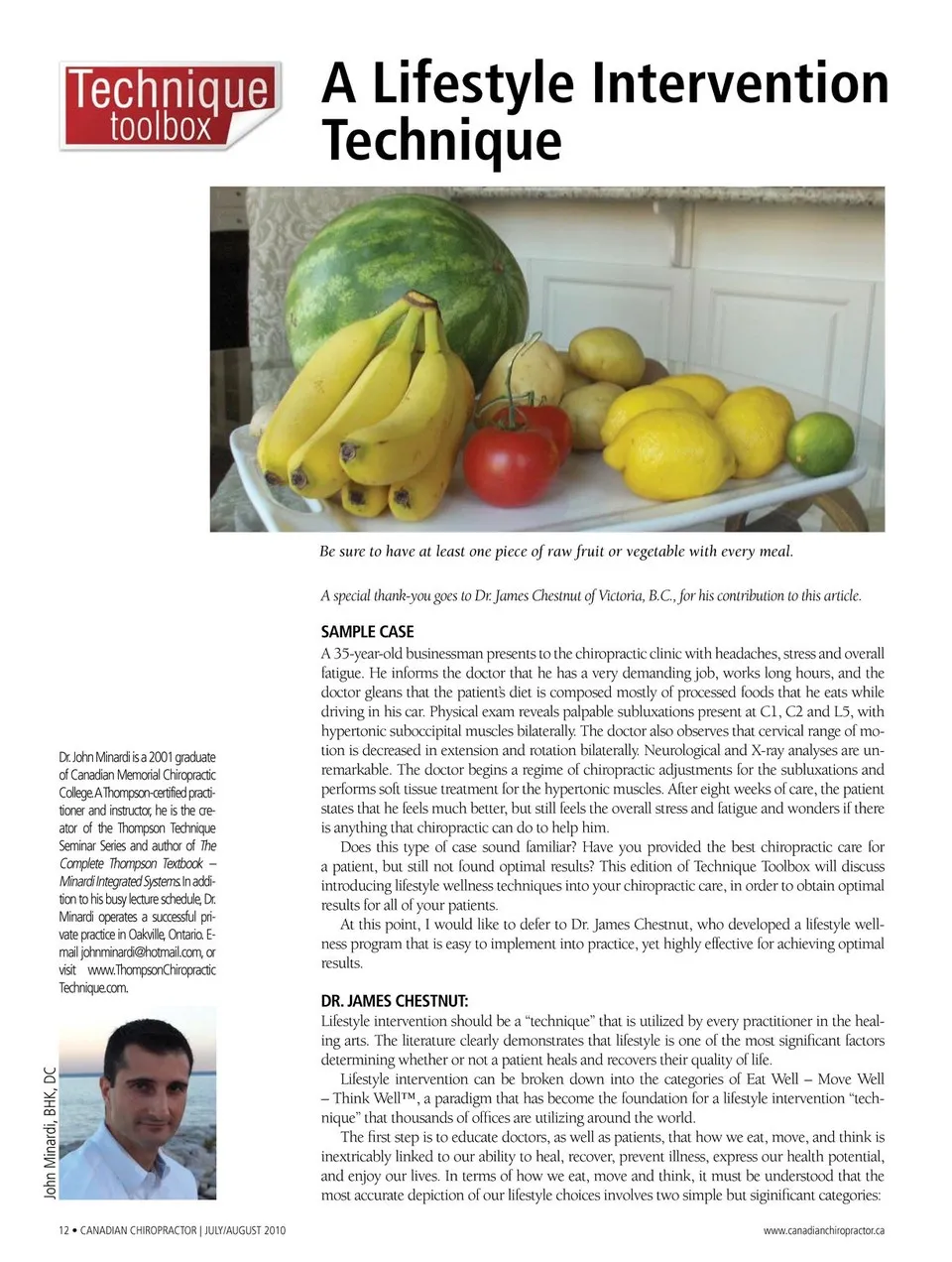
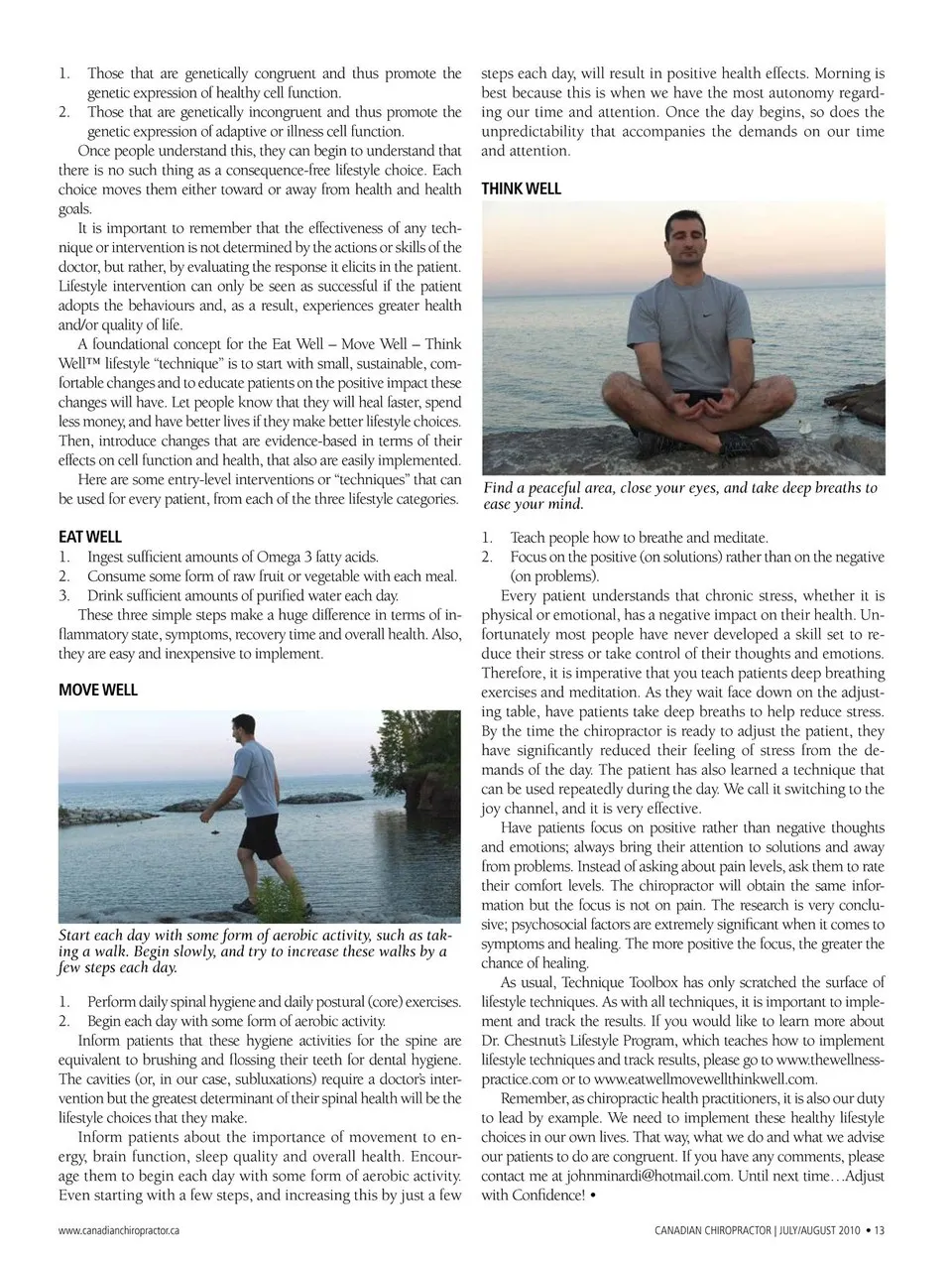
A Lifestyle Intervention Technique Be sure to have at least one piece of raw fruit or vegetable with every meal. A special thank-you goes to Dr. James Chestnut of Victoria, B.C., for his contribution to this article. Dr.John Minardi is a 2001 graduate of Canadian Memorial Chiropractic College.A Thompson-certified practi-tioner and instructor, he is the cre-ator of the Thompson Technique Seminar Series and author of The Complete Thompson Textbook – Minardi Integrated Systems. In addi-tion to his busy lecture schedule,Dr. Minardi operates a successful pri-vate practice in Oakville, Ontario. E-mail [email protected], or visit www.ThompsonChiropractic Technique.com. SAMPLE CASE A 35-year-old businessman presents to the chiropractic clinic with headaches, stress and overall fatigue. He informs the doctor that he has a very demanding job, works long hours, and the doctor gleans that the patient’s diet is composed mostly of processed foods that he eats while driving in his car. Physical exam reveals palpable subluxations present at C1, C2 and L5, with hypertonic suboccipital muscles bilaterally. The doctor also observes that cervical range of mo-tion is decreased in extension and rotation bilaterally. Neurological and X-ray analyses are un-remarkable. The doctor begins a regime of chiropractic adjustments for the subluxations and performs soft tissue treatment for the hypertonic muscles. After eight weeks of care, the patient states that he feels much better, but still feels the overall stress and fatigue and wonders if there is anything that chiropractic can do to help him. Does this type of case sound familiar? Have you provided the best chiropractic care for a patient, but still not found optimal results? This edition of Technique Toolbox will discuss introducing lifestyle wellness techniques into your chiropractic care, in order to obtain optimal results for all of your patients. At this point, I would like to defer to Dr. James Chestnut, who developed a lifestyle well-ness program that is easy to implement into practice, yet highly effective for achieving optimal results. DR. JAMES CHESTNUT: Lifestyle intervention should be a “technique” that is utilized by every practitioner in the heal-ing arts. The literature clearly demonstrates that lifestyle is one of the most significant factors determining whether or not a patient heals and recovers their quality of life. Lifestyle intervention can be broken down into the categories of Eat Well – Move Well – Think Well™, a paradigm that has become the foundation for a lifestyle intervention “tech-nique” that thousands of offices are utilizing around the world. The first step is to educate doctors, as well as patients, that how we eat, move, and think is inextricably linked to our ability to heal, recover, prevent illness, express our health potential, and enjoy our lives. In terms of how we eat, move and think, it must be understood that the most accurate depiction of our lifestyle choices involves two simple but siginificant categories: 12 • CANADIAN CHIROPRACTOR | JULY/AUGUST 2010 www.canadianchiropractor.ca John Minardi, BHK, DC
Chiropractic + Naturopathic Doctor July/August 2010: Page 12