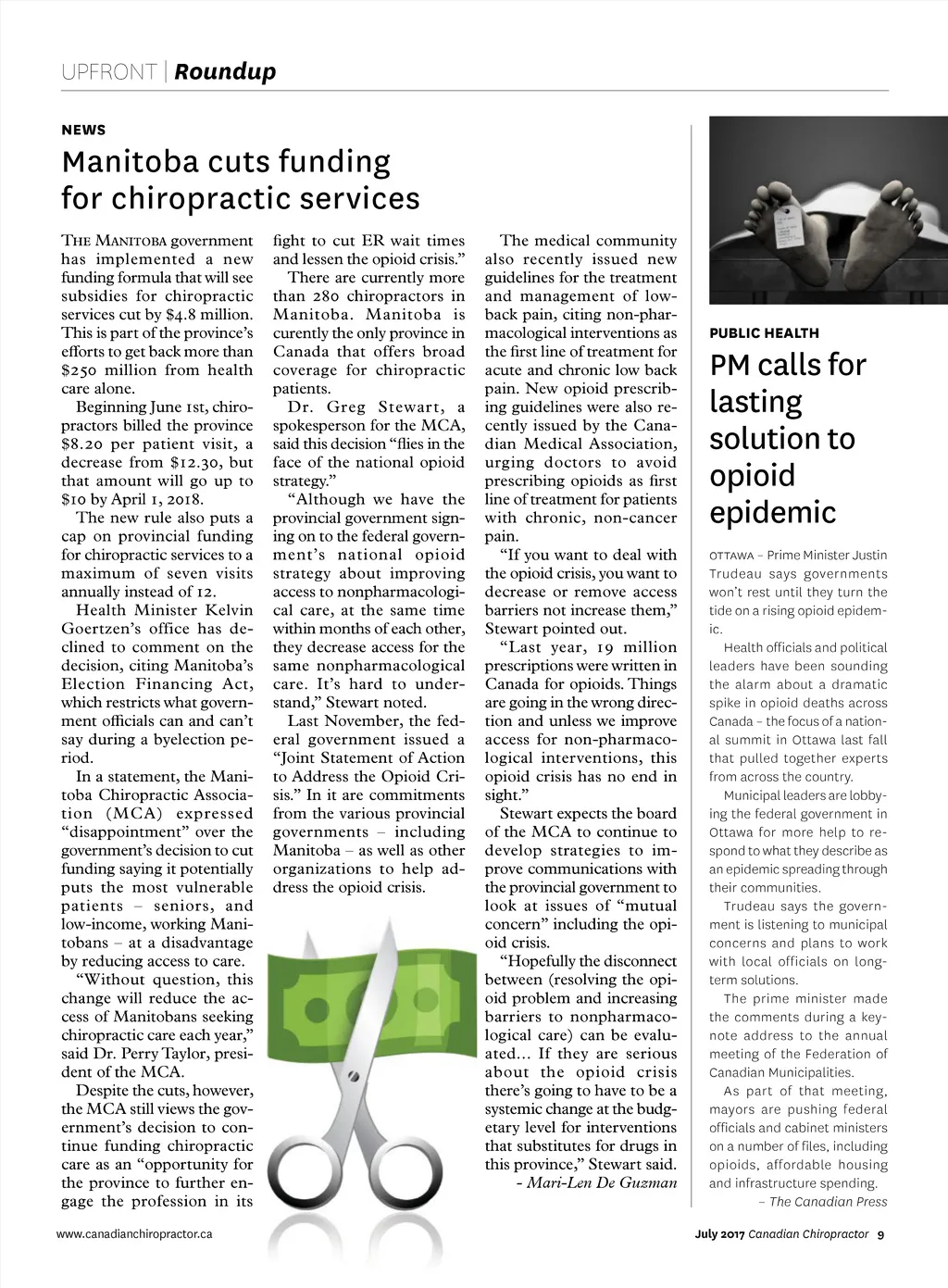
UPFRONT | Roundup NEWS Manitoba cuts funding for chiropractic services The Manitoba government has implemented a new funding formula that will see subsidies for chiropractic services cut by $4.8 million. This is part of the province’s efforts to get back more than $250 million from health care alone. Beginning June 1st, chiro-practors billed the province $8.20 per patient visit, a decrease from $12.30, but that amount will go up to $10 by April 1, 2018. The new rule also puts a cap on provincial funding for chiropractic services to a maximum of seven visits annually instead of 12. Health Minister Kelvin Goertzen’s office has de-clined to comment on the decision, citing Manitoba’s Election Financing Act, which restricts what govern-ment officials can and can’t say during a byelection pe-riod. In a statement, the Mani-toba Chiropractic Associa-tion (MCA) expressed “disappointment” over the government’s decision to cut funding saying it potentially puts the most vulnerable patients – seniors, and low-income, working Mani-tobans – at a disadvantage by reducing access to care. “Without question, this change will reduce the ac-cess of Manitobans seeking chiropractic care each year,” said Dr. Perry Taylor, presi-dent of the MCA. Despite the cuts, however, the MCA still views the gov-ernment’s decision to con-tinue funding chiropractic care as an “opportunity for the province to further en-gage the profession in its www.canadianchiropractor.ca fight to cut ER wait times and lessen the opioid crisis.” There are currently more than 280 chiropractors in Manitoba. Manitoba is curently the only province in Canada that offers broad coverage for chiropractic patients. Dr. Greg Stewart, a spokesperson for the MCA, said this decision “flies in the face of the national opioid strategy.” “Although we have the provincial government sign-ing on to the federal govern-ment’s national opioid strategy about improving access to nonpharmacologi-cal care, at the same time within months of each other, they decrease access for the same nonpharmacological care. It’s hard to under-stand,” Stewart noted. Last November, the fed-eral government issued a “Joint Statement of Action to Address the Opioid Cri-sis.” In it are commitments from the various provincial governments – including Manitoba – as well as other organizations to help ad-dress the opioid crisis. The medical community also recently issued new guidelines for the treatment and management of low-back pain, citing non-phar-macological interventions as the first line of treatment for acute and chronic low back pain. New opioid prescrib-ing guidelines were also re-cently issued by the Cana-dian Medical Association, urging doctors to avoid prescribing opioids as first line of treatment for patients with chronic, non-cancer pain. “If you want to deal with the opioid crisis, you want to decrease or remove access barriers not increase them,” Stewart pointed out. “Last year, 19 million prescriptions were written in Canada for opioids. Things are going in the wrong direc-tion and unless we improve access for non-pharmaco-logical interventions, this opioid crisis has no end in sight.” Stewart expects the board of the MCA to continue to develop strategies to im-prove communications with the provincial government to look at issues of “mutual concern” including the opi-oid crisis. “Hopefully the disconnect between (resolving the opi-oid problem and increasing barriers to nonpharmaco-logical care) can be evalu-ated... If they are serious about the opioid crisis there’s going to have to be a systemic change at the budg-etary level for interventions that substitutes for drugs in this province,” Stewart said. -Mari-Len De Guzman PUBLIC HEALTH PM calls for lasting solution to opioid epidemic ottawa – Prime Minister Justin Trudeau says governments won’t rest until they turn the tide on a rising opioid epidem-ic. Health officials and political leaders have been sounding the alarm about a dramatic spike in opioid deaths across Canada – the focus of a nation-al summit in Ottawa last fall that pulled together experts from across the country. Municipal leaders are lobby-ing the federal government in Ottawa for more help to re-spond to what they describe as an epidemic spreading through their communities. Trudeau says the govern-ment is listening to municipal concerns and plans to work with local officials on long-term solutions. The prime minister made the comments during a key-note address to the annual meeting of the Federation of Canadian Municipalities. As part of that meeting, mayors are pushing federal officials and cabinet ministers on a number of files, including opioids, affordable housing and infrastructure spending. – The Canadian Press July 2017 Canadian Chiropractor 9
Chiropractic + Naturopathic Doctor July 2017: Page 9