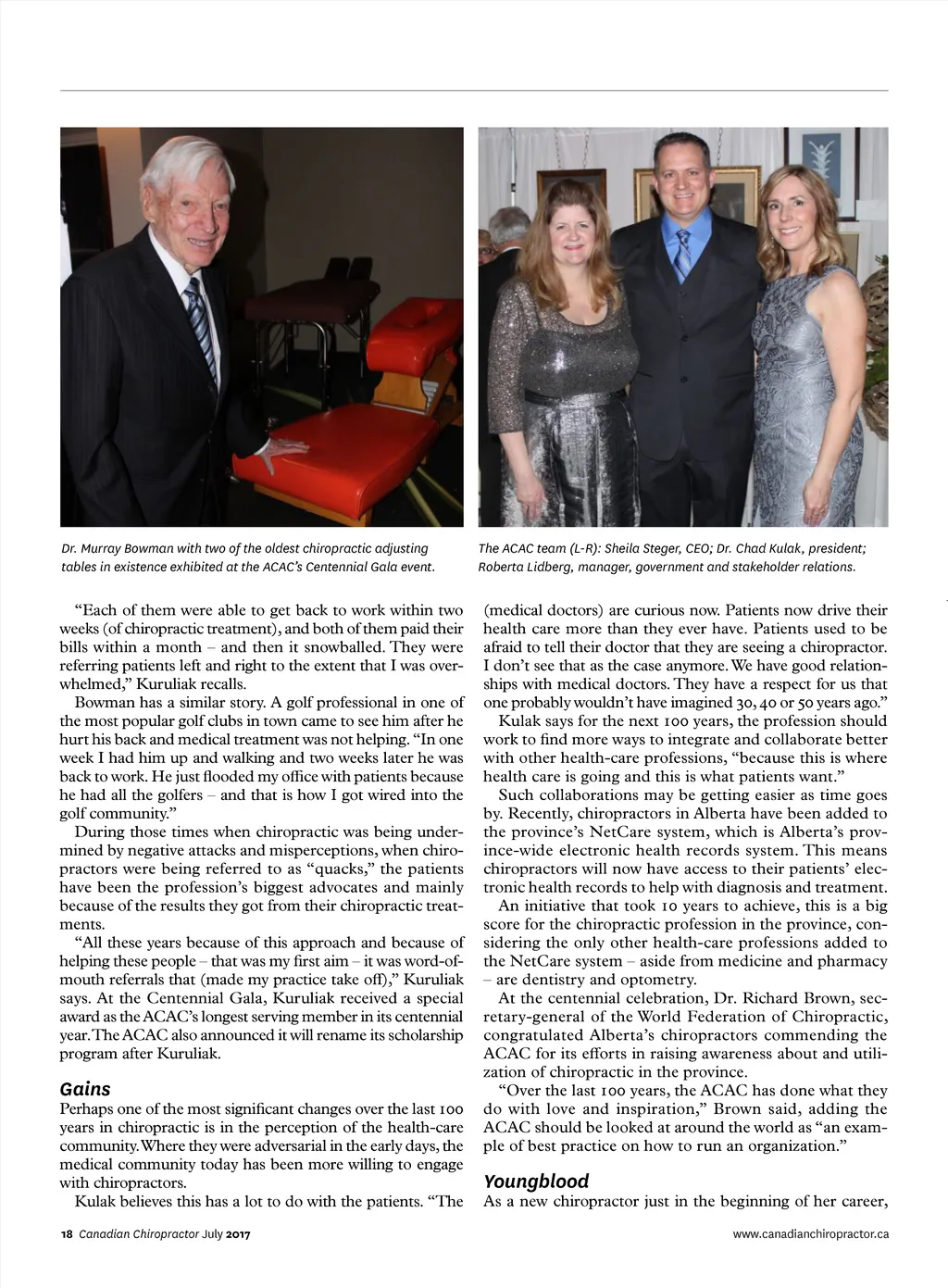
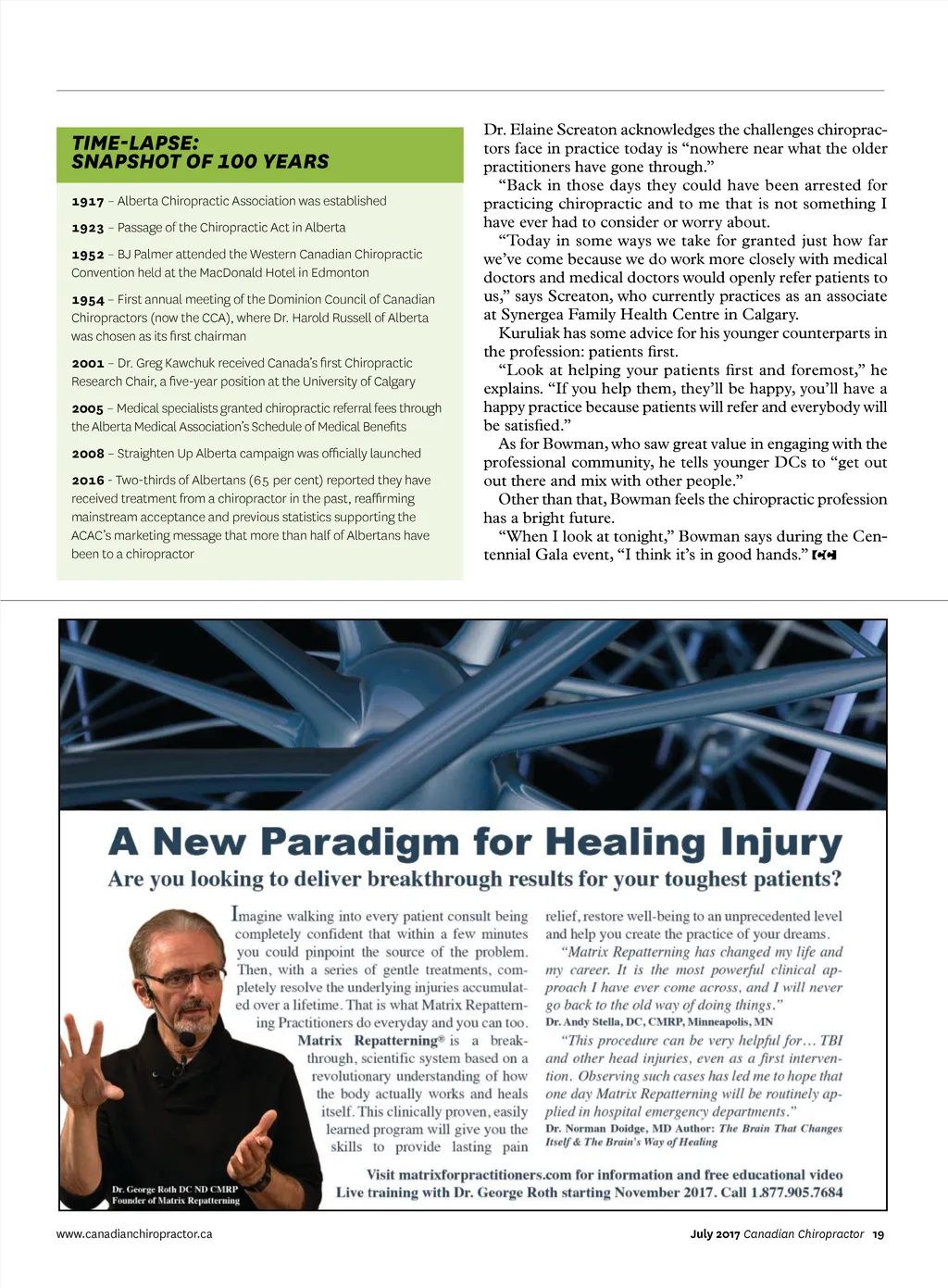
Dr. Murray Bowman with two of the oldest chiropractic adjusting tables in existence exhibited at the ACAC’s Centennial Gala event. The ACAC team (L-R): Sheila Steger, CEO; Dr. Chad Kulak, president; Roberta Lidberg, manager, government and stakeholder relations. “Each of them were able to get back to work within two weeks (of chiropractic treatment), and both of them paid their bills within a month – and then it snowballed. They were referring patients left and right to the extent that I was over-whelmed,” Kuruliak recalls. Bowman has a similar story. A golf professional in one of the most popular golf clubs in town came to see him after he hurt his back and medical treatment was not helping. “In one week I had him up and walking and two weeks later he was back to work. He just flooded my office with patients because he had all the golfers – and that is how I got wired into the golf community.” During those times when chiropractic was being under-mined by negative attacks and misperceptions, when chiro-practors were being referred to as “quacks,” the patients have been the profession’s biggest advocates and mainly because of the results they got from their chiropractic treat-ments. “All these years because of this approach and because of helping these people – that was my first aim – it was word-of-mouth referrals that (made my practice take off),” Kuruliak says. At the Centennial Gala, Kuruliak received a special award as the ACAC’s longest serving member in its centennial year. The ACAC also announced it will rename its scholarship program after Kuruliak. Gains Perhaps one of the most significant changes over the last 100 years in chiropractic is in the perception of the health-care community. Where they were adversarial in the early days, the medical community today has been more willing to engage with chiropractors. Kulak believes this has a lot to do with the patients. “The 18 Canadian Chiropractor July 2017 (medical doctors) are curious now. Patients now drive their health care more than they ever have. Patients used to be afraid to tell their doctor that they are seeing a chiropractor. I don’t see that as the case anymore. We have good relation-ships with medical doctors. They have a respect for us that one probably wouldn’t have imagined 30, 40 or 50 years ago.” Kulak says for the next 100 years, the profession should work to find more ways to integrate and collaborate better with other health-care professions, “because this is where health care is going and this is what patients want.” Such collaborations may be getting easier as time goes by. Recently, chiropractors in Alberta have been added to the province’s NetCare system, which is Alberta’s prov-ince-wide electronic health records system. This means chiropractors will now have access to their patients’ elec-tronic health records to help with diagnosis and treatment. An initiative that took 10 years to achieve, this is a big score for the chiropractic profession in the province, con-sidering the only other health-care professions added to the NetCare system – aside from medicine and pharmacy – are dentistry and optometry. At the centennial celebration, Dr. Richard Brown, sec-retary-general of the World Federation of Chiropractic, congratulated Alberta’s chiropractors commending the ACAC for its efforts in raising awareness about and utili-zation of chiropractic in the province. “Over the last 100 years, the ACAC has done what they do with love and inspiration,” Brown said, adding the ACAC should be looked at around the world as “an exam-ple of best practice on how to run an organization.” Youngblood As a new chiropractor just in the beginning of her career, www.canadianchiropractor.ca
Chiropractic + Naturopathic Doctor July 2017: Page 18