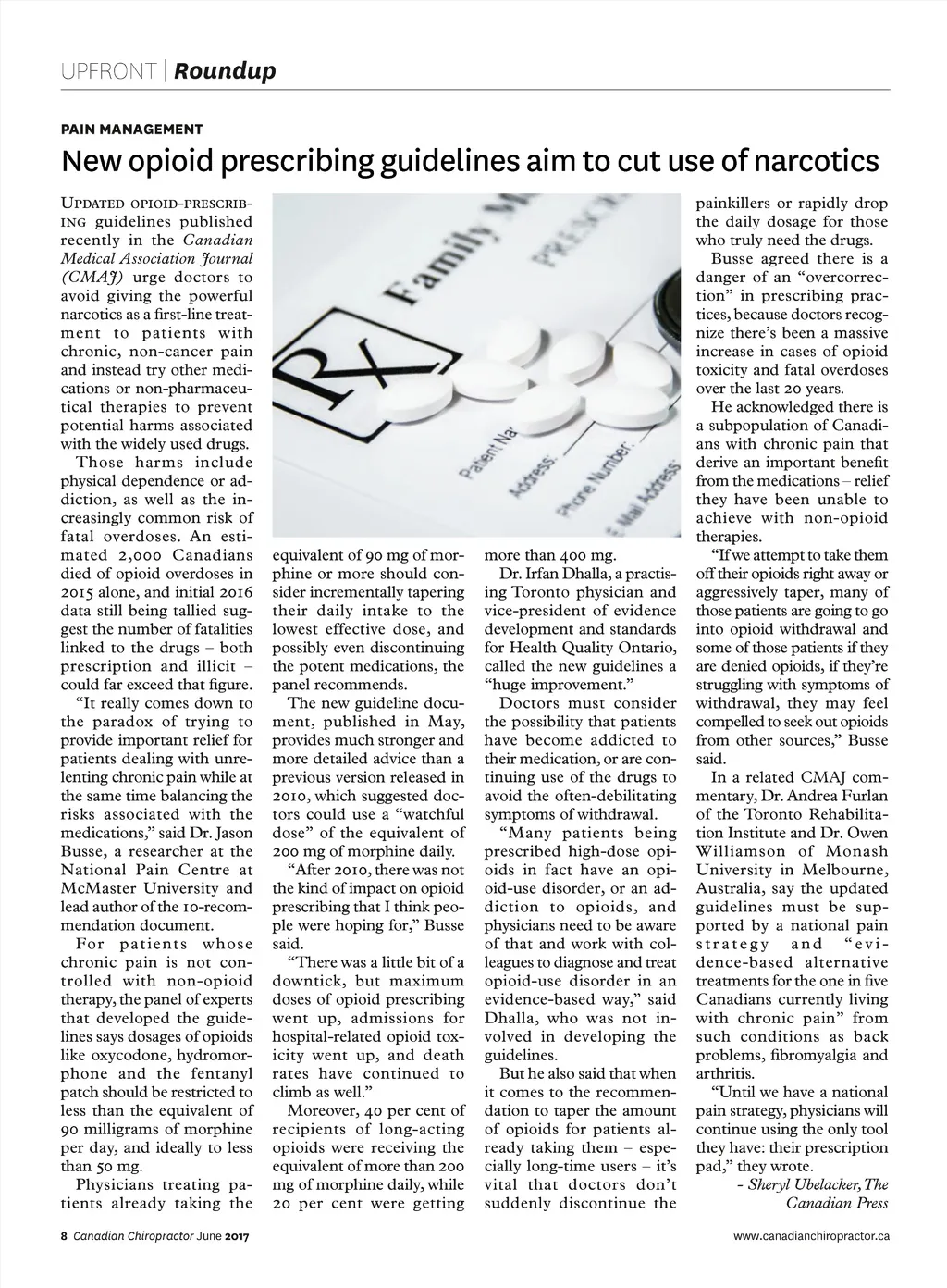
UPFRONT | Roundup PAIN MANAGEMENT New opioid prescribing guidelines aim to cut use of narcotics Updated opioid-prescrib-ing guidelines published recently in the Canadian Medical Association Journal (CMAJ) urge doctors to avoid giving the powerful narcotics as a first-line treat-ment to patients with chronic, non-cancer pain and instead try other medi-cations or non-pharmaceu-tical therapies to prevent potential harms associated with the widely used drugs. Those harms include physical dependence or ad-diction, as well as the in-creasingly common risk of fatal overdoses. An esti-mated 2,000 Canadians died of opioid overdoses in 2015 alone, and initial 2016 data still being tallied sug-gest the number of fatalities linked to the drugs – both prescription and illicit – could far exceed that figure. “It really comes down to the paradox of trying to provide important relief for patients dealing with unre-lenting chronic pain while at the same time balancing the risks associated with the medications,’’ said Dr. Jason Busse, a researcher at the National Pain Centre at McMaster University and lead author of the 10-recom-mendation document. For patients whose chronic pain is not con-trolled with non-opioid therapy, the panel of experts that developed the guide-lines says dosages of opioids like oxycodone, hydromor-phone and the fentanyl patch should be restricted to less than the equivalent of 90 milligrams of morphine per day, and ideally to less than 50 mg. Physicians treating pa-tients already taking the 8 Canadian Chiropractor June 2017 equivalent of 90 mg of mor-phine or more should con-sider incrementally tapering their daily intake to the lowest effective dose, and possibly even discontinuing the potent medications, the panel recommends. The new guideline docu-ment, published in May, provides much stronger and more detailed advice than a previous version released in 2010, which suggested doc-tors could use a “watchful dose” of the equivalent of 200 mg of morphine daily. “After 2010, there was not the kind of impact on opioid prescribing that I think peo-ple were hoping for,” Busse said. “There was a little bit of a downtick, but maximum doses of opioid prescribing went up, admissions for hospital-related opioid tox-icity went up, and death rates have continued to climb as well.” Moreover, 40 per cent of recipients of long-acting opioids were receiving the equivalent of more than 200 mg of morphine daily, while 20 per cent were getting more than 400 mg. Dr. Irfan Dhalla, a practis-ing Toronto physician and vice-president of evidence development and standards for Health Quality Ontario, called the new guidelines a “huge improvement.” Doctors must consider the possibility that patients have become addicted to their medication, or are con-tinuing use of the drugs to avoid the often-debilitating symptoms of withdrawal. “Many patients being prescribed high-dose opi-oids in fact have an opi-oid-use disorder, or an ad-diction to opioids, and physicians need to be aware of that and work with col-leagues to diagnose and treat opioid-use disorder in an evidence-based way,” said Dhalla, who was not in-volved in developing the guidelines. But he also said that when it comes to the recommen-dation to taper the amount of opioids for patients al-ready taking them – espe-cially long-time users – it’s vital that doctors don’t suddenly discontinue the painkillers or rapidly drop the daily dosage for those who truly need the drugs. Busse agreed there is a danger of an “overcorrec-tion” in prescribing prac-tices, because doctors recog-nize there’s been a massive increase in cases of opioid toxicity and fatal overdoses over the last 20 years. He acknowledged there is a subpopulation of Canadi-ans with chronic pain that derive an important benefit from the medications – relief they have been unable to achieve with non-opioid therapies. “If we attempt to take them off their opioids right away or aggressively taper, many of those patients are going to go into opioid withdrawal and some of those patients if they are denied opioids, if they’re struggling with symptoms of withdrawal, they may feel compelled to seek out opioids from other sources,” Busse said. In a related CMAJ com-mentary, Dr. Andrea Furlan of the Toronto Rehabilita-tion Institute and Dr. Owen Williamson of Monash University in Melbourne, Australia, say the updated guidelines must be sup-ported by a national pain strategy and “evi -dence-based alternative treatments for the one in five Canadians currently living with chronic pain” from such conditions as back problems, fibromyalgia and arthritis. “Until we have a national pain strategy, physicians will continue using the only tool they have: their prescription pad,” they wrote. -Sheryl Ubelacker, The Canadian Press www.canadianchiropractor.ca
Chiropractic + Naturopathic Doctor June 2017: Page 8