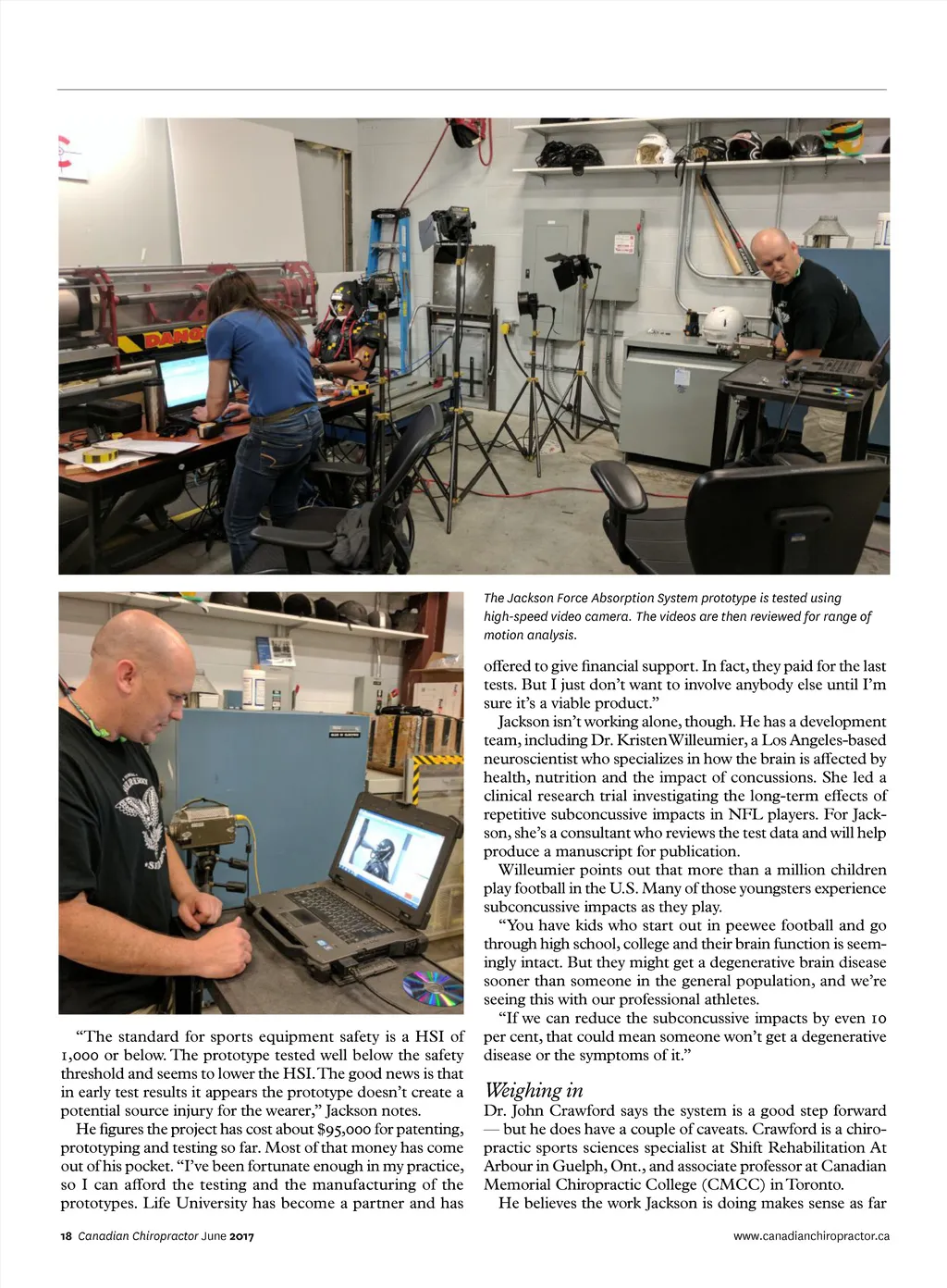
as reducing damage to the cervical spine goes. But even if Jackson’s system fully protects that area of the body, “there’s no way to put a seatbelt on the brain,” Crawford says. In other words, even if the cervical spine is kept from overextension, the brain could still receive a rattle – which means damage from concussions will continue to be a problem. Another concern is that the better the protective equip-ment, the more chances players will take. Today’s gridiron gladiators are bigger and stronger than players of the past. The equipment they wear is more shock absorbing, too. “Because they have so much protection, they feel they’re invincible,” Crawford says. “If you have a linesman wearing this system, he might think: ‘I can hit that guy harder because my neck is protected.’” That said, players and the public are better informed about the risks of concussion, thanks in part to high-profile concussion cases such as the one that sidelined hockey star Sidney Crosby a few years ago. Rowan’s Law might be the most poignant example. It is legislation in Ontario de-signed to reduce concussions in youth sports. The law is named after Rowan Stringer, an Ottawa high school rugby player who, in 2013, suffered two concussions and died a few days later. Crawford says people are more concerned about concus-sions and other dangers associated with contact sports. Modern attitudes are a lot different than they were when he played football. “I was taught that our facemask was a weapon and we should drive it into the numbers on the jersey of the player in front of us.” The juggling act Jackson seems poised to capitalize on the higher level of concussion awareness among players and the public. But remember, he isn’t just an inventor. He’s also a clinician, running a business. “That’s why it’s been a five-year project,” he says. “I devote maybe five, six hours a week to it. Usually when I’m sitting down to watch any sports on TV, I’ll work on it. If my hands are free and my brain is free, I might as well put time into that.” Jackson still has work to do. He has to get the product certified with a number of government safety organizations before he can test it on human subjects. Then come questions about the best way to manufacture, distribute and market the system. Despite the challenges ahead, however, this chiro-practor seems optimistic. “I would say that if the next round of testing indicates no stress or strain that would be a pathological factor for the cervical spine. Then probably within the next year we’ll have a product.” BackSwing ‘17 CMCC 13 th annual golf tournament www.canadianchiropractor.ca CC_CMCC_Backswing_May17_CSA.indd 1 June 2017 Canadian Chiropractor 19 2017-04-20 9:11 AM
Chiropractic + Naturopathic Doctor June 2017: Page 19