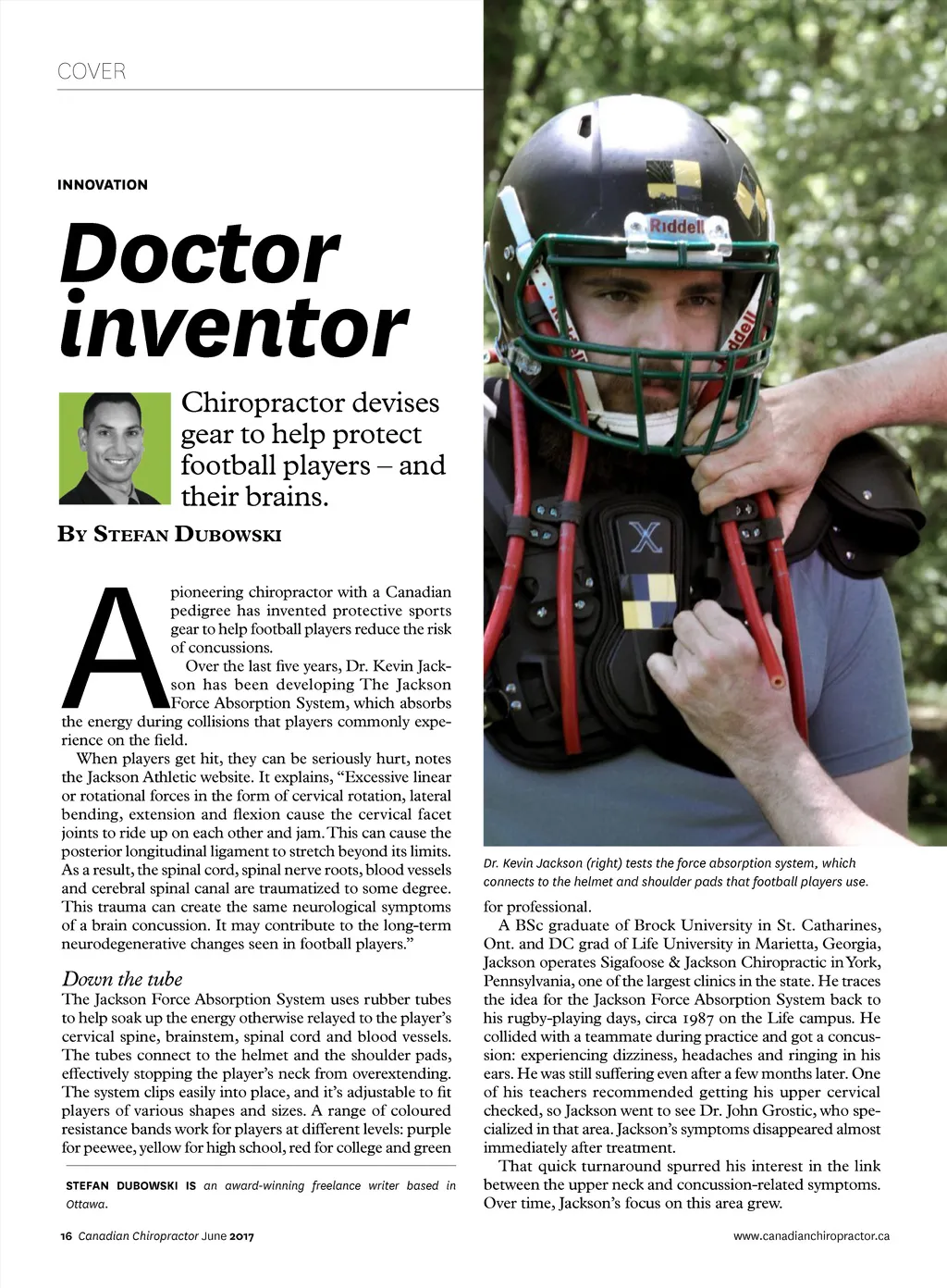
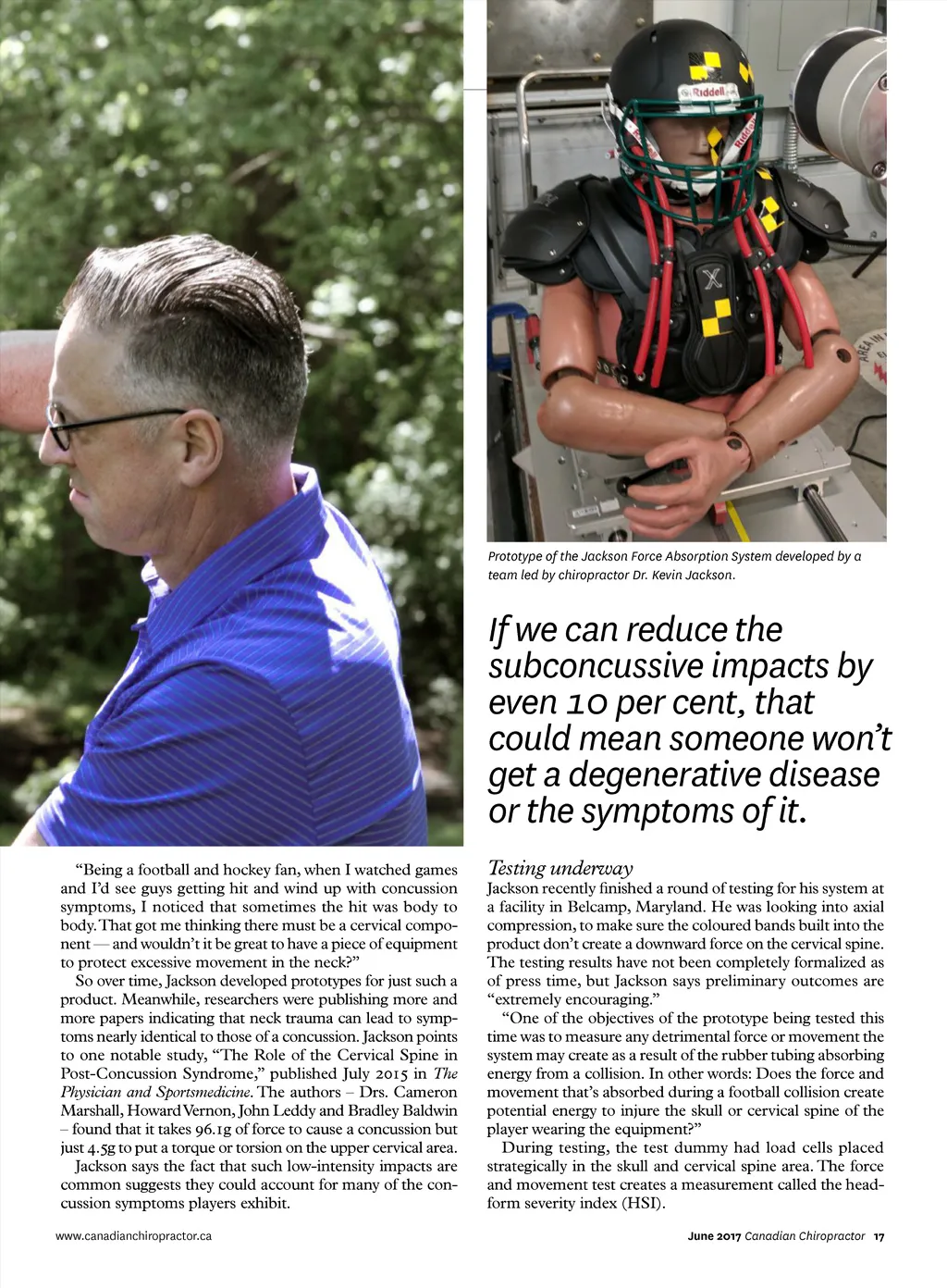
Prototype of the Jackson Force Absorption System developed by a team led by chiropractor Dr. Kevin Jackson. If we can reduce the subconcussive impacts by even 10 per cent, that could mean someone won’t get a degenerative disease or the symptoms of it. “Being a football and hockey fan, when I watched games and I’d see guys getting hit and wind up with concussion symptoms, I noticed that sometimes the hit was body to body. That got me thinking there must be a cervical compo-nent — and wouldn’t it be great to have a piece of equipment to protect excessive movement in the neck?” So over time, Jackson developed prototypes for just such a product. Meanwhile, researchers were publishing more and more papers indicating that neck trauma can lead to symp-toms nearly identical to those of a concussion. Jackson points to one notable study, “The Role of the Cervical Spine in Post-Concussion Syndrome,” published July 2015 in The Physician and Sportsmedicine . The authors – Drs. Cameron Marshall, Howard Vernon, John Leddy and Bradley Baldwin – found that it takes 96.1g of force to cause a concussion but just 4.5g to put a torque or torsion on the upper cervical area. Jackson says the fact that such low-intensity impacts are common suggests they could account for many of the con-cussion symptoms players exhibit. www.canadianchiropractor.ca Testing underway Jackson recently finished a round of testing for his system at a facility in Belcamp, Maryland. He was looking into axial compression, to make sure the coloured bands built into the product don’t create a downward force on the cervical spine. The testing results have not been completely formalized as of press time, but Jackson says preliminary outcomes are “extremely encouraging.” “One of the objectives of the prototype being tested this time was to measure any detrimental force or movement the system may create as a result of the rubber tubing absorbing energy from a collision. In other words: Does the force and movement that’s absorbed during a football collision create potential energy to injure the skull or cervical spine of the player wearing the equipment?” During testing, the test dummy had load cells placed strategically in the skull and cervical spine area. The force and movement test creates a measurement called the head-form severity index (HSI). June 2017 Canadian Chiropractor 17
Chiropractic + Naturopathic Doctor June 2017: Page 17