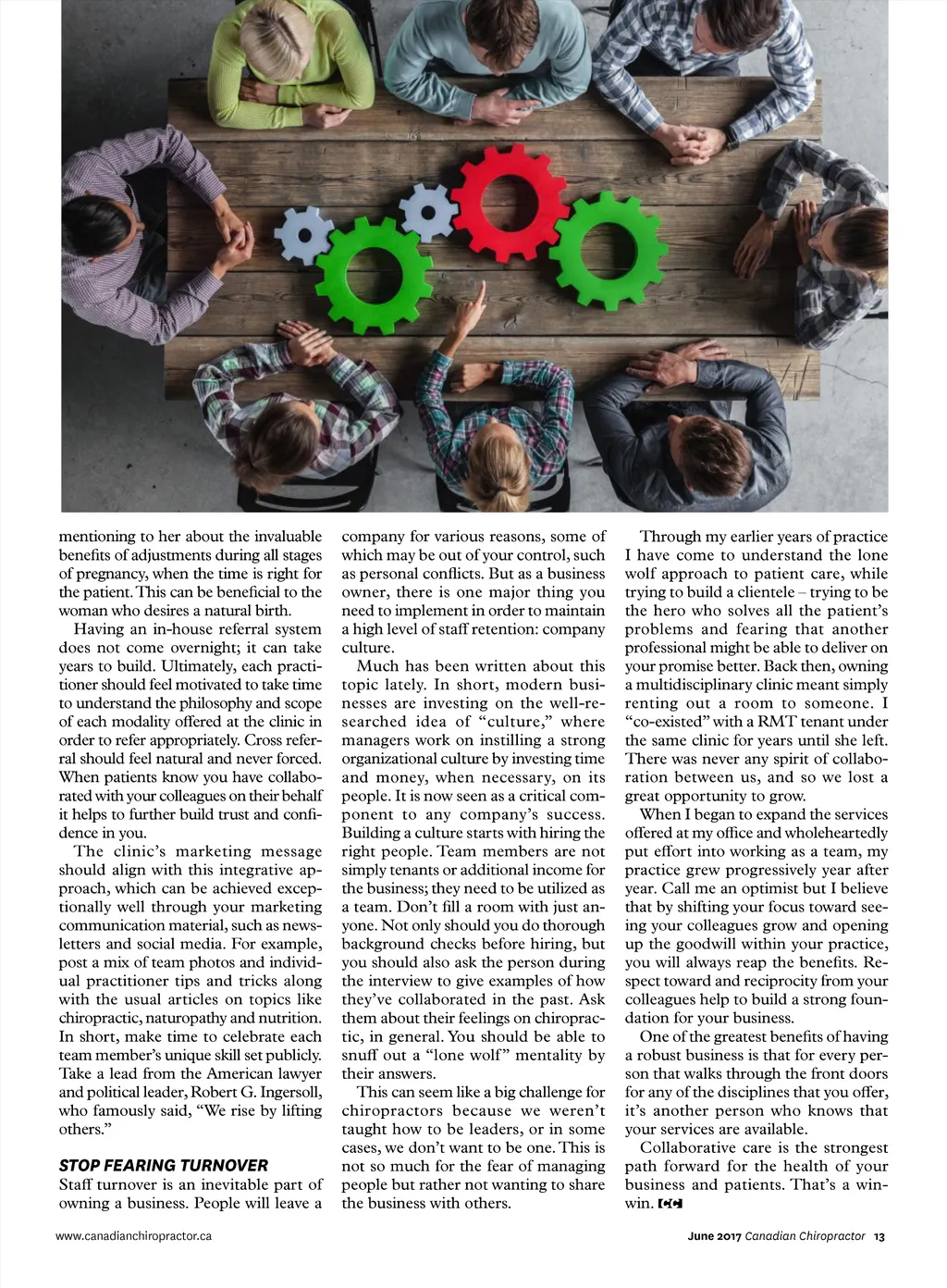
mentioning to her about the invaluable benefits of adjustments during all stages of pregnancy, when the time is right for the patient. This can be beneficial to the woman who desires a natural birth. Having an in-house referral system does not come overnight; it can take years to build. Ultimately, each practi-tioner should feel motivated to take time to understand the philosophy and scope of each modality offered at the clinic in order to refer appropriately. Cross refer-ral should feel natural and never forced. When patients know you have collabo-rated with your colleagues on their behalf it helps to further build trust and confi-dence in you. The clinic’s marketing message should align with this integrative ap-proach, which can be achieved excep-tionally well through your marketing communication material, such as news-letters and social media. For example, post a mix of team photos and individ-ual practitioner tips and tricks along with the usual articles on topics like chiropractic, naturopathy and nutrition. In short, make time to celebrate each team member’s unique skill set publicly. Take a lead from the American lawyer and political leader, Robert G. Ingersoll, who famously said, “We rise by lifting others.” STOP FEARING TURNOVER Staff turnover is an inevitable part of owning a business. People will leave a www.canadianchiropractor.ca company for various reasons, some of which may be out of your control, such as personal conflicts. But as a business owner, there is one major thing you need to implement in order to maintain a high level of staff retention: company culture. Much has been written about this topic lately. In short, modern busi-nesses are investing on the well-re-searched idea of “culture,” where managers work on instilling a strong organizational culture by investing time and money, when necessary, on its people. It is now seen as a critical com-ponent to any company’s success. Building a culture starts with hiring the right people. Team members are not simply tenants or additional income for the business; they need to be utilized as a team. Don’t fill a room with just an-yone. Not only should you do thorough background checks before hiring, but you should also ask the person during the interview to give examples of how they’ve collaborated in the past. Ask them about their feelings on chiroprac-tic, in general. You should be able to snuff out a “lone wolf” mentality by their answers. This can seem like a big challenge for chiropractors because we weren’t taught how to be leaders, or in some cases, we don’t want to be one. This is not so much for the fear of managing people but rather not wanting to share the business with others. Through my earlier years of practice I have come to understand the lone wolf approach to patient care, while trying to build a clientele – trying to be the hero who solves all the patient’s problems and fearing that another professional might be able to deliver on your promise better. Back then, owning a multidisciplinary clinic meant simply renting out a room to someone. I “co-existed” with a RMT tenant under the same clinic for years until she left. There was never any spirit of collabo-ration between us, and so we lost a great opportunity to grow. When I began to expand the services offered at my office and wholeheartedly put effort into working as a team, my practice grew progressively year after year. Call me an optimist but I believe that by shifting your focus toward see-ing your colleagues grow and opening up the goodwill within your practice, you will always reap the benefits. Re-spect toward and reciprocity from your colleagues help to build a strong foun-dation for your business. One of the greatest benefits of having a robust business is that for every per-son that walks through the front doors for any of the disciplines that you offer, it’s another person who knows that your services are available. Collaborative care is the strongest path forward for the health of your business and patients. That’s a win-win. June 2017 Canadian Chiropractor 13
Chiropractic + Naturopathic Doctor June 2017: Page 13