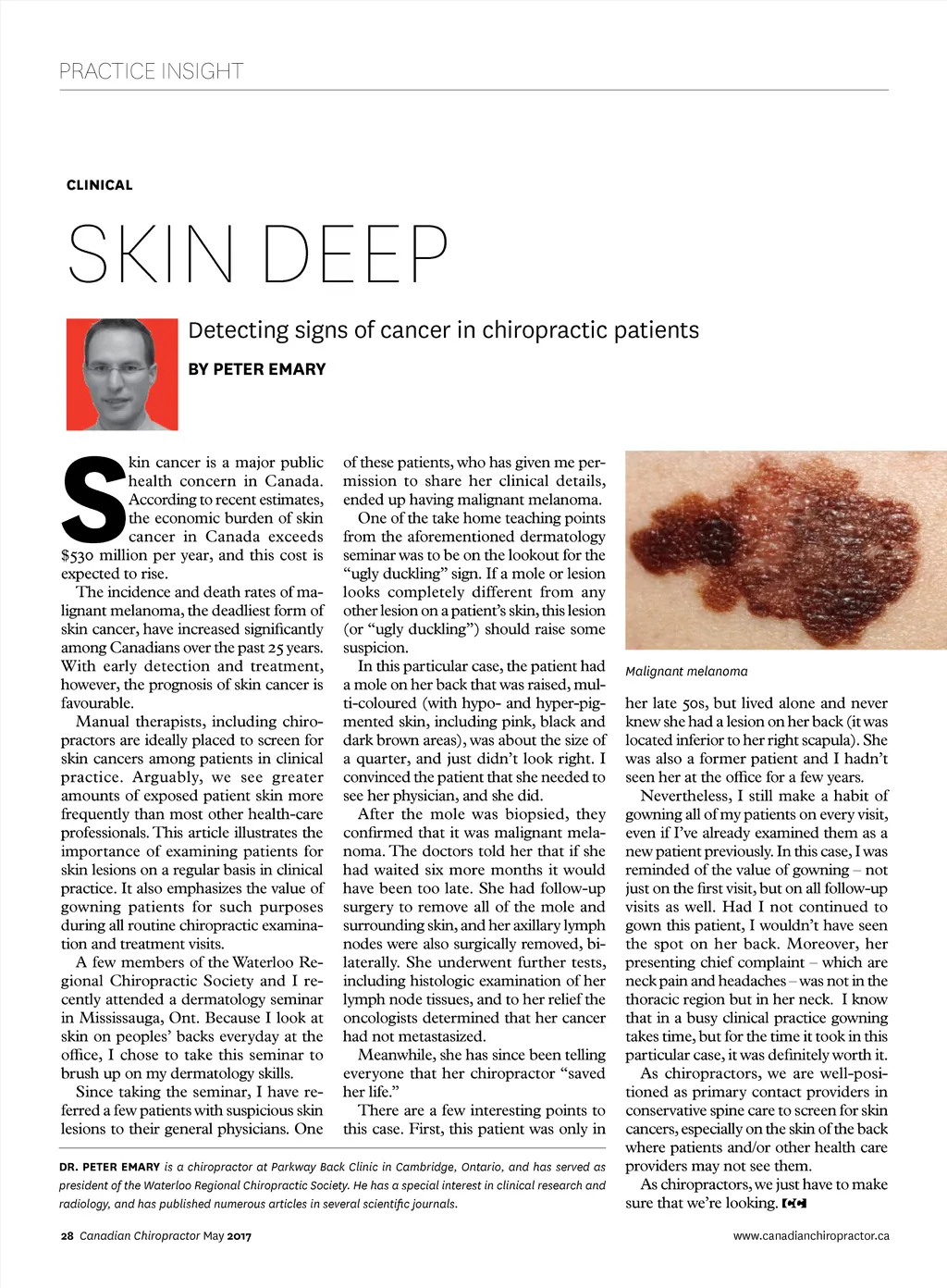
PRACTICE INSIGHT CLINICAL SKIN DEEP Detecting signs of cancer in chiropractic patients BY PETER EMARY S kin cancer is a major public health concern in Canada. According to recent estimates, the economic burden of skin cancer in Canada exceeds $530 million per year, and this cost is expected to rise. The incidence and death rates of ma-lignant melanoma, the deadliest form of skin cancer, have increased significantly among Canadians over the past 25 years. With early detection and treatment, however, the prognosis of skin cancer is favourable. Manual therapists, including chiro-practors are ideally placed to screen for skin cancers among patients in clinical practice. Arguably, we see greater amounts of exposed patient skin more frequently than most other health-care professionals. This article illustrates the importance of examining patients for skin lesions on a regular basis in clinical practice. It also emphasizes the value of gowning patients for such purposes during all routine chiropractic examina-tion and treatment visits. A few members of the Waterloo Re-gional Chiropractic Society and I re-cently attended a dermatology seminar in Mississauga, Ont. Because I look at skin on peoples’ backs everyday at the office, I chose to take this seminar to brush up on my dermatology skills. Since taking the seminar, I have re-ferred a few patients with suspicious skin lesions to their general physicians. One of these patients, who has given me per-mission to share her clinical details, ended up having malignant melanoma. One of the take home teaching points from the aforementioned dermatology seminar was to be on the lookout for the “ugly duckling” sign. If a mole or lesion looks completely different from any other lesion on a patient’s skin, this lesion (or “ugly duckling”) should raise some suspicion. In this particular case, the patient had a mole on her back that was raised, mul-ti-coloured (with hypo-and hyper-pig-mented skin, including pink, black and dark brown areas), was about the size of a quarter, and just didn’t look right. I convinced the patient that she needed to see her physician, and she did. After the mole was biopsied, they confirmed that it was malignant mela-noma. The doctors told her that if she had waited six more months it would have been too late. She had follow-up surgery to remove all of the mole and surrounding skin, and her axillary lymph nodes were also surgically removed, bi-laterally. She underwent further tests, including histologic examination of her lymph node tissues, and to her relief the oncologists determined that her cancer had not metastasized. Meanwhile, she has since been telling everyone that her chiropractor “saved her life.” There are a few interesting points to this case. First, this patient was only in Malignant melanoma DR. PETER EMARY is a chiropractor at Parkway Back Clinic in Cambridge, Ontario, and has served as president of the Waterloo Regional Chiropractic Society. He has a special interest in clinical research and radiology, and has published numerous articles in several scientific journals. 28 Canadian Chiropractor May 2017 her late 50s, but lived alone and never knew she had a lesion on her back (it was located inferior to her right scapula). She was also a former patient and I hadn’t seen her at the office for a few years. Nevertheless, I still make a habit of gowning all of my patients on every visit, even if I’ve already examined them as a new patient previously. In this case, I was reminded of the value of gowning – not just on the first visit, but on all follow-up visits as well. Had I not continued to gown this patient, I wouldn’t have seen the spot on her back. Moreover, her presenting chief complaint – which are neck pain and headaches – was not in the thoracic region but in her neck. I know that in a busy clinical practice gowning takes time, but for the time it took in this particular case, it was definitely worth it. As chiropractors, we are well-posi-tioned as primary contact providers in conservative spine care to screen for skin cancers, especially on the skin of the back where patients and/or other health care providers may not see them. As chiropractors, we just have to make sure that we’re looking. www.canadianchiropractor.ca
Chiropractic + Naturopathic Doctor May 2017: Page 28