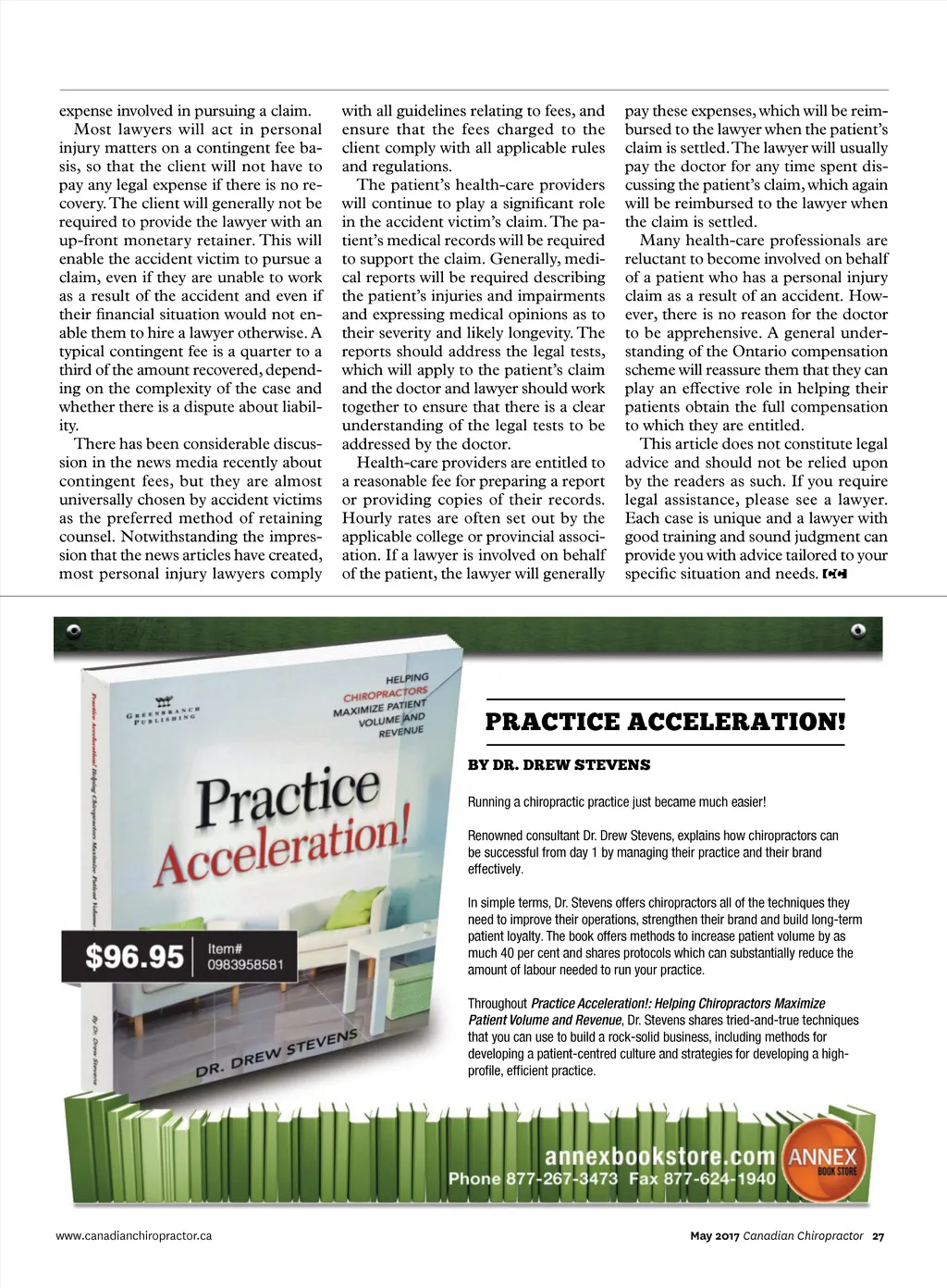
expense involved in pursuing a claim. Most lawyers will act in personal injury matters on a contingent fee ba-sis, so that the client will not have to pay any legal expense if there is no re-covery. The client will generally not be required to provide the lawyer with an up-front monetary retainer. This will enable the accident victim to pursue a claim, even if they are unable to work as a result of the accident and even if their financial situation would not en-able them to hire a lawyer otherwise. A typical contingent fee is a quarter to a third of the amount recovered, depend-ing on the complexity of the case and whether there is a dispute about liabil-ity. There has been considerable discus-sion in the news media recently about contingent fees, but they are almost universally chosen by accident victims as the preferred method of retaining counsel. Notwithstanding the impres-sion that the news articles have created, most personal injury lawyers comply with all guidelines relating to fees, and ensure that the fees charged to the client comply with all applicable rules and regulations. The patient’s health-care providers will continue to play a significant role in the accident victim’s claim. The pa-tient’s medical records will be required to support the claim. Generally, medi-cal reports will be required describing the patient’s injuries and impairments and expressing medical opinions as to their severity and likely longevity. The reports should address the legal tests, which will apply to the patient’s claim and the doctor and lawyer should work together to ensure that there is a clear understanding of the legal tests to be addressed by the doctor. Health-care providers are entitled to a reasonable fee for preparing a report or providing copies of their records. Hourly rates are often set out by the applicable college or provincial associ-ation. If a lawyer is involved on behalf of the patient, the lawyer will generally pay these expenses, which will be reim-bursed to the lawyer when the patient’s claim is settled. The lawyer will usually pay the doctor for any time spent dis-cussing the patient’s claim, which again will be reimbursed to the lawyer when the claim is settled. Many health-care professionals are reluctant to become involved on behalf of a patient who has a personal injury claim as a result of an accident. How-ever, there is no reason for the doctor to be apprehensive. A general under-standing of the Ontario compensation scheme will reassure them that they can play an effective role in helping their patients obtain the full compensation to which they are entitled. This article does not constitute legal advice and should not be relied upon by the readers as such. If you require legal assistance, please see a lawyer. Each case is unique and a lawyer with good training and sound judgment can provide you with advice tailored to your specific situation and needs. PRACTICE ACCELERATION! BY DR. DREW STEVENS Running a chiropractic practice just became much easier! Renowned consultant Dr. Drew Stevens, explains how chiropractors can be successful from day 1 by managing their practice and their brand effectively. In simple terms, Dr. Stevens offers chiropractors all of the techniques they need to improve their operations, strengthen their brand and build long-term patient loyalty. The book offers methods to increase patient volume by as much 40 per cent and shares protocols which can substantially reduce the amount of labour needed to run your practice. Throughout Practice Acceleration!: Helping Chiropractors Maximize Patient Volume and Revenue , Dr. Stevens shares tried-and-true techniques that you can use to build a rock-solid business, including methods for developing a patient-centred culture and strategies for developing a high-profile, efficient practice. www.canadianchiropractor.ca chiro book acceleration feb15.indd 1 May 2017 Canadian Chiropractor 27 2015-01-27 10:31 AM
Chiropractic + Naturopathic Doctor May 2017: Page 27