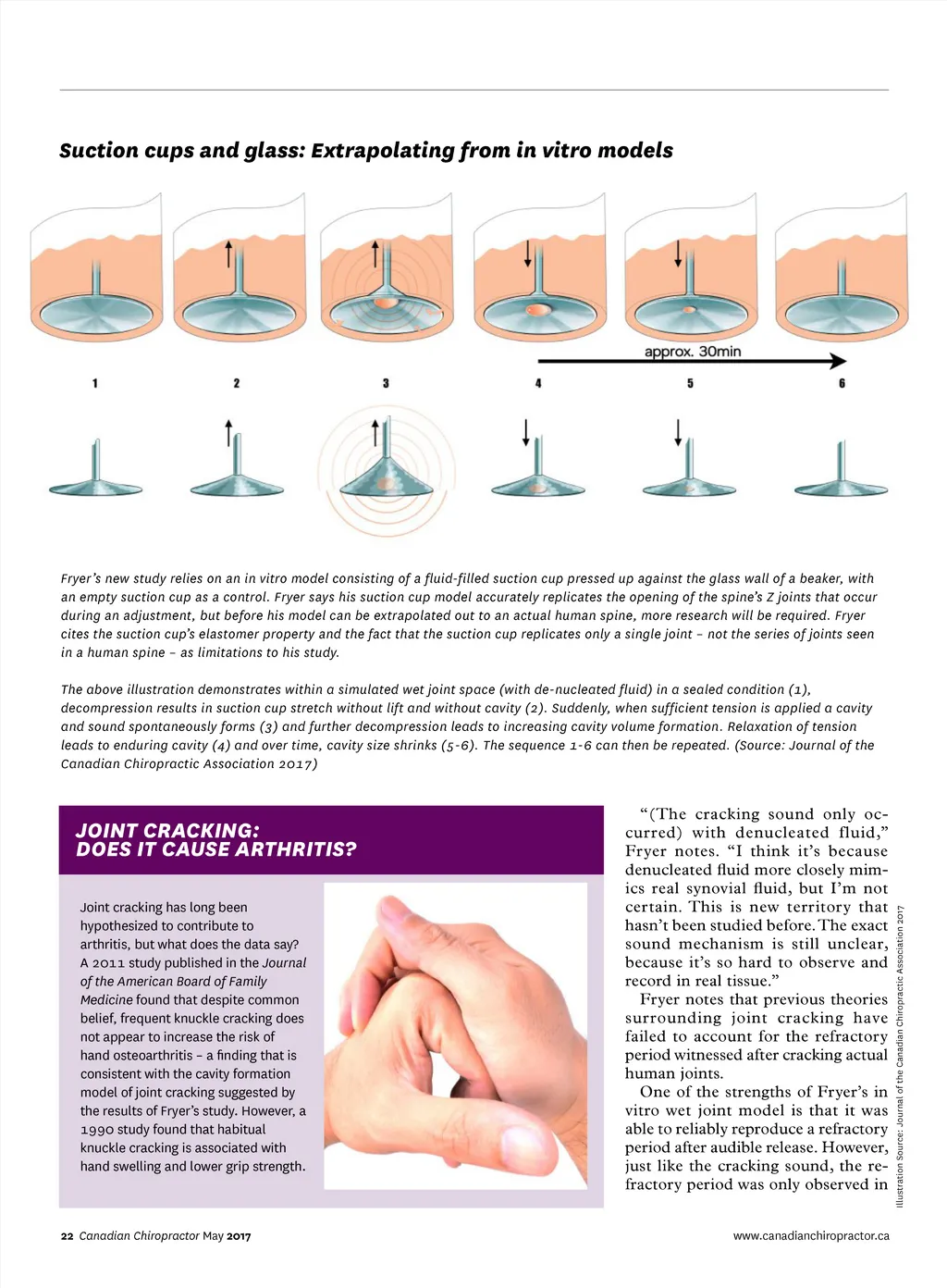
Suction cups and glass: Extrapolating from in vitro models Fryer’s new study relies on an in vitro model consisting of a fluid-filled suction cup pressed up against the glass wall of a beaker, with an empty suction cup as a control. Fryer says his suction cup model accurately replicates the opening of the spine’s Z joints that occur during an adjustment, but before his model can be extrapolated out to an actual human spine, more research will be required. Fryer cites the suction cup’s elastomer property and the fact that the suction cup replicates only a single joint – not the series of joints seen in a human spine – as limitations to his study. The above illustration demonstrates within a simulated wet joint space (with de-nucleated fluid) in a sealed condition (1), decompression results in suction cup stretch without lift and without cavity (2). Suddenly, when sufficient tension is applied a cavity and sound spontaneously forms (3) and further decompression leads to increasing cavity volume formation. Relaxation of tension leads to enduring cavity (4) and over time, cavity size shrinks (5-6). The sequence 1-6 can then be repeated. (Source: Journal of the Canadian Chiropractic Association 2017) JOINT CRACKING: DOES IT CAUSE ARTHRITIS? Joint cracking has long been hypothesized to contribute to arthritis, but what does the data say? A 2011 study published in the Journal of the American Board of Family Medicine found that despite common belief, frequent knuckle cracking does not appear to increase the risk of hand osteoarthritis – a finding that is consistent with the cavity formation model of joint cracking suggested by the results of Fryer’s study. However, a 1990 study found that habitual knuckle cracking is associated with hand swelling and lower grip strength. 22 Canadian Chiropractor May 2017 www.canadianchiropractor.ca Illustration Source: Journal of the Canadian Chiropractic Association 2017 “(The cracking sound only oc-curred) with denucleated fluid,” Fryer notes. “I think it’s because denucleated fluid more closely mim-ics real synovial fluid, but I’m not certain. This is new territory that hasn’t been studied before. The exact sound mechanism is still unclear, because it’s so hard to observe and record in real tissue.” Fryer notes that previous theories surrounding joint cracking have failed to account for the refractory period witnessed after cracking actual human joints. One of the strengths of Fryer’s in vitro wet joint model is that it was able to reliably reproduce a refractory period after audible release. However, just like the cracking sound, the re-fractory period was only observed in
Chiropractic + Naturopathic Doctor May 2017: Page 22