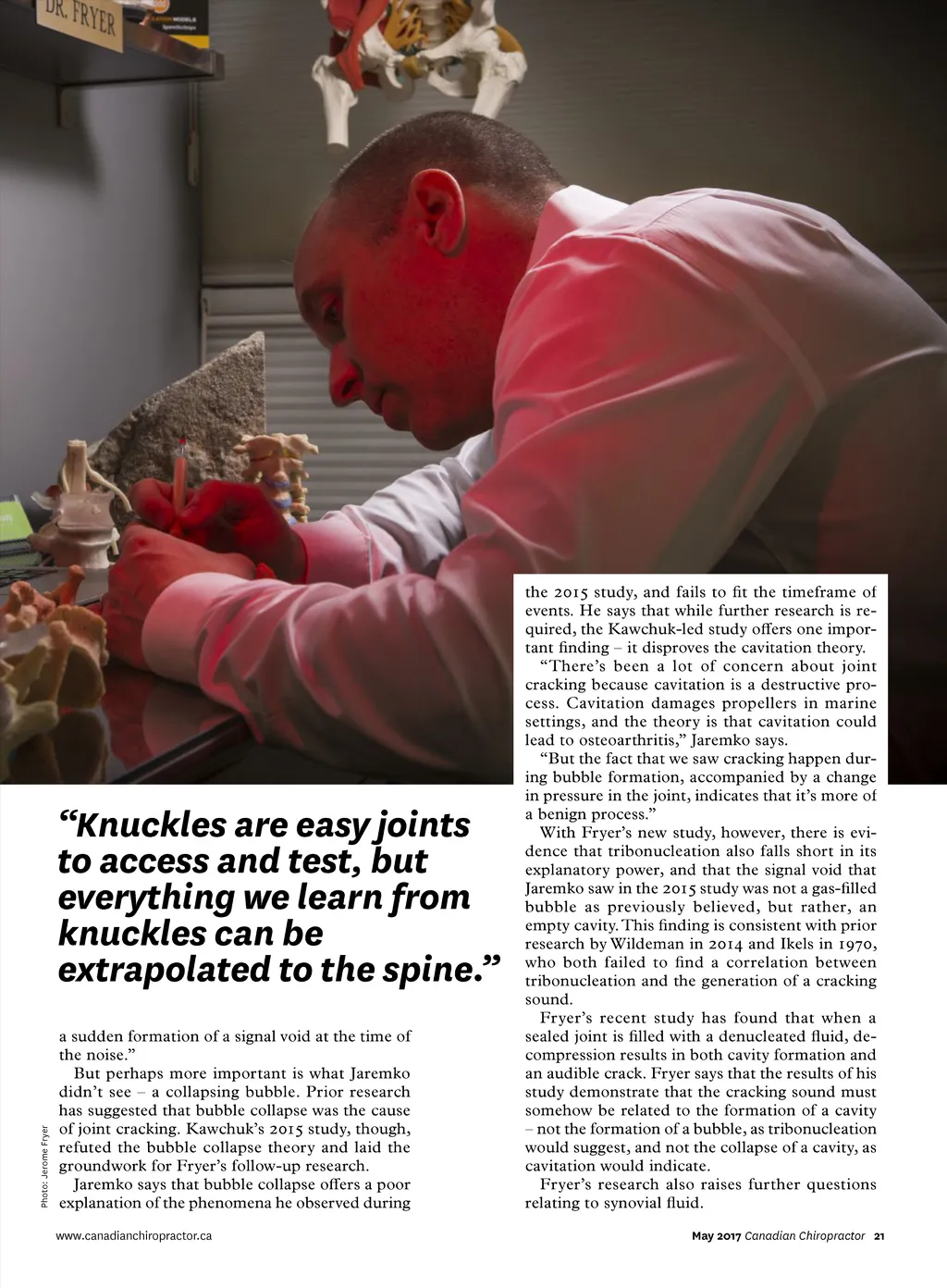
“Knuckles are easy joints to access and test, but everything we learn from knuckles can be extrapolated to the spine.” a sudden formation of a signal void at the time of the noise.” But perhaps more important is what Jaremko didn’t see – a collapsing bubble. Prior research has suggested that bubble collapse was the cause of joint cracking. Kawchuk’s 2015 study, though, refuted the bubble collapse theory and laid the groundwork for Fryer’s follow-up research. Jaremko says that bubble collapse offers a poor explanation of the phenomena he observed during www.canadianchiropractor.ca the 2015 study, and fails to fit the timeframe of events. He says that while further research is re-quired, the Kawchuk-led study offers one impor-tant finding – it disproves the cavitation theory. “There’s been a lot of concern about joint cracking because cavitation is a destructive pro-cess. Cavitation damages propellers in marine settings, and the theory is that cavitation could lead to osteoarthritis,” Jaremko says. “But the fact that we saw cracking happen dur-ing bubble formation, accompanied by a change in pressure in the joint, indicates that it’s more of a benign process.” With Fryer’s new study, however, there is evi-dence that tribonucleation also falls short in its explanatory power, and that the signal void that Jaremko saw in the 2015 study was not a gas-filled bubble as previously believed, but rather, an empty cavity. This finding is consistent with prior research by Wildeman in 2014 and Ikels in 1970, who both failed to find a correlation between tribonucleation and the generation of a cracking sound. Fryer’s recent study has found that when a sealed joint is filled with a denucleated fluid, de-compression results in both cavity formation and an audible crack. Fryer says that the results of his study demonstrate that the cracking sound must somehow be related to the formation of a cavity – not the formation of a bubble, as tribonucleation would suggest, and not the collapse of a cavity, as cavitation would indicate. Fryer’s research also raises further questions relating to synovial fluid. May 2017 Canadian Chiropractor 21 Photo: Jerome Fryer
Chiropractic + Naturopathic Doctor May 2017: Page 21