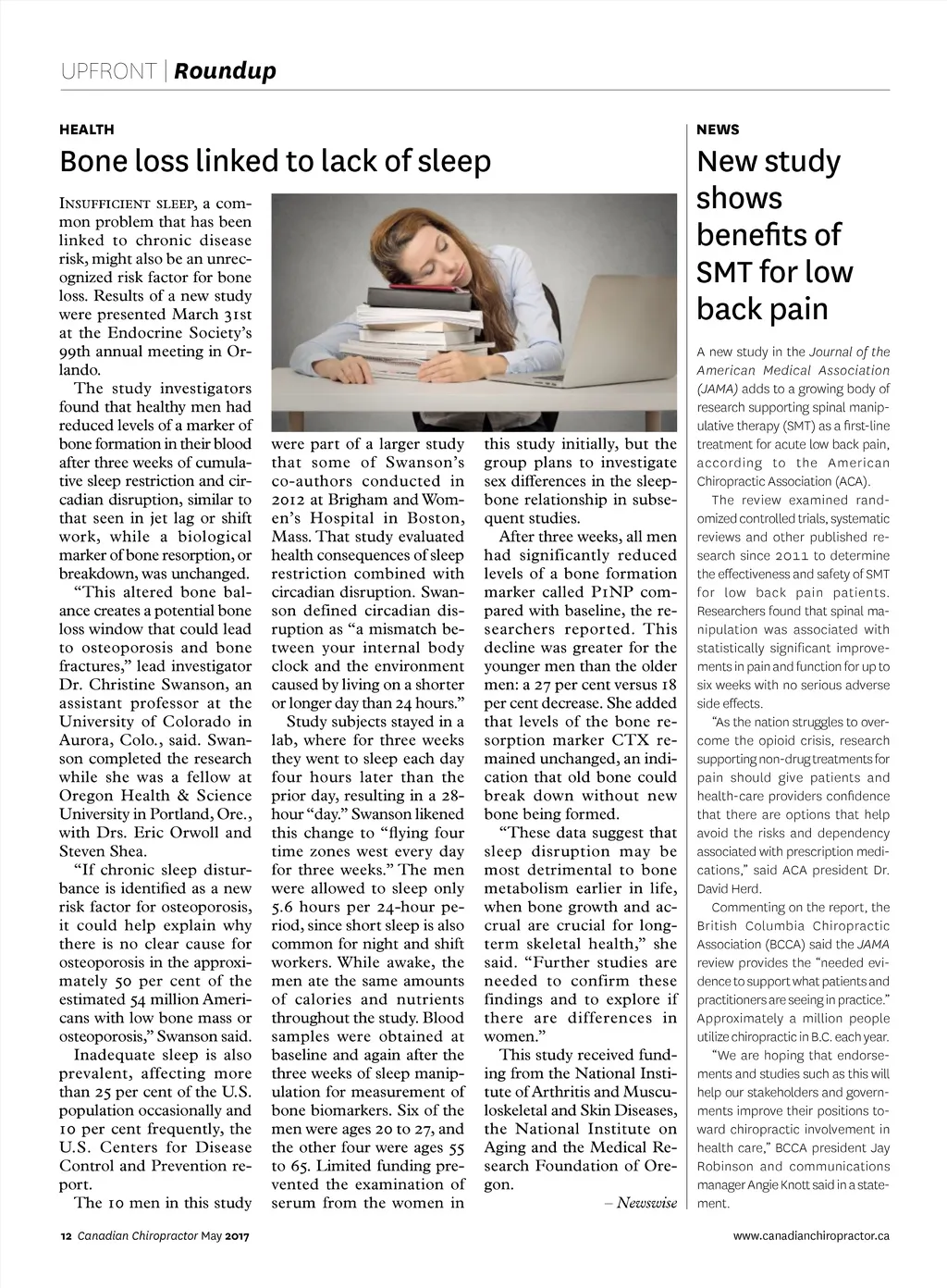
UPFRONT | Roundup HEALTH Bone loss linked to lack of sleep Insufficient sleep, a com-mon problem that has been linked to chronic disease risk, might also be an unrec-ognized risk factor for bone loss. Results of a new study were presented March 31st at the Endocrine Society’s 99th annual meeting in Or-lando. The study investigators found that healthy men had reduced levels of a marker of bone formation in their blood after three weeks of cumula-tive sleep restriction and cir-cadian disruption, similar to that seen in jet lag or shift work, while a biological marker of bone resorption, or breakdown, was unchanged. “This altered bone bal-ance creates a potential bone loss window that could lead to osteoporosis and bone fractures,” lead investigator Dr. Christine Swanson, an assistant professor at the University of Colorado in Aurora, Colo., said. Swan-son completed the research while she was a fellow at Oregon Health & Science University in Portland, Ore., with Drs. Eric Orwoll and Steven Shea. “If chronic sleep distur-bance is identified as a new risk factor for osteoporosis, it could help explain why there is no clear cause for osteoporosis in the approxi-mately 50 per cent of the estimated 54 million Ameri-cans with low bone mass or osteoporosis,” Swanson said. Inadequate sleep is also prevalent, affecting more than 25 per cent of the U.S. population occasionally and 10 per cent frequently, the U.S. Centers for Disease Control and Prevention re-port. The 10 men in this study 12 Canadian Chiropractor May 2017 NEWS New study shows benefits of SMT for low back pain A new study in the Journal of the American Medical Association (JAMA) adds to a growing body of research supporting spinal manip-ulative therapy (SMT) as a first-line treatment for acute low back pain, according to the American Chiropractic Association (ACA). The review examined rand-omized controlled trials, systematic reviews and other published re-search since 2011 to determine the effectiveness and safety of SMT for low back pain patients. Researchers found that spinal ma-nipulation was associated with statistically significant improve-ments in pain and function for up to six weeks with no serious adverse side effects. “As the nation struggles to over-come the opioid crisis, research supporting non-drug treatments for pain should give patients and health-care providers confidence that there are options that help avoid the risks and dependency associated with prescription medi-cations,” said ACA president Dr. David Herd. Commenting on the report, the British Columbia Chiropractic Association (BCCA) said the JAMA review provides the “needed evi-dence to support what patients and practitioners are seeing in practice.” Approximately a million people utilize chiropractic in B.C. each year. “We are hoping that endorse-ments and studies such as this will help our stakeholders and govern-ments improve their positions to-ward chiropractic involvement in health care,” BCCA president Jay Robinson and communications manager Angie Knott said in a state-ment. www.canadianchiropractor.ca were part of a larger study that some of Swanson’s co-authors conducted in 2012 at Brigham and Wom-en’s Hospital in Boston, Mass. That study evaluated health consequences of sleep restriction combined with circadian disruption. Swan-son defined circadian dis-ruption as “a mismatch be-tween your internal body clock and the environment caused by living on a shorter or longer day than 24 hours.” Study subjects stayed in a lab, where for three weeks they went to sleep each day four hours later than the prior day, resulting in a 28-hour “day.” Swanson likened this change to “flying four time zones west every day for three weeks.” The men were allowed to sleep only 5.6 hours per 24-hour pe-riod, since short sleep is also common for night and shift workers. While awake, the men ate the same amounts of calories and nutrients throughout the study. Blood samples were obtained at baseline and again after the three weeks of sleep manip-ulation for measurement of bone biomarkers. Six of the men were ages 20 to 27, and the other four were ages 55 to 65. Limited funding pre-vented the examination of serum from the women in this study initially, but the group plans to investigate sex differences in the sleep-bone relationship in subse-quent studies. After three weeks, all men had significantly reduced levels of a bone formation marker called P1NP com-pared with baseline, the re-searchers reported. This decline was greater for the younger men than the older men: a 27 per cent versus 18 per cent decrease. She added that levels of the bone re-sorption marker CTX re-mained unchanged, an indi-cation that old bone could break down without new bone being formed. “These data suggest that sleep disruption may be most detrimental to bone metabolism earlier in life, when bone growth and ac-crual are crucial for long-term skeletal health,” she said. “Further studies are needed to confirm these findings and to explore if there are differences in women.” This study received fund-ing from the National Insti-tute of Arthritis and Muscu-loskeletal and Skin Diseases, the National Institute on Aging and the Medical Re-search Foundation of Ore-gon. – Newswise
Chiropractic + Naturopathic Doctor May 2017: Page 12