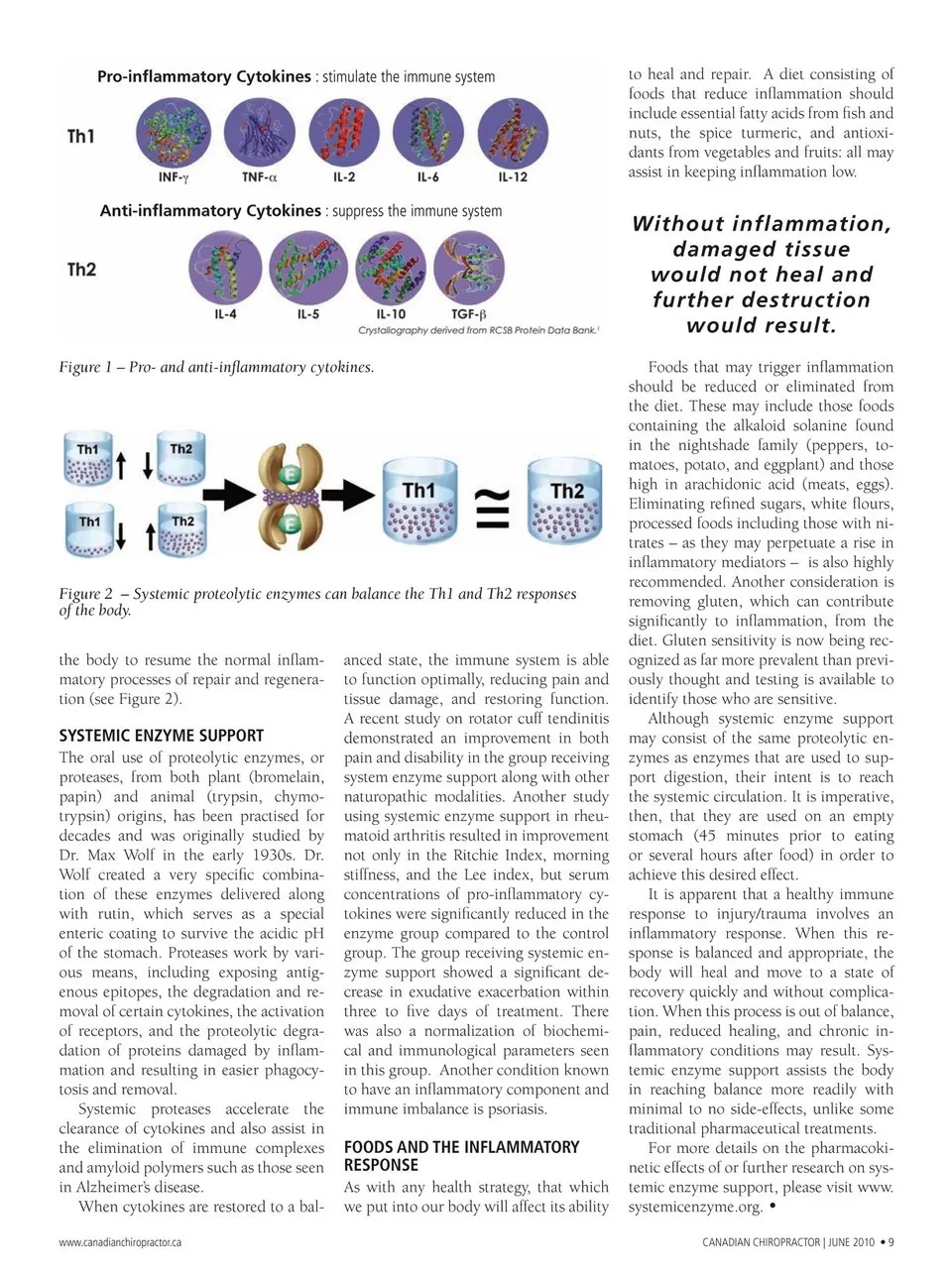
Managing ‘Healthy’ Inflammation System enzyme support Dr. Victoria Coleman is a 1994 graduate of CMCC and a BSc in Kinesiology specializing in Fitness Assessment and Exercise Counsel- ing. Working with patients over the years, it became her mission to teach people that everything you eat, breath, drink, and think affects your health. This fuelled her desire to further expand her career and continue her studies. She is an avid follower of the Institute for Functional Medicine and is currently working toward her certification in Functional Medicine. Dr. Victoria Coleman is also the president of Douglas Laboratories/Pure Encap- sulations Canada. t may seem contradictory to hear the term “healthy” inflammation; however, inflam- mation is a key response of the body’s defence system – a protective response involv- ing cells and chemicals called to an area to repair damage. Triggers that may cause inflammation include trauma such as fractures, sprains/strains, invading virus/bacteria, allergens, to list a few. Inflammation is an overall general innate response of the immune system to pathogens. Without inflammation, damaged tissue would not heal and further destruction would result. I Inflammation is typically noted by redness, swelling, heat, and pain, and is further defined as acute or chronic. It is when inflammation becomes ongoing, and the immune response is out of balance, that detrimental damage results in further tissue destruction, leading to the development of conditions such as allergy, arthritis, and autoimmune dis- orders. It is important again to note that the goal should not be to stop all inflammation, but to ensure that the balance of the immune response ensues. A LOOK AT CYTOKINES Cytokines are the key chemicals produced for cellular communication. These may be further subdivided into Th1 (pro-inflammatory) cytokines including INF-, TNF-, IL- 2, IL-6, and IL-12 and Th2 (anti-inflammatory) cytokines, which include IL-4, IL-5, IL-10, TGF- (see figure 1). When Th1 cytokines predominate, acute inflammatory re- sponses result, leading to uncontrolled tissue damage and autoimmune disorders. When Th2 cytokines are in excess, as seen in chronic inflammation, this may result in allergy and atopy (asthma, eczema, allergic rhinitis). There are many conditions in which mark- ers of inflammation show this imbalanced state of Th1:Th2. The goal is to balance the Th1 and Th2 responses of the body, hence balancing the immune response and allowing 8 • CANADIAN CHIROPRACTOR | JUNE 2010 www.canadianchiropractor.ca Victoria Coleman, DC
Chiropractic + Naturopathic Doctor June 2010: Page 8