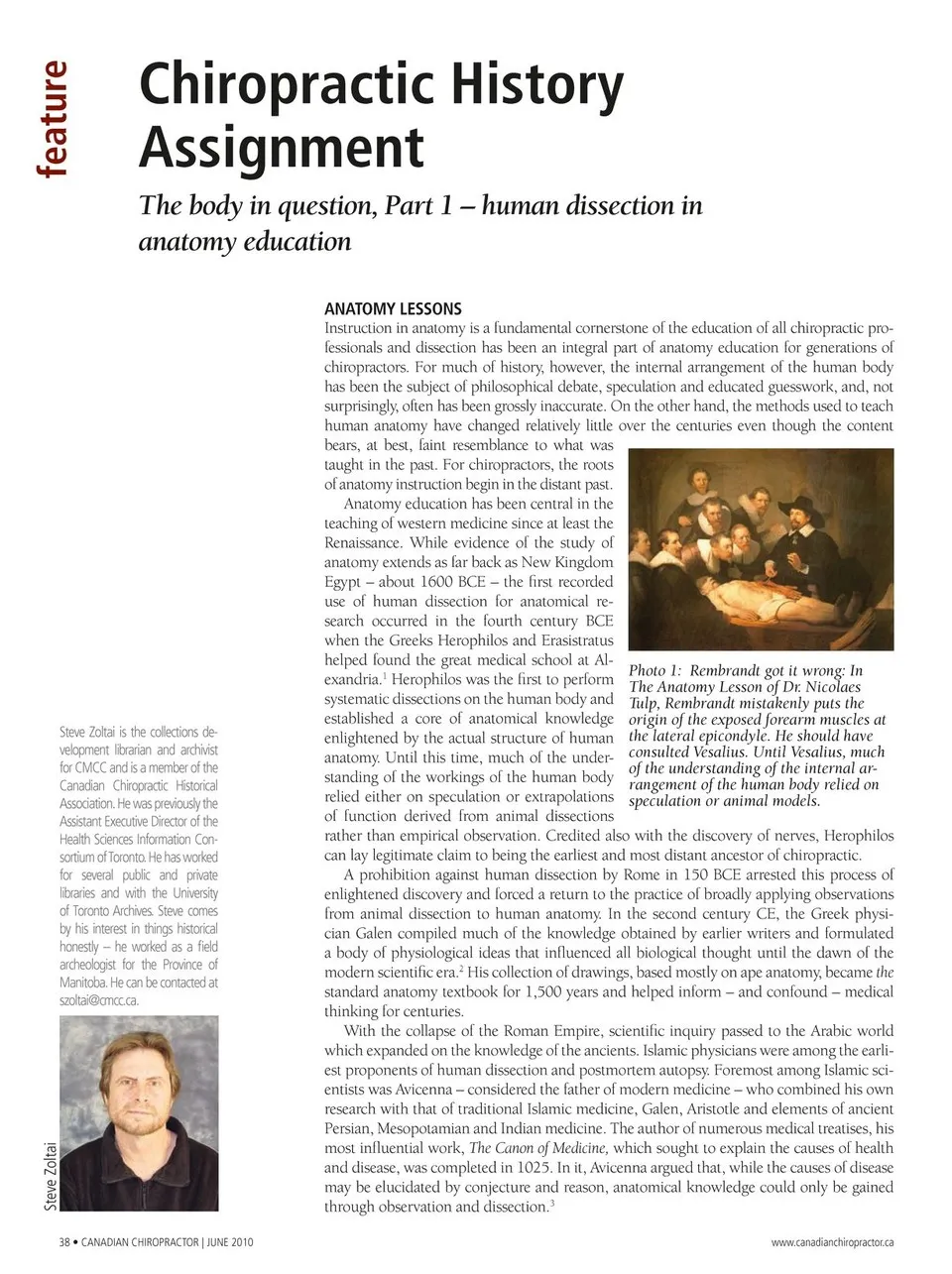
Chiropractic History Assignment The body in question, Part 1 – human dissection in anatomy education ANATOMY LESSONS Steve Zoltai is the collections de- velopment librarian and archivist for CMCC and is a member of the Canadian Chiropractic Historical Association.He was previously the Assistant Executive Director of the Health Sciences Information Con- sortium of Toronto.He has worked for several public and private libraries and with the University of Toronto Archives. Steve comes by his interest in things historical honestly – he worked as a field archeologist for the Province of Manitoba.He can be contacted at [email protected]. Herophilos was the first to perform systematic dissections on the human body and established a core of anatomical knowledge enlightened by the actual structure of human anatomy. Until this time, much of the under- standing of the workings of the human body relied either on speculation or extrapolations of function derived from animal dissections rather than empirical observation. Credited also with the discovery of nerves, Herophilos can lay legitimate claim to being the earliest and most distant ancestor of chiropractic. A prohibition against human dissection by Rome in 150 BCE arrested this process of enlightened discovery and forced a return to the practice of broadly applying observations from animal dissection to human anatomy. In the second century CE, the Greek physi- cian Galen compiled much of the knowledge obtained by earlier writers and formulated a body of physiological ideas that influenced all biological thought until the dawn of the modern scientific era.2 Instruction in anatomy is a fundamental cornerstone of the education of all chiropractic pro- fessionals and dissection has been an integral part of anatomy education for generations of chiropractors. For much of history, however, the internal arrangement of the human body has been the subject of philosophical debate, speculation and educated guesswork, and, not surprisingly, often has been grossly inaccurate. On the other hand, the methods used to teach human anatomy have changed relatively little over the centuries even though the content bears, at best, faint resemblance to what was taught in the past. For chiropractors, the roots of anatomy instruction begin in the distant past. Anatomy education has been central in the teaching of western medicine since at least the Renaissance. While evidence of the study of anatomy extends as far back as New Kingdom Egypt – about 1600 BCE – the first recorded use of human dissection for anatomical re- search occurred in the fourth century BCE when the Greeks Herophilos and Erasistratus helped found the great medical school at Al- exandria.1 Photo 1: Rembrandt got it wrong: In The Anatomy Lesson of Dr. Nicolaes Tulp, Rembrandt mistakenly puts the origin of the exposed forearm muscles at the lateral epicondyle. He should have consulted Vesalius. Until Vesalius, much of the understanding of the internal ar- rangement of the human body relied on speculation or animal models. His collection of drawings, based mostly on ape anatomy, became the standard anatomy textbook for 1,500 years and helped inform – and confound – medical thinking for centuries. With the collapse of the Roman Empire, scientific inquiry passed to the Arabic world which expanded on the knowledge of the ancients. Islamic physicians were among the earli- est proponents of human dissection and postmortem autopsy. Foremost among Islamic sci- entists was Avicenna – considered the father of modern medicine – who combined his own research with that of traditional Islamic medicine, Galen, Aristotle and elements of ancient Persian, Mesopotamian and Indian medicine. The author of numerous medical treatises, his most influential work, The Canon of Medicine, which sought to explain the causes of health and disease, was completed in 1025. In it, Avicenna argued that, while the causes of disease may be elucidated by conjecture and reason, anatomical knowledge could only be gained through observation and dissection.3 38 • CANADIAN CHIROPRACTOR | JUNE 2010 www.canadianchiropractor.ca Steve Zoltai feature
Chiropractic + Naturopathic Doctor June 2010: Page 38