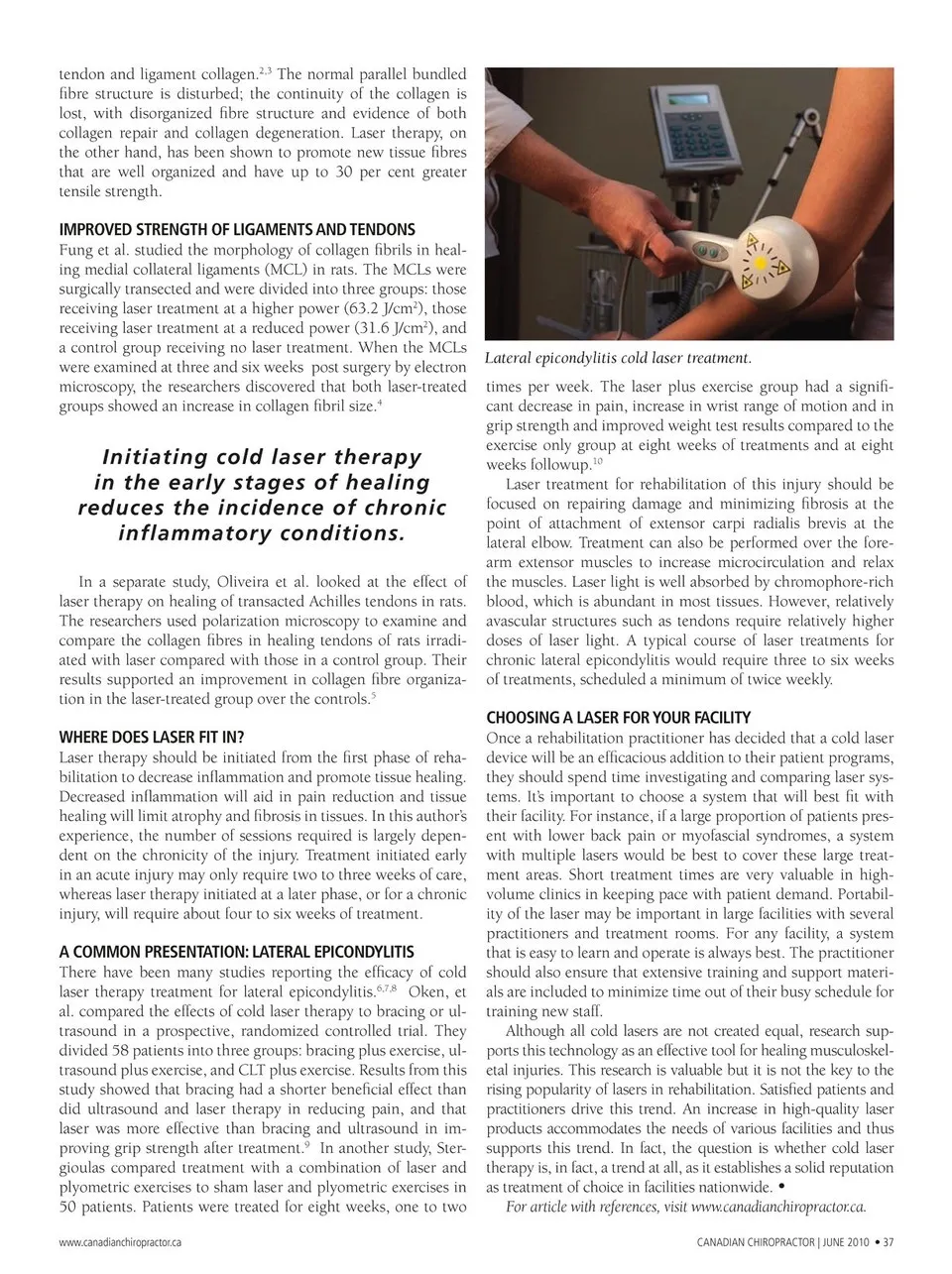
tendon and ligament collagen.2,3 The normal parallel bundled fibre structure is disturbed; the continuity of the collagen is lost, with disorganized fibre structure and evidence of both collagen repair and collagen degeneration. Laser therapy, on the other hand, has been shown to promote new tissue fibres that are well organized and have up to 30 per cent greater tensile strength. IMPROVED STRENGTH OF LIGAMENTS AND TENDONS Fung et al. studied the morphology of collagen fibrils in heal- ing medial collateral ligaments (MCL) in rats. The MCLs were surgically transected and were divided into three groups: those receiving laser treatment at a higher power (63.2 J/cm2 receiving laser treatment at a reduced power (31.6 J/cm2 ), those ), and a control group receiving no laser treatment. When the MCLs were examined at three and six weeks post surgery by electron microscopy, the researchers discovered that both laser-treated groups showed an increase in collagen fibril size.4 Initiating cold laser therapy in the early stages of healing reduces the incidence of chronic inflammatory conditions. In a separate study, Oliveira et al. looked at the effect of laser therapy on healing of transacted Achilles tendons in rats. The researchers used polarization microscopy to examine and compare the collagen fibres in healing tendons of rats irradi- ated with laser compared with those in a control group. Their results supported an improvement in collagen fibre organiza- tion in the laser-treated group over the controls.5 WHERE DOES LASER FIT IN? Laser therapy should be initiated from the first phase of reha- bilitation to decrease inflammation and promote tissue healing. Decreased inflammation will aid in pain reduction and tissue healing will limit atrophy and fibrosis in tissues. In this author’s experience, the number of sessions required is largely depen- dent on the chronicity of the injury. Treatment initiated early in an acute injury may only require two to three weeks of care, whereas laser therapy initiated at a later phase, or for a chronic injury, will require about four to six weeks of treatment. A COMMON PRESENTATION: LATERAL EPICONDYLITIS There have been many studies reporting the efficacy of cold laser therapy treatment for lateral epicondylitis.6,7,8 Oken, et al. compared the effects of cold laser therapy to bracing or ul- trasound in a prospective, randomized controlled trial. They divided 58 patients into three groups: bracing plus exercise, ul- trasound plus exercise, and CLT plus exercise. Results from this study showed that bracing had a shorter beneficial effect than did ultrasound and laser therapy in reducing pain, and that laser was more effective than bracing and ultrasound in im- proving grip strength after treatment.9 In another study, Ster- gioulas compared treatment with a combination of laser and plyometric exercises to sham laser and plyometric exercises in 50 patients. Patients were treated for eight weeks, one to two www.canadianchiropractor.ca Lateral epicondylitis cold laser treatment. times per week. The laser plus exercise group had a signifi- cant decrease in pain, increase in wrist range of motion and in grip strength and improved weight test results compared to the exercise only group at eight weeks of treatments and at eight weeks followup.10 Laser treatment for rehabilitation of this injury should be focused on repairing damage and minimizing fibrosis at the point of attachment of extensor carpi radialis brevis at the lateral elbow. Treatment can also be performed over the fore- arm extensor muscles to increase microcirculation and relax the muscles. Laser light is well absorbed by chromophore-rich blood, which is abundant in most tissues. However, relatively avascular structures such as tendons require relatively higher doses of laser light. A typical course of laser treatments for chronic lateral epicondylitis would require three to six weeks of treatments, scheduled a minimum of twice weekly. CHOOSING A LASER FOR YOUR FACILITY Once a rehabilitation practitioner has decided that a cold laser device will be an efficacious addition to their patient programs, they should spend time investigating and comparing laser sys- tems. It’s important to choose a system that will best fit with their facility. For instance, if a large proportion of patients pres- ent with lower back pain or myofascial syndromes, a system with multiple lasers would be best to cover these large treat- ment areas. Short treatment times are very valuable in high- volume clinics in keeping pace with patient demand. Portabil- ity of the laser may be important in large facilities with several practitioners and treatment rooms. For any facility, a system that is easy to learn and operate is always best. The practitioner should also ensure that extensive training and support materi- als are included to minimize time out of their busy schedule for training new staff. Although all cold lasers are not created equal, research sup- ports this technology as an effective tool for healing musculoskel- etal injuries. This research is valuable but it is not the key to the rising popularity of lasers in rehabilitation. Satisfied patients and practitioners drive this trend. An increase in high-quality laser products accommodates the needs of various facilities and thus supports this trend. In fact, the question is whether cold laser therapy is, in fact, a trend at all, as it establishes a solid reputation as treatment of choice in facilities nationwide. • For article with references, visit www.canadianchiropractor.ca. CANADIAN CHIROPRACTOR | JUNE 2010 • 37
Chiropractic + Naturopathic Doctor June 2010: Page 37