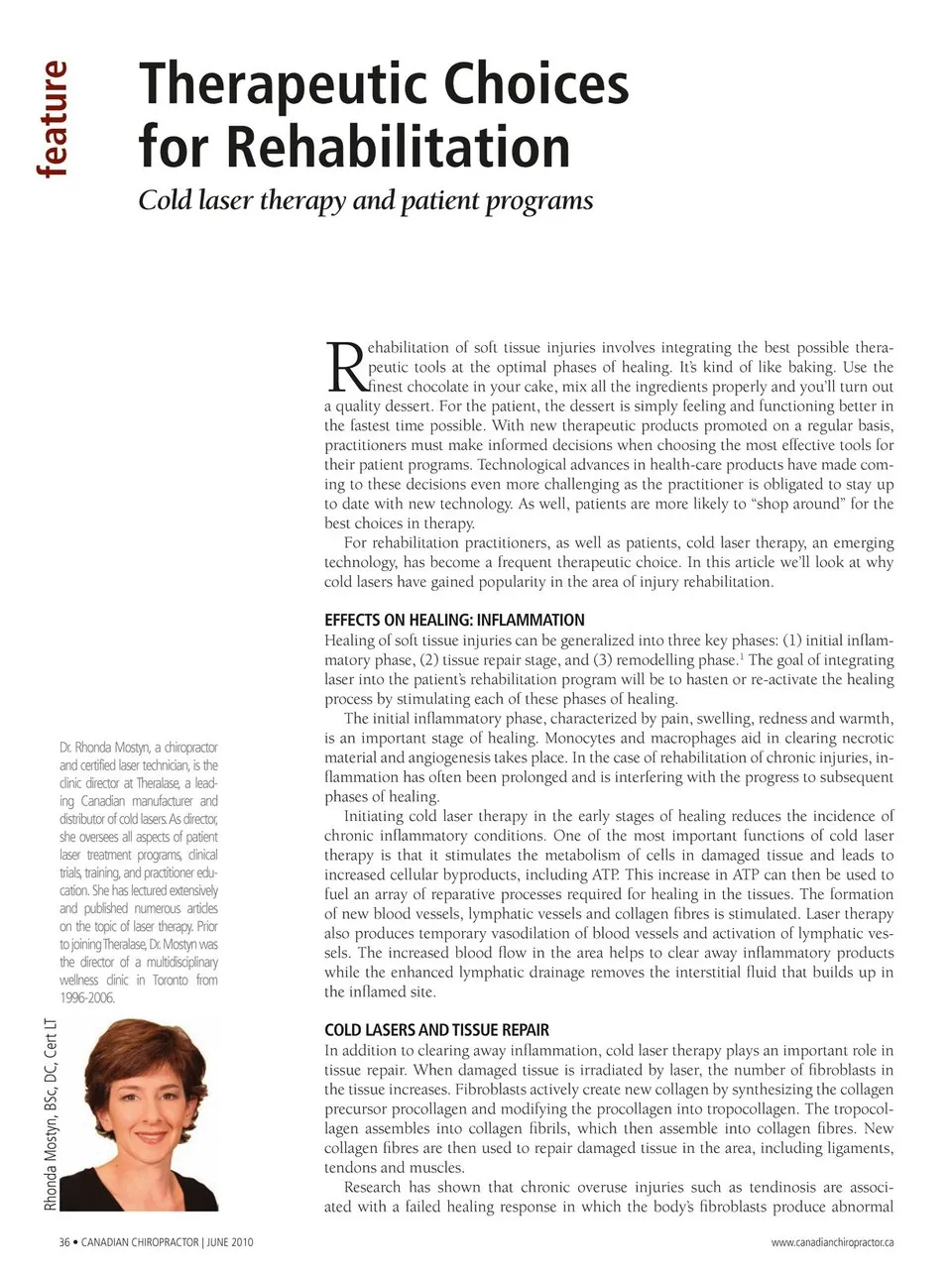
Therapeutic Choices for Rehabilitation Cold laser therapy and patient programs ehabilitation of soft tissue injuries involves integrating the best possible thera- peutic tools at the optimal phases of healing. It’s kind of like baking. Use the finest chocolate in your cake, mix all the ingredients properly and you’ll turn out a quality dessert. For the patient, the dessert is simply feeling and functioning better in the fastest time possible. With new therapeutic products promoted on a regular basis, practitioners must make informed decisions when choosing the most effective tools for their patient programs. Technological advances in health-care products have made com- ing to these decisions even more challenging as the practitioner is obligated to stay up to date with new technology. As well, patients are more likely to “shop around” for the best choices in therapy. For rehabilitation practitioners, as well as patients, cold laser therapy, an emerging technology, has become a frequent therapeutic choice. In this article we’ll look at why cold lasers have gained popularity in the area of injury rehabilitation. R EFFECTS ON HEALING:INFLAMMATION Healing of soft tissue injuries can be generalized into three key phases: (1) initial inflam- matory phase, (2) tissue repair stage, and (3) remodelling phase.1 The goal of integrating Dr. Rhonda Mostyn, a chiropractor and certified laser technician, is the clinic director at Theralase, a lead- ing Canadian manufacturer and distributor of cold lasers. As director, she oversees all aspects of patient laser treatment programs, clinical trials, training,and practitioner edu- cation. She has lectured extensively and published numerous articles on the topic of laser therapy. Prior to joining Theralase,Dr.Mostyn was the director of a multidisciplinary wellness clinic in Toronto from 1996-2006. laser into the patient’s rehabilitation program will be to hasten or re-activate the healing process by stimulating each of these phases of healing. The initial inflammatory phase, characterized by pain, swelling, redness and warmth, is an important stage of healing. Monocytes and macrophages aid in clearing necrotic material and angiogenesis takes place. In the case of rehabilitation of chronic injuries, in- flammation has often been prolonged and is interfering with the progress to subsequent phases of healing. Initiating cold laser therapy in the early stages of healing reduces the incidence of chronic inflammatory conditions. One of the most important functions of cold laser therapy is that it stimulates the metabolism of cells in damaged tissue and leads to increased cellular byproducts, including ATP. This increase in ATP can then be used to fuel an array of reparative processes required for healing in the tissues. The formation of new blood vessels, lymphatic vessels and collagen fibres is stimulated. Laser therapy also produces temporary vasodilation of blood vessels and activation of lymphatic ves- sels. The increased blood flow in the area helps to clear away inflammatory products while the enhanced lymphatic drainage removes the interstitial fluid that builds up in the inflamed site. COLD LASERS AND TISSUE REPAIR In addition to clearing away inflammation, cold laser therapy plays an important role in tissue repair. When damaged tissue is irradiated by laser, the number of fibroblasts in the tissue increases. Fibroblasts actively create new collagen by synthesizing the collagen precursor procollagen and modifying the procollagen into tropocollagen. The tropocol- lagen assembles into collagen fibrils, which then assemble into collagen fibres. New collagen fibres are then used to repair damaged tissue in the area, including ligaments, tendons and muscles. Research has shown that chronic overuse injuries such as tendinosis are associ- ated with a failed healing response in which the body’s fibroblasts produce abnormal 36 • CANADIAN CHIROPRACTOR | JUNE 2010 www.canadianchiropractor.ca Rhonda Mostyn, BSc, DC, Cert LT feature
Chiropractic + Naturopathic Doctor June 2010: Page 36