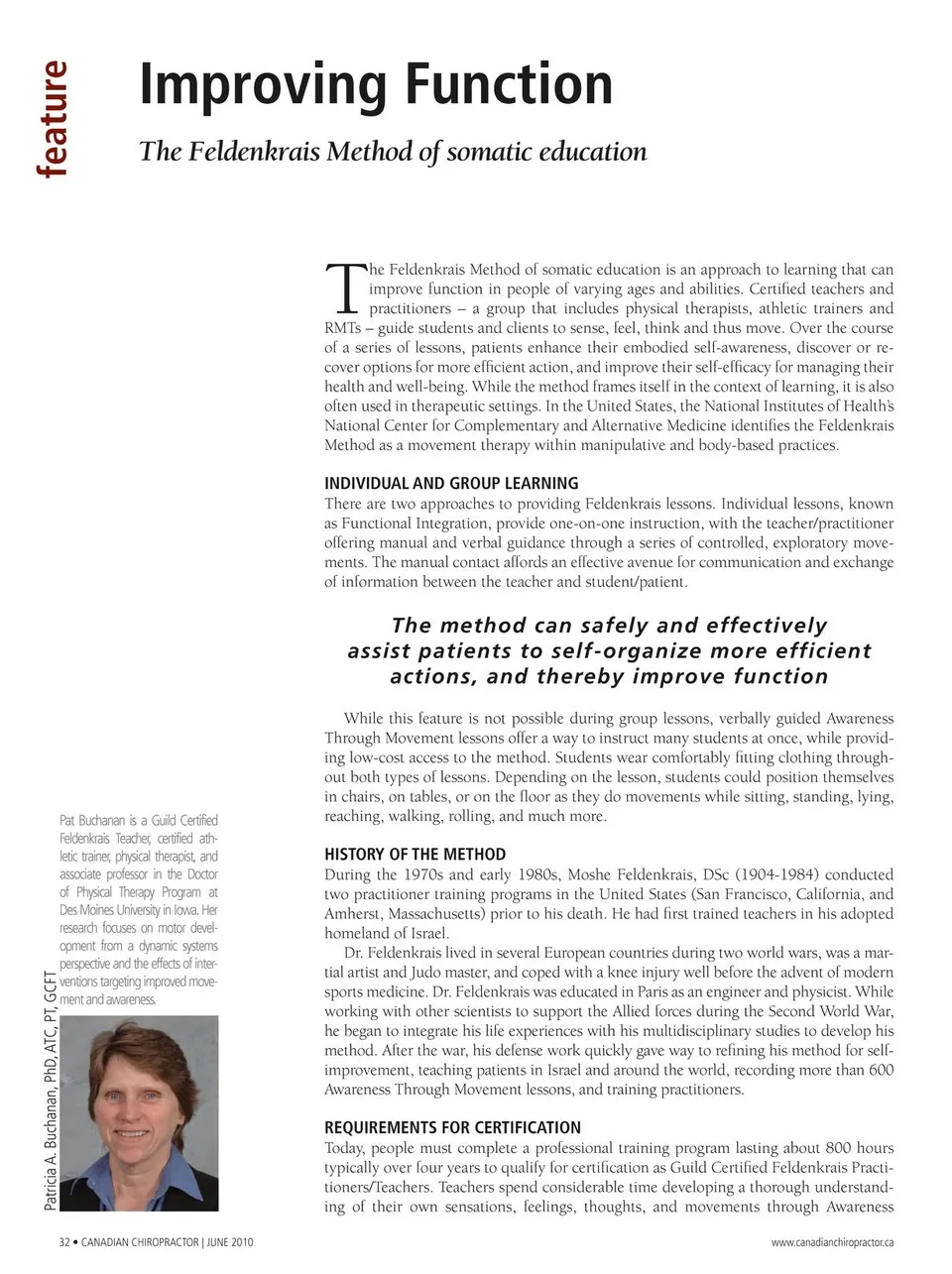
Improving Function The Feldenkrais Method of somatic education T he Feldenkrais Method of somatic education is an approach to learning that can improve function in people of varying ages and abilities. Certified teachers and practitioners – a group that includes physical therapists, athletic trainers and RMTs – guide students and clients to sense, feel, think and thus move. Over the course of a series of lessons, patients enhance their embodied self-awareness, discover or re- cover options for more efficient action, and improve their self-efficacy for managing their health and well-being. While the method frames itself in the context of learning, it is also often used in therapeutic settings. In the United States, the National Institutes of Health’s National Center for Complementary and Alternative Medicine identifies the Feldenkrais Method as a movement therapy within manipulative and body-based practices. INDIVIDUAL AND GROUP LEARNING There are two approaches to providing Feldenkrais lessons. Individual lessons, known as Functional Integration, provide one-on-one instruction, with the teacher/practitioner offering manual and verbal guidance through a series of controlled, exploratory move- ments. The manual contact affords an effective avenue for communication and exchange of information between the teacher and student/patient. The method can safely and effectively assist patients to self-organize more efficient actions, and thereby improve function While this feature is not possible during group lessons, verbally guided Awareness Pat Buchanan is a Guild Certified Feldenkrais Teacher, certified ath- letic trainer, physical therapist, and associate professor in the Doctor of Physical Therapy Program at Des Moines University in Iowa. Her research focuses on motor devel- opment from a dynamic systems perspective and the effects of inter- ventions targeting improved move- ment and awareness. Through Movement lessons offer a way to instruct many students at once, while provid- ing low-cost access to the method. Students wear comfortably fitting clothing through- out both types of lessons. Depending on the lesson, students could position themselves in chairs, on tables, or on the floor as they do movements while sitting, standing, lying, reaching, walking, rolling, and much more. HISTORY OF THE METHOD During the 1970s and early 1980s, Moshe Feldenkrais, DSc (1904-1984) conducted two practitioner training programs in the United States (San Francisco, California, and Amherst, Massachusetts) prior to his death. He had first trained teachers in his adopted homeland of Israel. Dr. Feldenkrais lived in several European countries during two world wars, was a mar- tial artist and Judo master, and coped with a knee injury well before the advent of modern sports medicine. Dr. Feldenkrais was educated in Paris as an engineer and physicist. While working with other scientists to support the Allied forces during the Second World War, he began to integrate his life experiences with his multidisciplinary studies to develop his method. After the war, his defense work quickly gave way to refining his method for self- improvement, teaching patients in Israel and around the world, recording more than 600 Awareness Through Movement lessons, and training practitioners. REQUIREMENTS FOR CERTIFICATION Today, people must complete a professional training program lasting about 800 hours typically over four years to qualify for certification as Guild Certified Feldenkrais Practi- tioners/Teachers. Teachers spend considerable time developing a thorough understand- ing of their own sensations, feelings, thoughts, and movements through Awareness 32 • CANADIAN CHIROPRACTOR | JUNE 2010 www.canadianchiropractor.ca Patricia A. Buchanan, PhD, ATC, PT, GCFT feature
Chiropractic + Naturopathic Doctor June 2010: Page 32