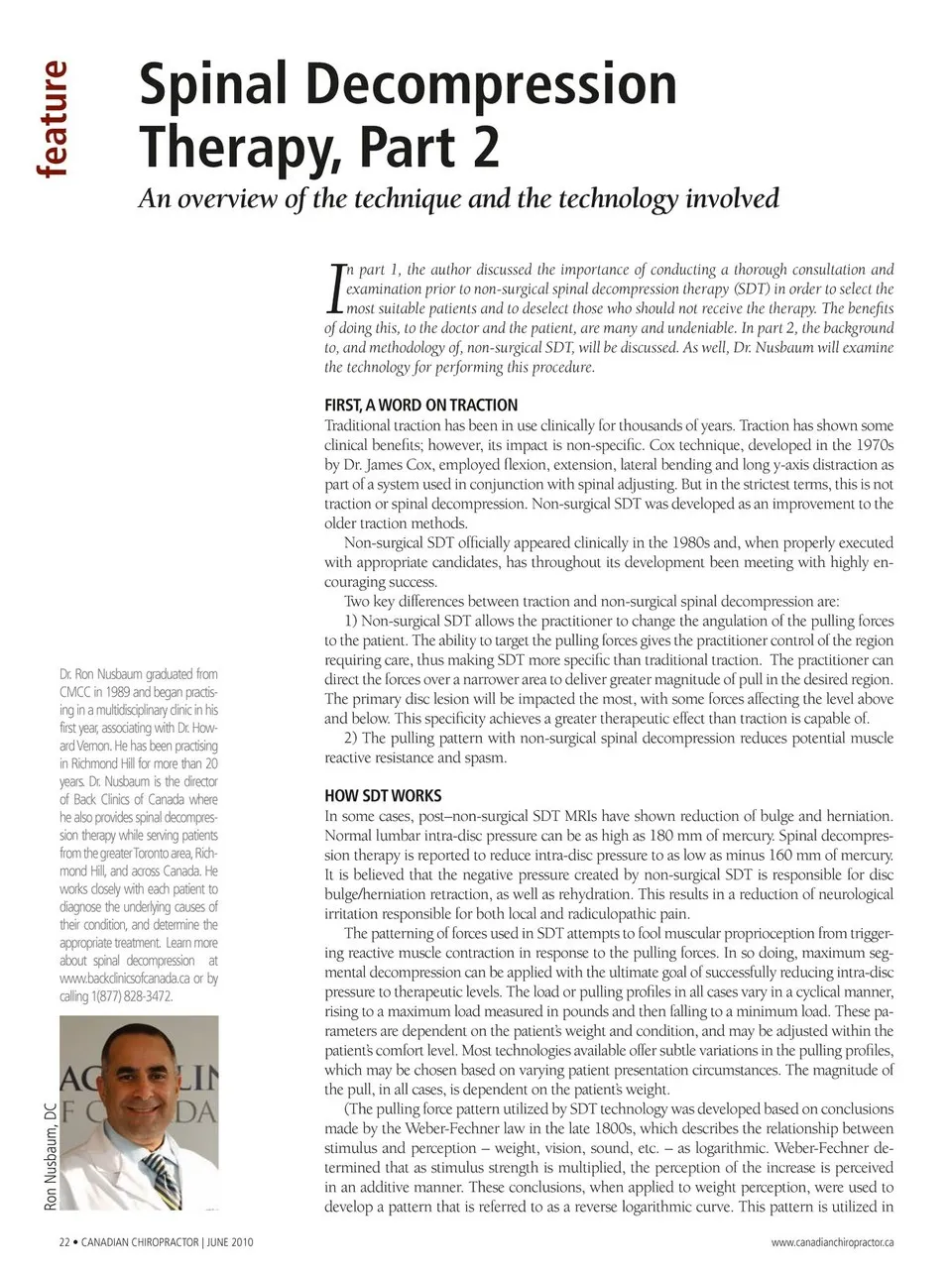
Spinal Decompression Therapy, Part 2 An overview of the technique and the technology involved I n part 1, the author discussed the importance of conducting a thorough consultation and examination prior to non-surgical spinal decompression therapy (SDT) in order to select the most suitable patients and to deselect those who should not receive the therapy. The benefits of doing this, to the doctor and the patient, are many and undeniable. In part 2, the background to, and methodology of, non-surgical SDT, will be discussed. As well, Dr. Nusbaum will examine the technology for performing this procedure. FIRST,A WORD ON TRACTION Traditional traction has been in use clinically for thousands of years. Traction has shown some clinical benefits; however, its impact is non-specific. Cox technique, developed in the 1970s by Dr. James Cox, employed flexion, extension, lateral bending and long y-axis distraction as part of a system used in conjunction with spinal adjusting. But in the strictest terms, this is not traction or spinal decompression. Non-surgical SDT was developed as an improvement to the older traction methods. Non-surgical SDT officially appeared clinically in the 1980s and, when properly executed Dr. Ron Nusbaum graduated from CMCC in 1989 and began practis- ing in a multidisciplinary clinic in his first year, associating with Dr.How- ard Vernon.He has been practising in Richmond Hill for more than 20 years. Dr. Nusbaum is the director of Back Clinics of Canada where he also provides spinal decompres- sion therapy while serving patients from the greater Toronto area,Rich- mond Hill, and across Canada. He works closely with each patient to diagnose the underlying causes of their condition, and determine the appropriate treatment. Learn more about spinal decompression at www.backclinicsofcanada.ca or by calling 1(877) 828-3472. with appropriate candidates, has throughout its development been meeting with highly en- couraging success. Two key differences between traction and non-surgical spinal decompression are: 1) Non-surgical SDT allows the practitioner to change the angulation of the pulling forces to the patient. The ability to target the pulling forces gives the practitioner control of the region requiring care, thus making SDT more specific than traditional traction. The practitioner can direct the forces over a narrower area to deliver greater magnitude of pull in the desired region. The primary disc lesion will be impacted the most, with some forces affecting the level above and below. This specificity achieves a greater therapeutic effect than traction is capable of. 2) The pulling pattern with non-surgical spinal decompression reduces potential muscle reactive resistance and spasm. HOW SDT WORKS In some cases, post–non-surgical SDT MRIs have shown reduction of bulge and herniation. Normal lumbar intra-disc pressure can be as high as 180 mm of mercury. Spinal decompres- sion therapy is reported to reduce intra-disc pressure to as low as minus 160 mm of mercury. It is believed that the negative pressure created by non-surgical SDT is responsible for disc bulge/herniation retraction, as well as rehydration. This results in a reduction of neurological irritation responsible for both local and radiculopathic pain. The patterning of forces used in SDT attempts to fool muscular proprioception from trigger- ing reactive muscle contraction in response to the pulling forces. In so doing, maximum seg- mental decompression can be applied with the ultimate goal of successfully reducing intra-disc pressure to therapeutic levels. The load or pulling profiles in all cases vary in a cyclical manner, rising to a maximum load measured in pounds and then falling to a minimum load. These pa- rameters are dependent on the patient’s weight and condition, and may be adjusted within the patient’s comfort level. Most technologies available offer subtle variations in the pulling profiles, which may be chosen based on varying patient presentation circumstances. The magnitude of the pull, in all cases, is dependent on the patient’s weight. (The pulling force pattern utilized by SDT technology was developed based on conclusions made by the Weber-Fechner law in the late 1800s, which describes the relationship between stimulus and perception – weight, vision, sound, etc. – as logarithmic. Weber-Fechner de- termined that as stimulus strength is multiplied, the perception of the increase is perceived in an additive manner. These conclusions, when applied to weight perception, were used to develop a pattern that is referred to as a reverse logarithmic curve. This pattern is utilized in 22 • CANADIAN CHIROPRACTOR | JUNE 2010 www.canadianchiropractor.ca Ron Nusbaum, DC feature
Chiropractic + Naturopathic Doctor June 2010: Page 21