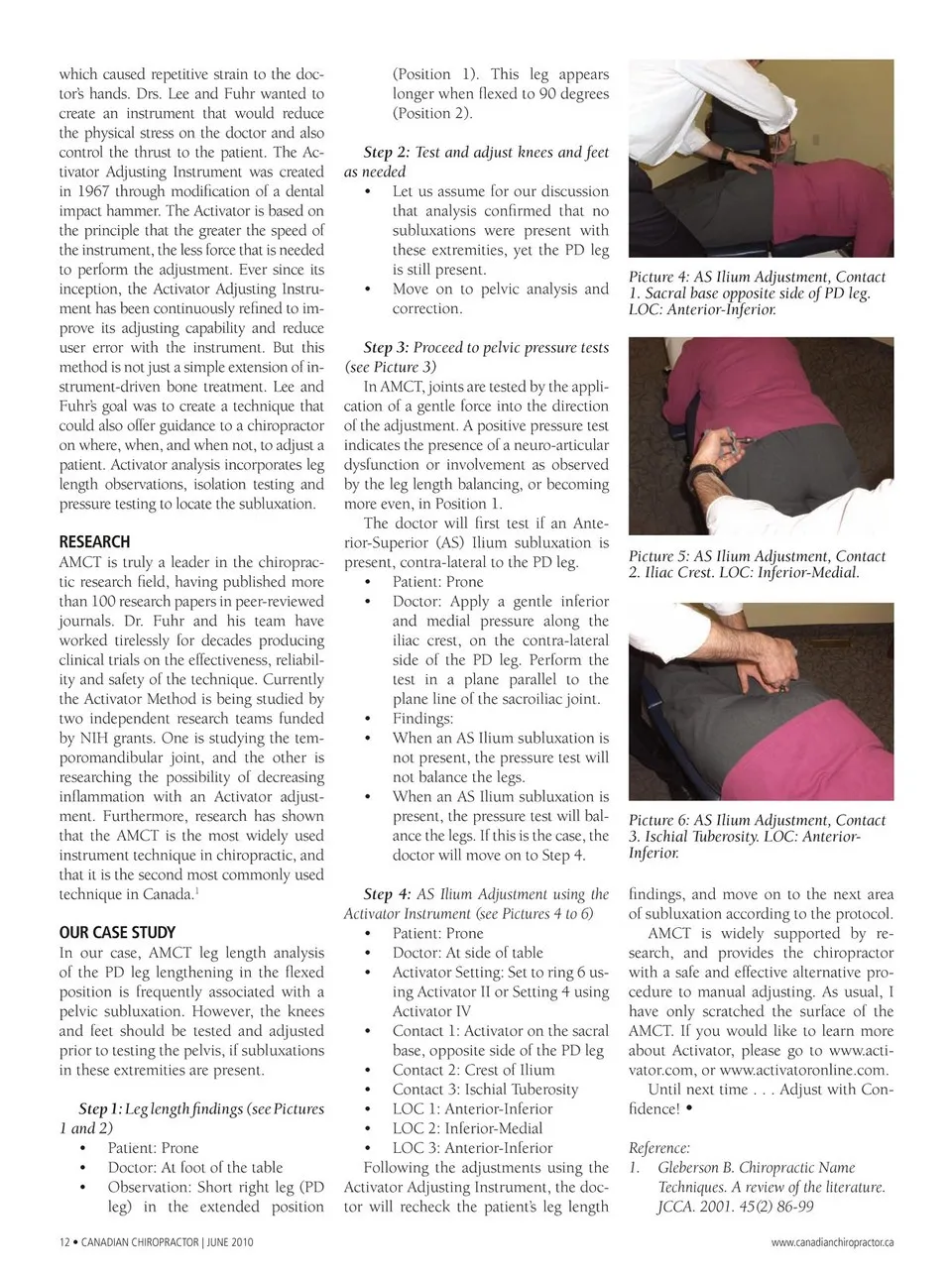
which caused repetitive strain to the doc- tor’s hands. Drs. Lee and Fuhr wanted to create an instrument that would reduce the physical stress on the doctor and also control the thrust to the patient. The Ac- tivator Adjusting Instrument was created in 1967 through modification of a dental impact hammer. The Activator is based on the principle that the greater the speed of the instrument, the less force that is needed to perform the adjustment. Ever since its inception, the Activator Adjusting Instru- ment has been continuously refined to im- prove its adjusting capability and reduce user error with the instrument. But this method is not just a simple extension of in- strument-driven bone treatment. Lee and Fuhr’s goal was to create a technique that could also offer guidance to a chiropractor on where, when, and when not, to adjust a patient. Activator analysis incorporates leg length observations, isolation testing and pressure testing to locate the subluxation. RESEARCH AMCT is truly a leader in the chiroprac- tic research field, having published more than 100 research papers in peer-reviewed journals. Dr. Fuhr and his team have worked tirelessly for decades producing clinical trials on the effectiveness, reliabil- ity and safety of the technique. Currently the Activator Method is being studied by two independent research teams funded by NIH grants. One is studying the tem- poromandibular joint, and the other is researching the possibility of decreasing inflammation with an Activator adjust- ment. Furthermore, research has shown that the AMCT is the most widely used instrument technique in chiropractic, and that it is the second most commonly used technique in Canada.1 OUR CASE STUDY In our case, AMCT leg length analysis of the PD leg lengthening in the flexed position is frequently associated with a pelvic subluxation. However, the knees and feet should be tested and adjusted prior to testing the pelvis, if subluxations in these extremities are present. Step 1: Leg length findings (see Pictures 1 and 2) • Patient: Prone • Doctor: At foot of the table • Observation: Short right leg (PD leg) in the extended position 12 • CANADIAN CHIROPRACTOR | JUNE 2010 (Position 1). This leg appears longer when flexed to 90 degrees (Position 2). Step 2: Test and adjust knees and feet as needed • Let us assume for our discussion that analysis confirmed that no subluxations were present with these extremities, yet the PD leg is still present. • Move on to pelvic analysis and correction. Step 3: Proceed to pelvic pressure tests (see Picture 3) In AMCT, joints are tested by the appli- cation of a gentle force into the direction of the adjustment. A positive pressure test indicates the presence of a neuro-articular dysfunction or involvement as observed by the leg length balancing, or becoming more even, in Position 1. The doctor will first test if an Ante- rior-Superior (AS) Ilium subluxation is present, contra-lateral to the PD leg. • Patient: Prone • Doctor: Apply a gentle inferior and medial pressure along the iliac crest, on the contra-lateral side of the PD leg. Perform the test in a plane parallel to the plane line of the sacroiliac joint. • Findings: • When an AS Ilium subluxation is not present, the pressure test will not balance the legs. • When an AS Ilium subluxation is present, the pressure test will bal- ance the legs. If this is the case, the doctor will move on to Step 4. Step 4: AS Ilium Adjustment using the Activator Instrument (see Pictures 4 to 6) • Patient: Prone • Doctor: At side of table • Activator Setting: Set to ring 6 us- ing Activator II or Setting 4 using Activator IV • Contact 1: Activator on the sacral base, opposite side of the PD leg • Contact 2: Crest of Ilium • Contact 3: Ischial Tuberosity • LOC 1: Anterior-Inferior • LOC 2: Inferior-Medial • LOC 3: Anterior-Inferior Following the adjustments using the Activator Adjusting Instrument, the doc- tor will recheck the patient’s leg length Picture 6: AS Ilium Adjustment, Contact 3. Ischial Tuberosity. LOC: Anterior- Inferior. findings, and move on to the next area of subluxation according to the protocol. AMCT is widely supported by re- search, and provides the chiropractor with a safe and effective alternative pro- cedure to manual adjusting. As usual, I have only scratched the surface of the AMCT. If you would like to learn more about Activator, please go to www.acti- vator.com, or www.activatoronline.com. Until next time . . . Adjust with Con- fidence! • Reference: 1. Gleberson B. Chiropractic Name Techniques. A review of the literature. JCCA. 2001. 45(2) 86-99 www.canadianchiropractor.ca Picture 5: AS Ilium Adjustment, Contact 2. Iliac Crest. LOC: Inferior-Medial. Picture 4: AS Ilium Adjustment, Contact 1. Sacral base opposite side of PD leg. LOC: Anterior-Inferior.
Chiropractic + Naturopathic Doctor June 2010: Page 12