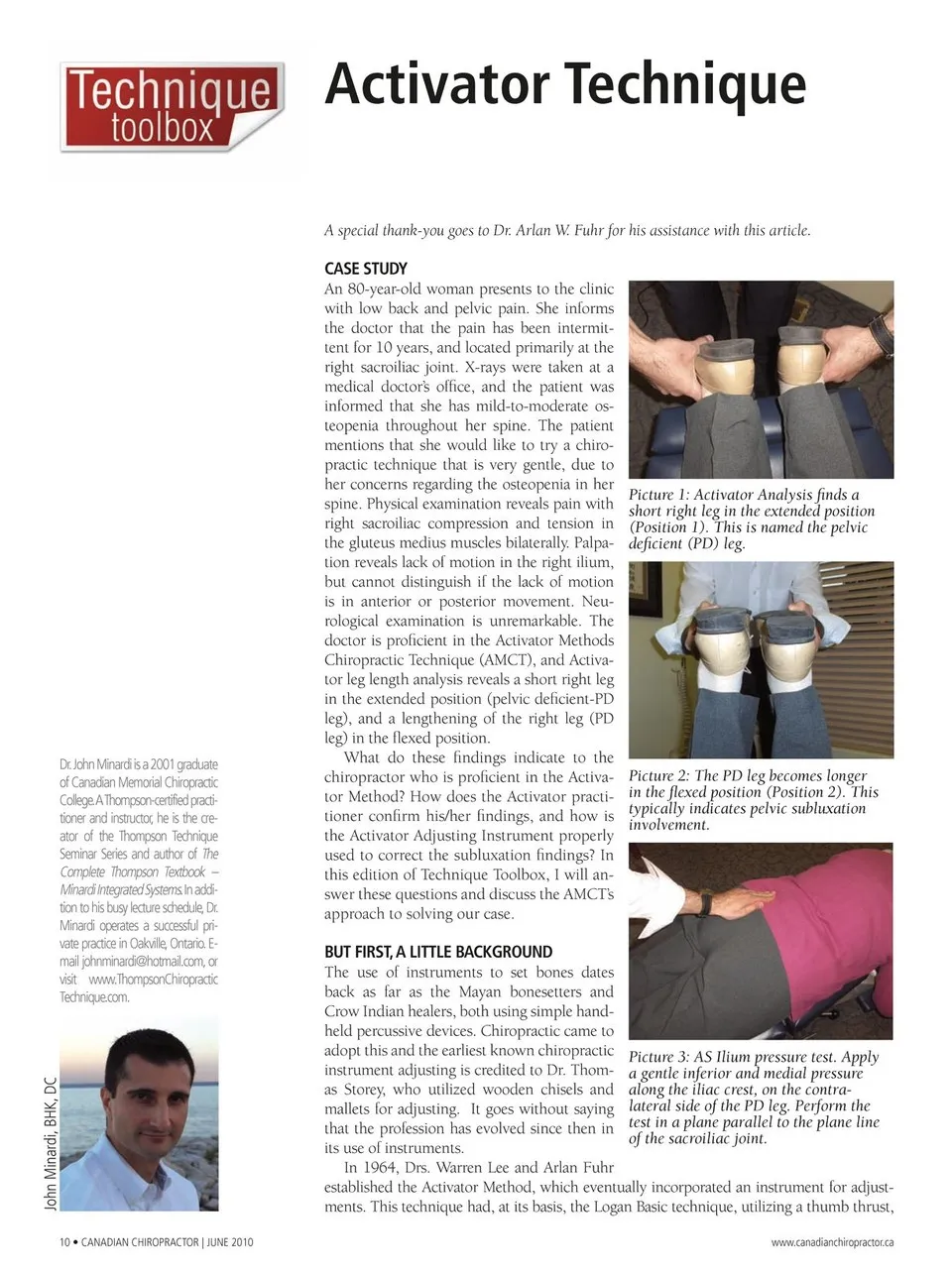
Activator Technique A special thank-you goes to Dr. Arlan W. Fuhr for his assistance with this article. CASE STUDY An 80-year-old woman presents to the clinic with low back and pelvic pain. She informs the doctor that the pain has been intermit- tent for 10 years, and located primarily at the right sacroiliac joint. X-rays were taken at a medical doctor’s office, and the patient was informed that she has mild-to-moderate os- teopenia throughout her spine. The patient mentions that she would like to try a chiro- practic technique that is very gentle, due to her concerns regarding the osteopenia in her spine. Physical examination reveals pain with right sacroiliac compression and tension in the gluteus medius muscles bilaterally. Palpa- tion reveals lack of motion in the right ilium, but cannot distinguish if the lack of motion is in anterior or posterior movement. Neu- rological examination is unremarkable. The doctor is proficient in the Activator Methods Chiropractic Technique (AMCT), and Activa- tor leg length analysis reveals a short right leg in the extended position (pelvic deficient-PD leg), and a lengthening of the right leg (PD leg) in the flexed position. Dr.John Minardi is a 2001 graduate of Canadian Memorial Chiropractic College.A Thompson-certified practi- tioner and instructor, he is the cre- ator of the Thompson Technique Seminar Series and author of The Complete Thompson Textbook – Minardi Integrated Systems. In addi- tion to his busy lecture schedule,Dr. Minardi operates a successful pri- vate practice in Oakville, Ontario. E- mail [email protected], or visit www.ThompsonChiropractic Technique.com. What do these findings indicate to the chiropractor who is proficient in the Activa- tor Method? How does the Activator practi- tioner confirm his/her findings, and how is the Activator Adjusting Instrument properly used to correct the subluxation findings? In this edition of Technique Toolbox, I will an- swer these questions and discuss the AMCT’s approach to solving our case. BUT FIRST, A LITTLE BACKGROUND The use of instruments to set bones dates back as far as the Mayan bonesetters and Crow Indian healers, both using simple hand- held percussive devices. Chiropractic came to adopt this and the earliest known chiropractic instrument adjusting is credited to Dr. Thom- as Storey, who utilized wooden chisels and mallets for adjusting. It goes without saying that the profession has evolved since then in its use of instruments. In 1964, Drs. Warren Lee and Arlan Fuhr 10 • CANADIAN CHIROPRACTOR | JUNE 2010 Picture 2: The PD leg becomes longer in the flexed position (Position 2). This typically indicates pelvic subluxation involvement. Picture 1: Activator Analysis finds a short right leg in the extended position (Position 1). This is named the pelvic deficient (PD) leg. Picture 3: AS Ilium pressure test. Apply a gentle inferior and medial pressure along the iliac crest, on the contra- lateral side of the PD leg. Perform the test in a plane parallel to the plane line of the sacroiliac joint. established the Activator Method, which eventually incorporated an instrument for adjust- ments. This technique had, at its basis, the Logan Basic technique, utilizing a thumb thrust, www.canadianchiropractor.ca John Minardi, BHK, DC
Chiropractic + Naturopathic Doctor June 2010: Page 10