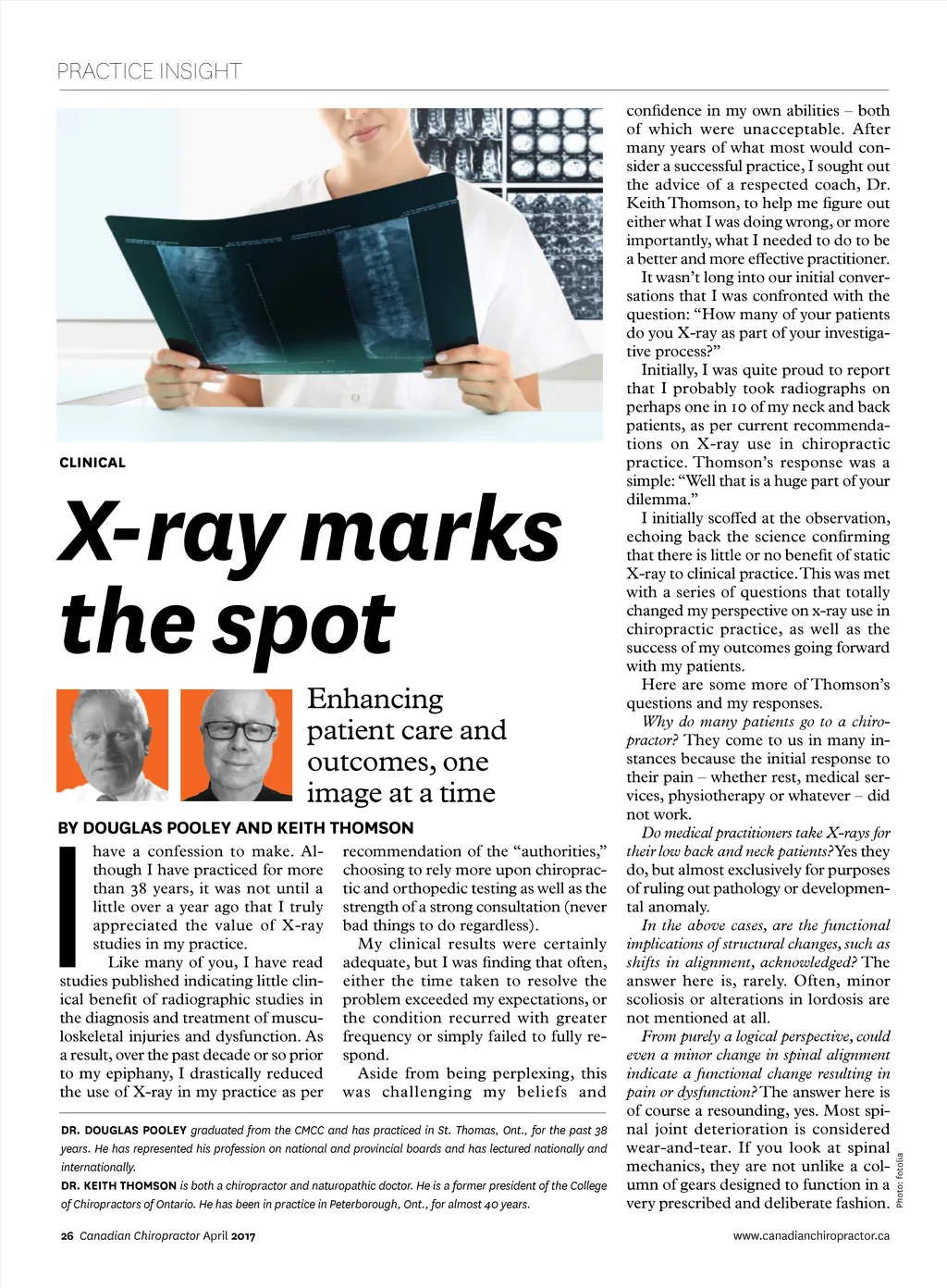
PRACTICE INSIGHT confidence in my own abilities – both of which were unacceptable. After many years of what most would con-sider a successful practice, I sought out the advice of a respected coach, Dr. Keith Thomson, to help me figure out either what I was doing wrong, or more importantly, what I needed to do to be a better and more effective practitioner. It wasn’t long into our initial conver-sations that I was confronted with the question: “How many of your patients do you X-ray as part of your investiga-tive process?” Initially, I was quite proud to report that I probably took radiographs on perhaps one in 10 of my neck and back patients, as per current recommenda-tions on X-ray use in chiropractic practice. Thomson’s response was a simple: “Well that is a huge part of your dilemma.” I initially scoffed at the observation, echoing back the science confirming that there is little or no benefit of static X-ray to clinical practice. This was met with a series of questions that totally changed my perspective on x-ray use in chiropractic practice, as well as the success of my outcomes going forward with my patients. Here are some more of Thomson’s questions and my responses. Why do many patients go to a chiro-practor? They come to us in many in-stances because the initial response to their pain – whether rest, medical ser-vices, physiotherapy or whatever – did not work. Do medical practitioners take X-rays for their low back and neck patients? Yes they do, but almost exclusively for purposes of ruling out pathology or developmen-tal anomaly. In the above cases, are the functional implications of structural changes, such as shifts in alignment, acknowledged? The answer here is, rarely. Often, minor scoliosis or alterations in lordosis are not mentioned at all. From purely a logical perspective, could even a minor change in spinal alignment indicate a functional change resulting in pain or dysfunction? The answer here is of course a resounding, yes. Most spi-nal joint deterioration is considered wear-and-tear. If you look at spinal mechanics, they are not unlike a col-umn of gears designed to function in a very prescribed and deliberate fashion. www.canadianchiropractor.ca CLINICAL X-ray marks the spot I Enhancing patient care and outcomes, one image at a time recommendation of the “authorities,” choosing to rely more upon chiroprac-tic and orthopedic testing as well as the strength of a strong consultation (never bad things to do regardless). My clinical results were certainly adequate, but I was finding that often, either the time taken to resolve the problem exceeded my expectations, or the condition recurred with greater frequency or simply failed to fully re-spond. Aside from being perplexing, this was challenging my beliefs and BY DOUGLAS POOLEY AND KEITH THOMSON have a confession to make. Al-though I have practiced for more than 38 years, it was not until a little over a year ago that I truly appreciated the value of X-ray studies in my practice. Like many of you, I have read studies published indicating little clin-ical benefit of radiographic studies in the diagnosis and treatment of muscu-loskeletal injuries and dysfunction. As a result, over the past decade or so prior to my epiphany, I drastically reduced the use of X-ray in my practice as per DR. DOUGLAS POOLEY graduated from the CMCC and has practiced in St. Thomas, Ont., for the past 38 years. He has represented his profession on national and provincial boards and has lectured nationally and internationally. DR. KEITH THOMSON is both a chiropractor and naturopathic doctor. He is a former president of the College of Chiropractors of Ontario. He has been in practice in Peterborough, Ont., for almost 40 years. 26 Canadian Chiropractor April 2017 Photo: fotolia
Chiropractic + Naturopathic Doctor April 2017: Page 26