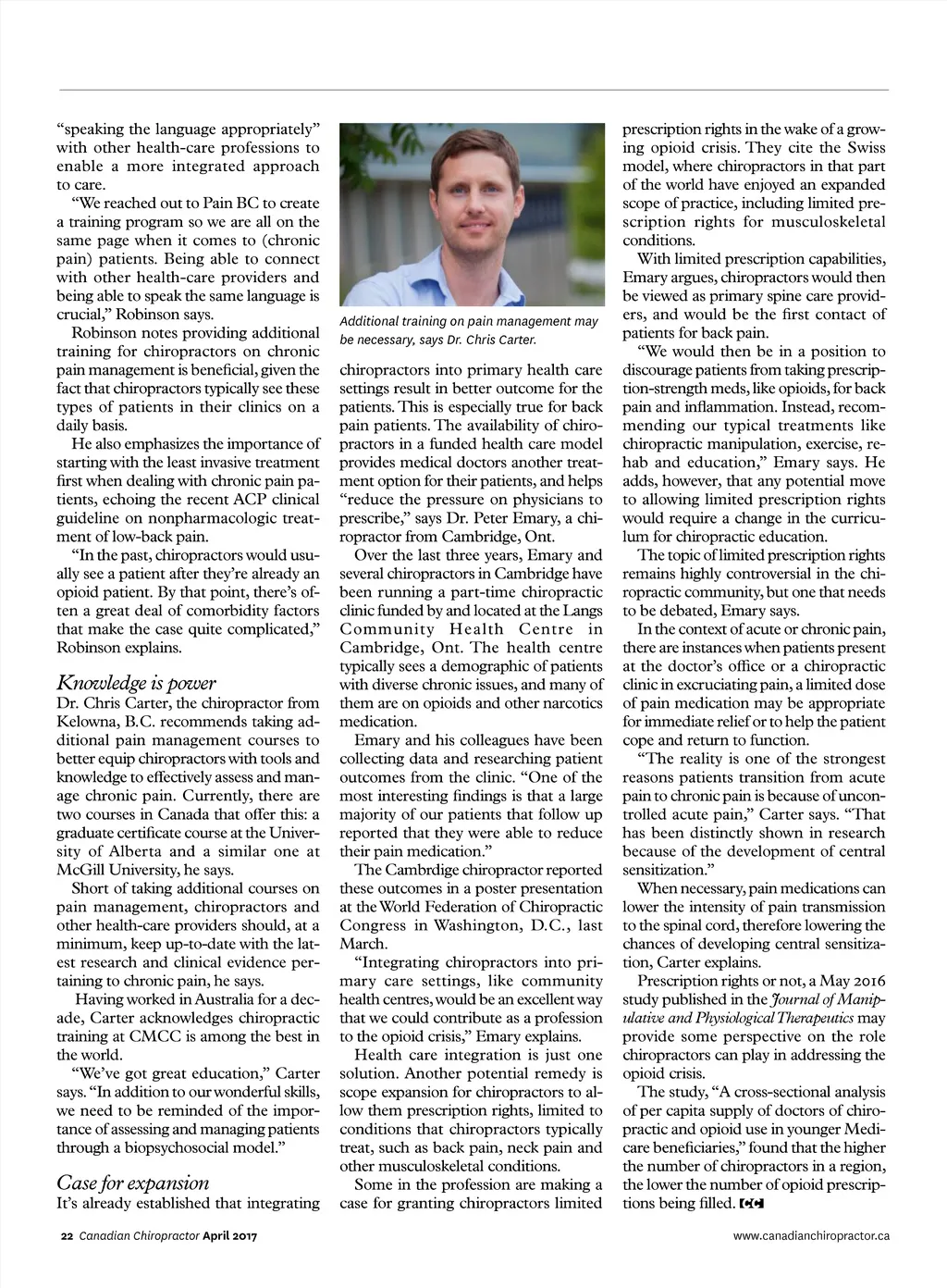
“speaking the language appropriately” with other health-care professions to enable a more integrated approach to care. “We reached out to Pain BC to create a training program so we are all on the same page when it comes to (chronic pain) patients. Being able to connect with other health-care providers and being able to speak the same language is crucial,” Robinson says. Robinson notes providing additional training for chiropractors on chronic pain management is beneficial, given the fact that chiropractors typically see these types of patients in their clinics on a daily basis. He also emphasizes the importance of starting with the least invasive treatment first when dealing with chronic pain pa-tients, echoing the recent ACP clinical guideline on nonpharmacologic treat-ment of low-back pain. “In the past, chiropractors would usu-ally see a patient after they’re already an opioid patient. By that point, there’s of-ten a great deal of comorbidity factors that make the case quite complicated,” Robinson explains. Dr. Chris Carter, the chiropractor from Kelowna, B.C. recommends taking ad-ditional pain management courses to better equip chiropractors with tools and knowledge to effectively assess and man-age chronic pain. Currently, there are two courses in Canada that offer this: a graduate certificate course at the Univer-sity of Alberta and a similar one at McGill University, he says. Short of taking additional courses on pain management, chiropractors and other health-care providers should, at a minimum, keep up-to-date with the lat-est research and clinical evidence per-taining to chronic pain, he says. Having worked in Australia for a dec-ade, Carter acknowledges chiropractic training at CMCC is among the best in the world. “We’ve got great education,” Carter says. “In addition to our wonderful skills, we need to be reminded of the impor-tance of assessing and managing patients through a biopsychosocial model.” Additional training on pain management may be necessary, says Dr. Chris Carter. Knowledge is power Case for expansion It’s already established that integrating 22 Canadian Chiropractor April 2017 chiropractors into primary health care settings result in better outcome for the patients. This is especially true for back pain patients. The availability of chiro-practors in a funded health care model provides medical doctors another treat-ment option for their patients, and helps “reduce the pressure on physicians to prescribe,” says Dr. Peter Emary, a chi-ropractor from Cambridge, Ont. Over the last three years, Emary and several chiropractors in Cambridge have been running a part-time chiropractic clinic funded by and located at the Langs Community Health Centre in Cambridge, Ont. The health centre typically sees a demographic of patients with diverse chronic issues, and many of them are on opioids and other narcotics medication. Emary and his colleagues have been collecting data and researching patient outcomes from the clinic. “One of the most interesting findings is that a large majority of our patients that follow up reported that they were able to reduce their pain medication.” The Cambrdige chiropractor reported these outcomes in a poster presentation at the World Federation of Chiropractic Congress in Washington, D.C., last March. “Integrating chiropractors into pri-mary care settings, like community health centres, would be an excellent way that we could contribute as a profession to the opioid crisis,” Emary explains. Health care integration is just one solution. Another potential remedy is scope expansion for chiropractors to al-low them prescription rights, limited to conditions that chiropractors typically treat, such as back pain, neck pain and other musculoskeletal conditions. Some in the profession are making a case for granting chiropractors limited prescription rights in the wake of a grow-ing opioid crisis. They cite the Swiss model, where chiropractors in that part of the world have enjoyed an expanded scope of practice, including limited pre-scription rights for musculoskeletal conditions. With limited prescription capabilities, Emary argues, chiropractors would then be viewed as primary spine care provid-ers, and would be the first contact of patients for back pain. “We would then be in a position to discourage patients from taking prescrip-tion-strength meds, like opioids, for back pain and inflammation. Instead, recom-mending our typical treatments like chiropractic manipulation, exercise, re-hab and education,” Emary says. He adds, however, that any potential move to allowing limited prescription rights would require a change in the curricu-lum for chiropractic education. The topic of limited prescription rights remains highly controversial in the chi-ropractic community, but one that needs to be debated, Emary says. In the context of acute or chronic pain, there are instances when patients present at the doctor’s office or a chiropractic clinic in excruciating pain, a limited dose of pain medication may be appropriate for immediate relief or to help the patient cope and return to function. “The reality is one of the strongest reasons patients transition from acute pain to chronic pain is because of uncon-trolled acute pain,” Carter says. “That has been distinctly shown in research because of the development of central sensitization.” When necessary, pain medications can lower the intensity of pain transmission to the spinal cord, therefore lowering the chances of developing central sensitiza-tion, Carter explains. Prescription rights or not, a May 2016 study published in the Journal of Manip-ulative and Physiological Therapeutics may provide some perspective on the role chiropractors can play in addressing the opioid crisis. The study, “A cross-sectional analysis of per capita supply of doctors of chiro-practic and opioid use in younger Medi-care beneficiaries,” found that the higher the number of chiropractors in a region, the lower the number of opioid prescrip-tions being filled. www.canadianchiropractor.ca
Chiropractic + Naturopathic Doctor April 2017: Page 22