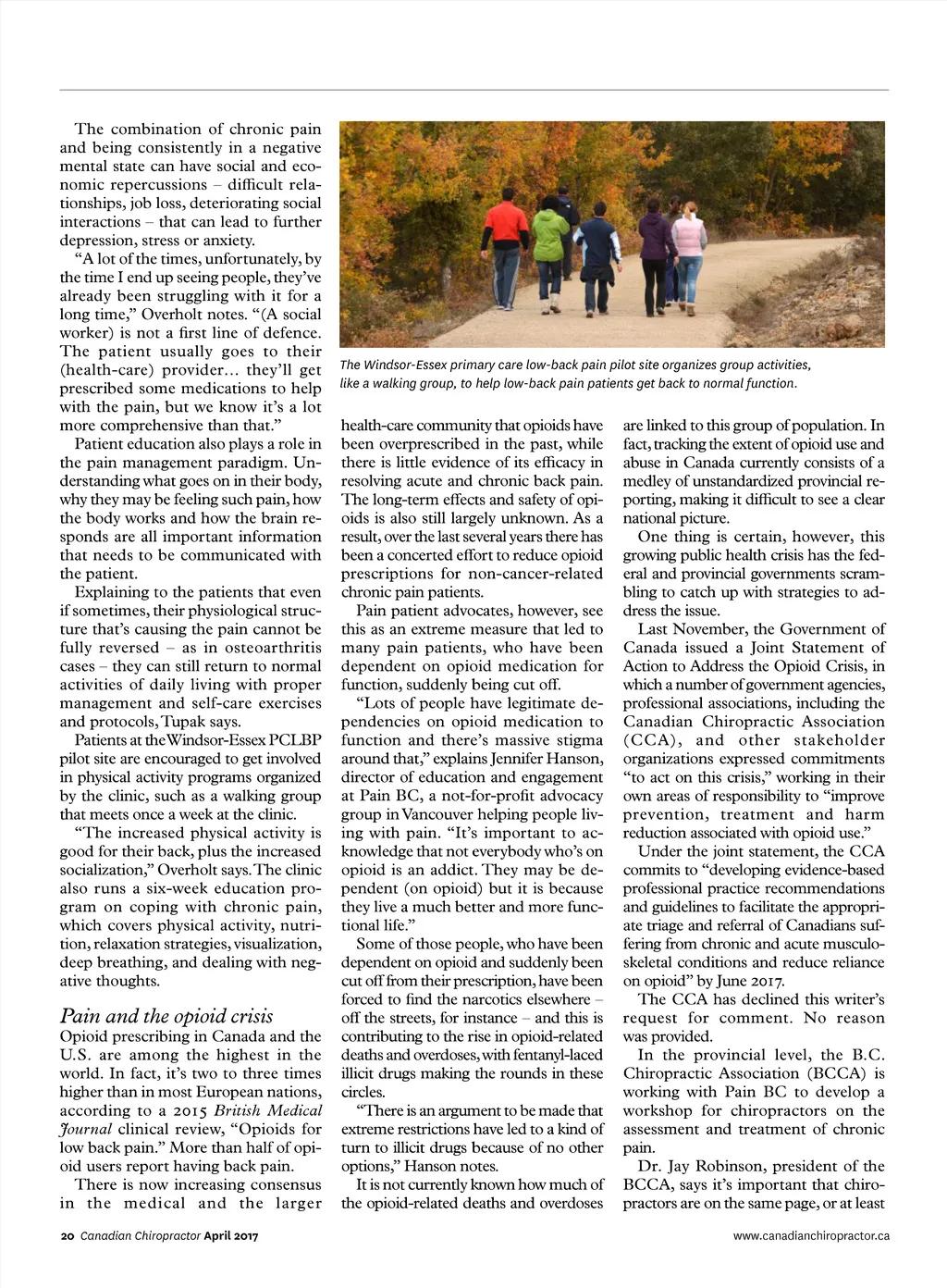
The combination of chronic pain and being consistently in a negative mental state can have social and eco-nomic repercussions – difficult rela-tionships, job loss, deteriorating social interactions – that can lead to further depression, stress or anxiety. “A lot of the times, unfortunately, by the time I end up seeing people, they’ve already been struggling with it for a long time,” Overholt notes. “(A social worker) is not a first line of defence. The patient usually goes to their (health-care) provider… they’ll get prescribed some medications to help with the pain, but we know it’s a lot more comprehensive than that.” Patient education also plays a role in the pain management paradigm. Un-derstanding what goes on in their body, why they may be feeling such pain, how the body works and how the brain re-sponds are all important information that needs to be communicated with the patient. Explaining to the patients that even if sometimes, their physiological struc-ture that’s causing the pain cannot be fully reversed – as in osteoarthritis cases – they can still return to normal activities of daily living with proper management and self-care exercises and protocols, Tupak says. Patients at the Windsor-Essex PCLBP pilot site are encouraged to get involved in physical activity programs organized by the clinic, such as a walking group that meets once a week at the clinic. “The increased physical activity is good for their back, plus the increased socialization,” Overholt says. The clinic also runs a six-week education pro-gram on coping with chronic pain, which covers physical activity, nutri-tion, relaxation strategies, visualization, deep breathing, and dealing with neg-ative thoughts. The Windsor-Essex primary care low-back pain pilot site organizes group activities, like a walking group, to help low-back pain patients get back to normal function. Pain and the opioid crisis Opioid prescribing in Canada and the U.S. are among the highest in the world. In fact, it’s two to three times higher than in most European nations, according to a 2015 British Medical Journal clinical review, “Opioids for low back pain.” More than half of opi-oid users report having back pain. There is now increasing consensus in the medical and the larger 20 Canadian Chiropractor April 2017 health-care community that opioids have been overprescribed in the past, while there is little evidence of its efficacy in resolving acute and chronic back pain. The long-term effects and safety of opi-oids is also still largely unknown. As a result, over the last several years there has been a concerted effort to reduce opioid prescriptions for non-cancer-related chronic pain patients. Pain patient advocates, however, see this as an extreme measure that led to many pain patients, who have been dependent on opioid medication for function, suddenly being cut off. “Lots of people have legitimate de-pendencies on opioid medication to function and there’s massive stigma around that,” explains Jennifer Hanson, director of education and engagement at Pain BC, a not-for-profit advocacy group in Vancouver helping people liv-ing with pain. “It’s important to ac-knowledge that not everybody who’s on opioid is an addict. They may be de-pendent (on opioid) but it is because they live a much better and more func-tional life.” Some of those people, who have been dependent on opioid and suddenly been cut off from their prescription, have been forced to find the narcotics elsewhere – off the streets, for instance – and this is contributing to the rise in opioid-related deaths and overdoses, with fentanyl-laced illicit drugs making the rounds in these circles. “There is an argument to be made that extreme restrictions have led to a kind of turn to illicit drugs because of no other options,” Hanson notes. It is not currently known how much of the opioid-related deaths and overdoses are linked to this group of population. In fact, tracking the extent of opioid use and abuse in Canada currently consists of a medley of unstandardized provincial re-porting, making it difficult to see a clear national picture. One thing is certain, however, this growing public health crisis has the fed-eral and provincial governments scram-bling to catch up with strategies to ad-dress the issue. Last November, the Government of Canada issued a Joint Statement of Action to Address the Opioid Crisis, in which a number of government agencies, professional associations, including the Canadian Chiropractic Association (CCA), and other stakeholder organizations expressed commitments “to act on this crisis,” working in their own areas of responsibility to “improve prevention, treatment and harm reduction associated with opioid use.” Under the joint statement, the CCA commits to “developing evidence-based professional practice recommendations and guidelines to facilitate the appropri-ate triage and referral of Canadians suf-fering from chronic and acute musculo-skeletal conditions and reduce reliance on opioid” by June 2017. The CCA has declined this writer’s request for comment. No reason was provided. In the provincial level, the B.C. Chiropractic Association (BCCA) is working with Pain BC to develop a workshop for chiropractors on the assessment and treatment of chronic pain. Dr. Jay Robinson, president of the BCCA, says it’s important that chiro-practors are on the same page, or at least www.canadianchiropractor.ca
Chiropractic + Naturopathic Doctor April 2017: Page 20