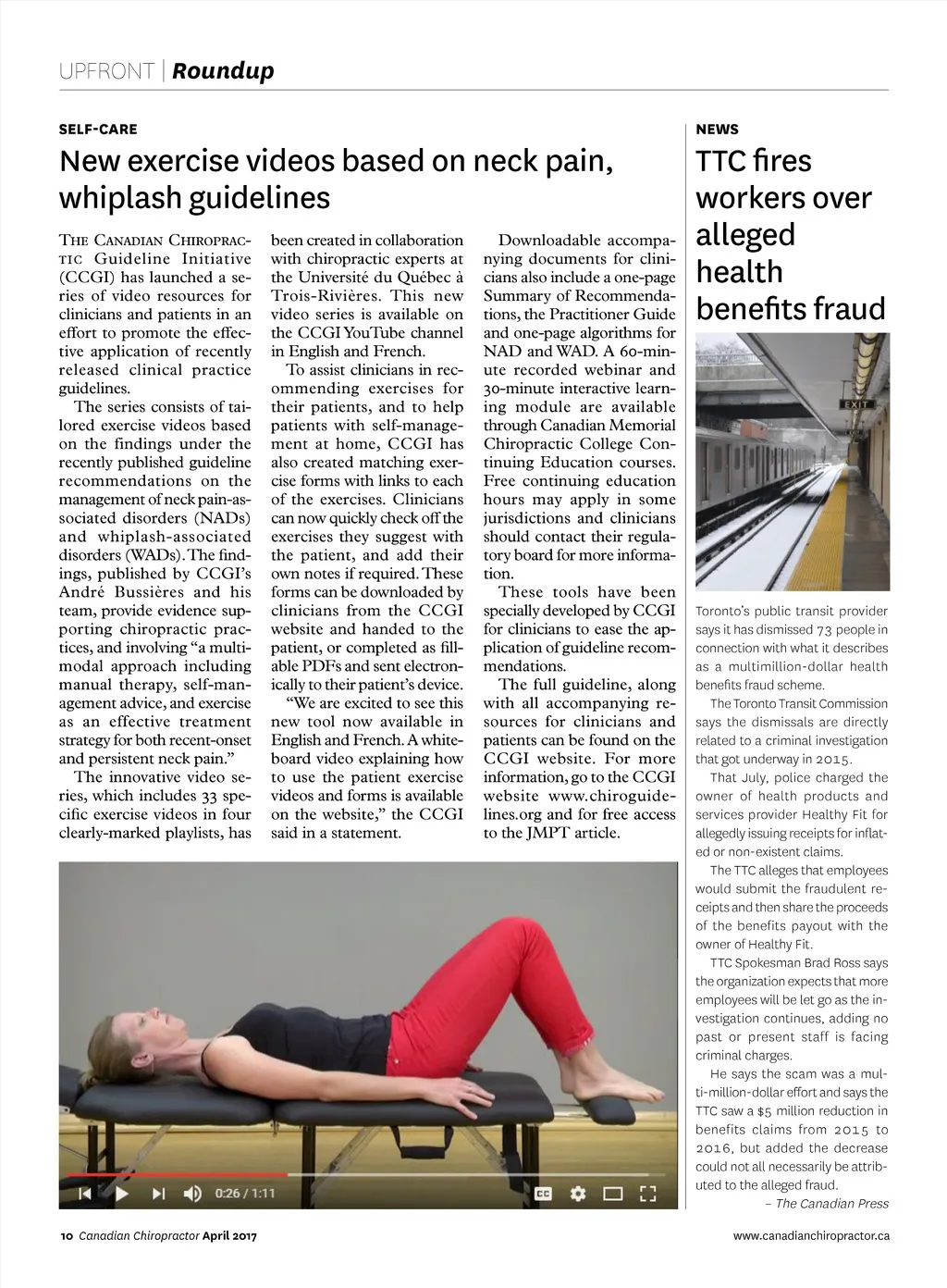
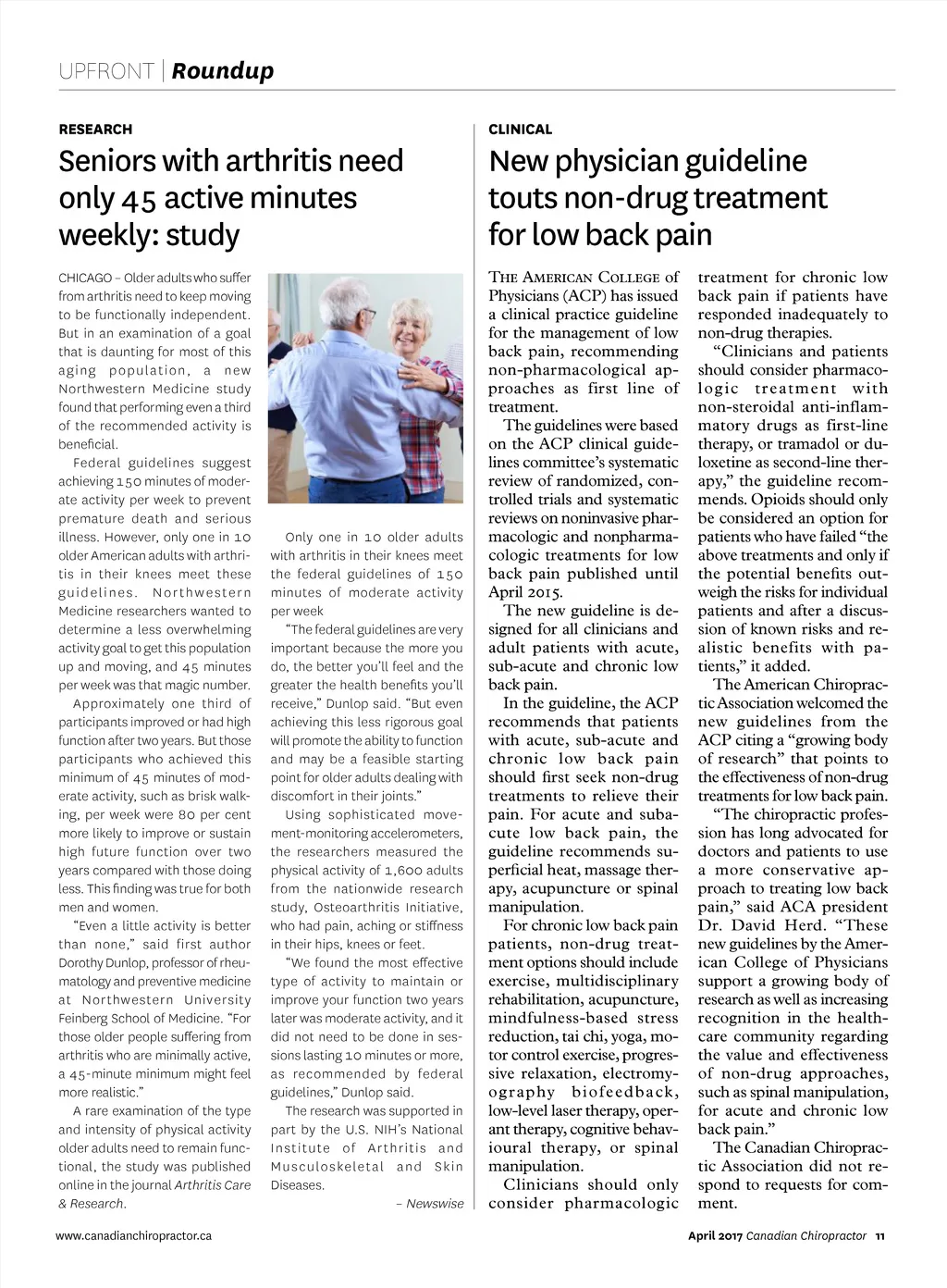
UPFRONT | Roundup RESEARCH Seniors with arthritis need only 45 active minutes weekly: study CHICAGO – Older adults who suffer from arthritis need to keep moving to be functionally independent. But in an examination of a goal that is daunting for most of this aging popula tion, a new Northwestern Medicine study found that performing even a third of the recommended activity is beneficial. Federal guidelines suggest achieving 150 minutes of moder-ate activity per week to prevent premature death and serious illness. However, only one in 10 older American adults with arthri-tis in their knees meet these g uideline s. Northwe st er n Medicine researchers wanted to determine a less overwhelming activity goal to get this population up and moving, and 45 minutes per week was that magic number. Approximately one third of participants improved or had high function after two years. But those participants who achieved this minimum of 45 minutes of mod-erate activity, such as brisk walk-ing, per week were 80 per cent more likely to improve or sustain high future function over two years compared with those doing less. This finding was true for both men and women. “Even a little activity is better than none,” said first author Dorothy Dunlop, professor of rheu-matology and preventive medicine at Northwestern University Feinberg School of Medicine. “For those older people suffering from arthritis who are minimally active, a 45-minute minimum might feel more realistic.” A rare examination of the type and intensity of physical activity older adults need to remain func-tional, the study was published online in the journal Arthritis Care & Research . www.canadianchiropractor.ca CLINICAL New physician guideline touts non-drug treatment for low back pain The American College of Physicians (ACP) has issued a clinical practice guideline for the management of low back pain, recommending non-pharmacological ap-proaches as first line of treatment. The guidelines were based on the ACP clinical guide-lines committee’s systematic review of randomized, con-trolled trials and systematic reviews on noninvasive phar-macologic and nonpharma-cologic treatments for low back pain published until April 2015. The new guideline is de-signed for all clinicians and adult patients with acute, sub-acute and chronic low back pain. In the guideline, the ACP recommends that patients with acute, sub-acute and chronic low back pain should first seek non-drug treatments to relieve their pain. For acute and suba-cute low back pain, the guideline recommends su-perficial heat, massage ther-apy, acupuncture or spinal manipulation. For chronic low back pain patients, non-drug treat-ment options should include exercise, multidisciplinary rehabilitation, acupuncture, mindfulness-based stress reduction, tai chi, yoga, mo-tor control exercise, progres-sive relaxation, electromy-og raphy biofeedback, low-level laser therapy, oper-ant therapy, cognitive behav-ioural therapy, or spinal manipulation. Clinicians should only consider pharmacologic treatment for chronic low back pain if patients have responded inadequately to non-drug therapies. “Clinicians and patients should consider pharmaco-log ic treatment with non-steroidal anti-inflam-matory drugs as first-line therapy, or tramadol or du-loxetine as second-line ther-apy,” the guideline recom-mends. Opioids should only be considered an option for patients who have failed “the above treatments and only if the potential benefits out-weigh the risks for individual patients and after a discus-sion of known risks and re-alistic benefits with pa-tients,” it added. The American Chiroprac-tic Association welcomed the new guidelines from the ACP citing a “growing body of research” that points to the effectiveness of non-drug treatments for low back pain. “The chiropractic profes-sion has long advocated for doctors and patients to use a more conservative ap-proach to treating low back pain,” said ACA president Dr. David Herd. “These new guidelines by the Amer-ican College of Physicians support a growing body of research as well as increasing recognition in the health-care community regarding the value and effectiveness of non-drug approaches, such as spinal manipulation, for acute and chronic low back pain.” The Canadian Chiroprac-tic Association did not re-spond to requests for com-ment. April 2017 Canadian Chiropractor 11 Only one in 10 older adults with arthritis in their knees meet the federal guidelines of 150 minutes of moderate activity per week “The federal guidelines are very important because the more you do, the better you’ll feel and the greater the health benefits you’ll receive,” Dunlop said. “But even achieving this less rigorous goal will promote the ability to function and may be a feasible starting point for older adults dealing with discomfort in their joints.” Using sophisticated move-ment-monitoring accelerometers, the researchers measured the physical activity of 1,600 adults from the nationwide research study, Osteoarthritis Initiative, who had pain, aching or stiffness in their hips, knees or feet. “We found the most effective type of activity to maintain or improve your function two years later was moderate activity, and it did not need to be done in ses-sions lasting 10 minutes or more, as recommended by federal guidelines,” Dunlop said. The research was supported in part by the U.S. NIH’s National In stitute of A rthritis and M us c u lo s ke le ta l a n d S k i n Diseases. – Newswise
Chiropractic + Naturopathic Doctor April 2017: Page 11