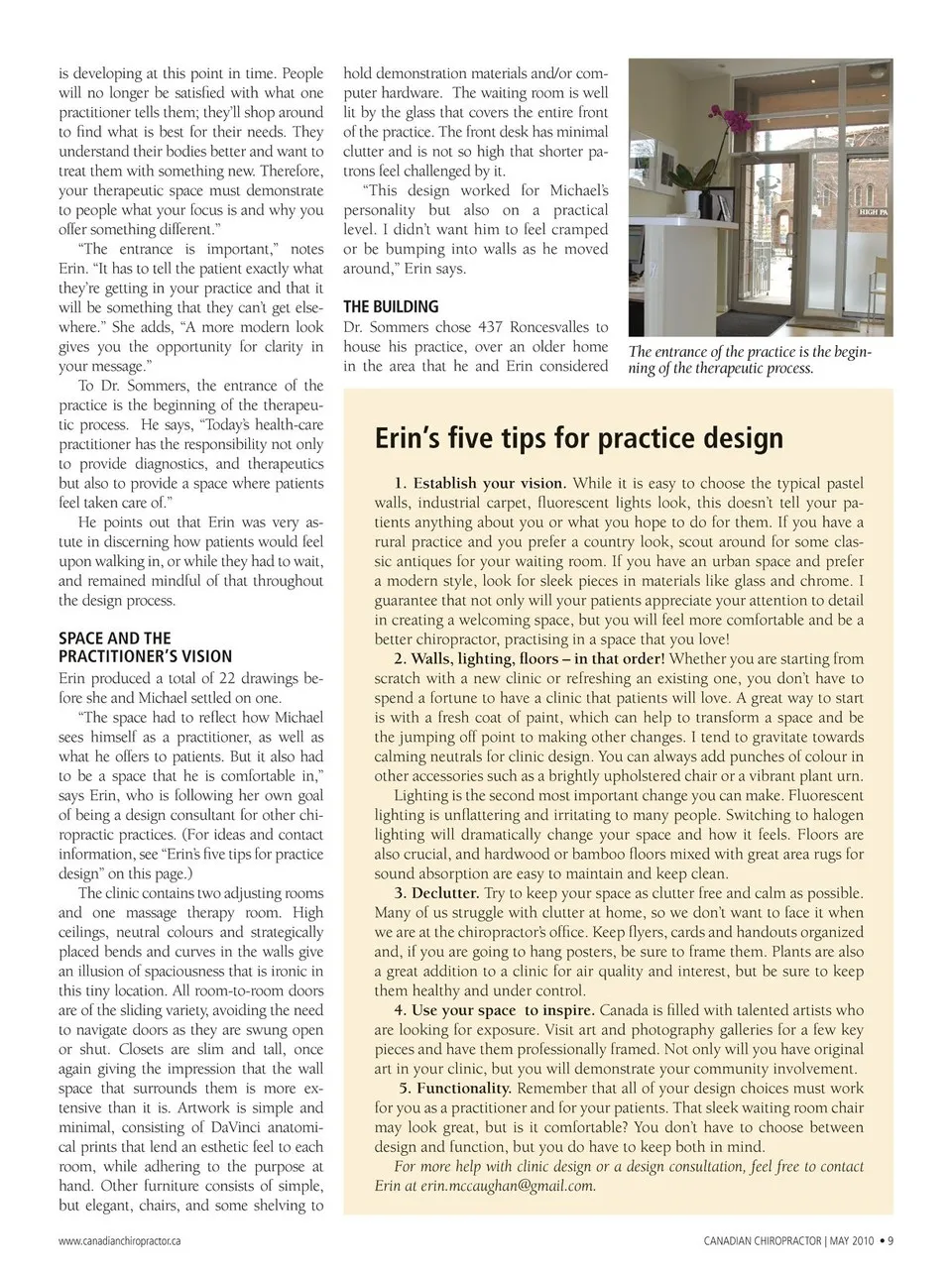
is developing at this point in time. People will no longer be satisfied with what one practitioner tells them; they’ll shop around to find what is best for their needs. They understand their bodies better and want to treat them with something new. Therefore, your therapeutic space must demonstrate to people what your focus is and why you offer something different.” “The entrance is important,” notes Erin. “It has to tell the patient exactly what they’re getting in your practice and that it will be something that they can’t get else- where.” She adds, “A more modern look gives you the opportunity for clarity in your message.” To Dr. Sommers, the entrance of the practice is the beginning of the therapeu- tic process. He says, “Today’s health-care practitioner has the responsibility not only to provide diagnostics, and therapeutics but also to provide a space where patients feel taken care of.” He points out that Erin was very as- tute in discerning how patients would feel upon walking in, or while they had to wait, and remained mindful of that throughout the design process. SPACE AND THE PRACTITIONER’S VISION Erin produced a total of 22 drawings be- fore she and Michael settled on one. “The space had to reflect how Michael sees himself as a practitioner, as well as what he offers to patients. But it also had to be a space that he is comfortable in,” says Erin, who is following her own goal of being a design consultant for other chi- ropractic practices. (For ideas and contact information, see “Erin’s five tips for practice design” on this page.) The clinic contains two adjusting rooms and one massage therapy room. High ceilings, neutral colours and strategically placed bends and curves in the walls give an illusion of spaciousness that is ironic in this tiny location. All room-to-room doors are of the sliding variety, avoiding the need to navigate doors as they are swung open or shut. Closets are slim and tall, once again giving the impression that the wall space that surrounds them is more ex- tensive than it is. Artwork is simple and minimal, consisting of DaVinci anatomi- cal prints that lend an esthetic feel to each room, while adhering to the purpose at hand. Other furniture consists of simple, but elegant, chairs, and some shelving to www.canadianchiropractor.ca hold demonstration materials and/or com- puter hardware. The waiting room is well lit by the glass that covers the entire front of the practice. The front desk has minimal clutter and is not so high that shorter pa- trons feel challenged by it. “This design worked for Michael’s personality but also on a practical level. I didn’t want him to feel cramped or be bumping into walls as he moved around,” Erin says. THE BUILDING Dr. Sommers chose 437 Roncesvalles to house his practice, over an older home in the area that he and Erin considered The entrance of the practice is the begin- ning of the therapeutic process. Erin’s five tips for practice design 1. Establish your vision. While it is easy to choose the typical pastel walls, industrial carpet, fluorescent lights look, this doesn’t tell your pa- tients anything about you or what you hope to do for them. If you have a rural practice and you prefer a country look, scout around for some clas- sic antiques for your waiting room. If you have an urban space and prefer a modern style, look for sleek pieces in materials like glass and chrome. I guarantee that not only will your patients appreciate your attention to detail in creating a welcoming space, but you will feel more comfortable and be a better chiropractor, practising in a space that you love! 2. Walls, lighting, floors – in that order! Whether you are starting from scratch with a new clinic or refreshing an existing one, you don’t have to spend a fortune to have a clinic that patients will love. A great way to start is with a fresh coat of paint, which can help to transform a space and be the jumping off point to making other changes. I tend to gravitate towards calming neutrals for clinic design. You can always add punches of colour in other accessories such as a brightly upholstered chair or a vibrant plant urn. Lighting is the second most important change you can make. Fluorescent lighting is unflattering and irritating to many people. Switching to halogen lighting will dramatically change your space and how it feels. Floors are also crucial, and hardwood or bamboo floors mixed with great area rugs for sound absorption are easy to maintain and keep clean. 3. Declutter. Try to keep your space as clutter free and calm as possible. Many of us struggle with clutter at home, so we don’t want to face it when we are at the chiropractor’s office. Keep flyers, cards and handouts organized and, if you are going to hang posters, be sure to frame them. Plants are also a great addition to a clinic for air quality and interest, but be sure to keep them healthy and under control. 4. Use your space to inspire. Canada is filled with talented artists who are looking for exposure. Visit art and photography galleries for a few key pieces and have them professionally framed. Not only will you have original art in your clinic, but you will demonstrate your community involvement. 5. Functionality. Remember that all of your design choices must work for you as a practitioner and for your patients. That sleek waiting room chair may look great, but is it comfortable? You don’t have to choose between design and function, but you do have to keep both in mind. For more help with clinic design or a design consultation, feel free to contact Erin at [email protected]. CANADIAN CHIROPRACTOR | MAY 2010 • 9
Chiropractic + Naturopathic Doctor May 2010: Page 9