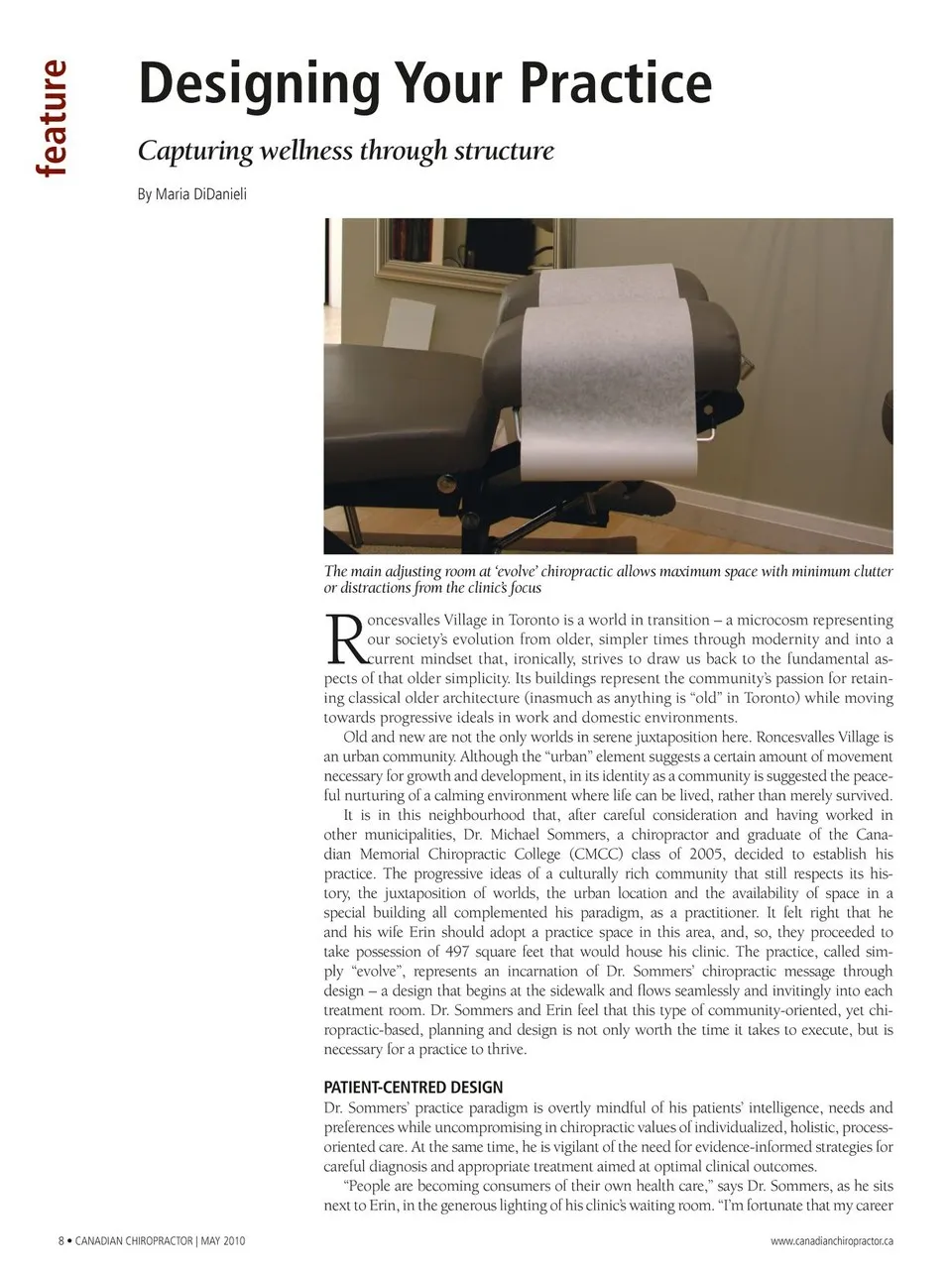
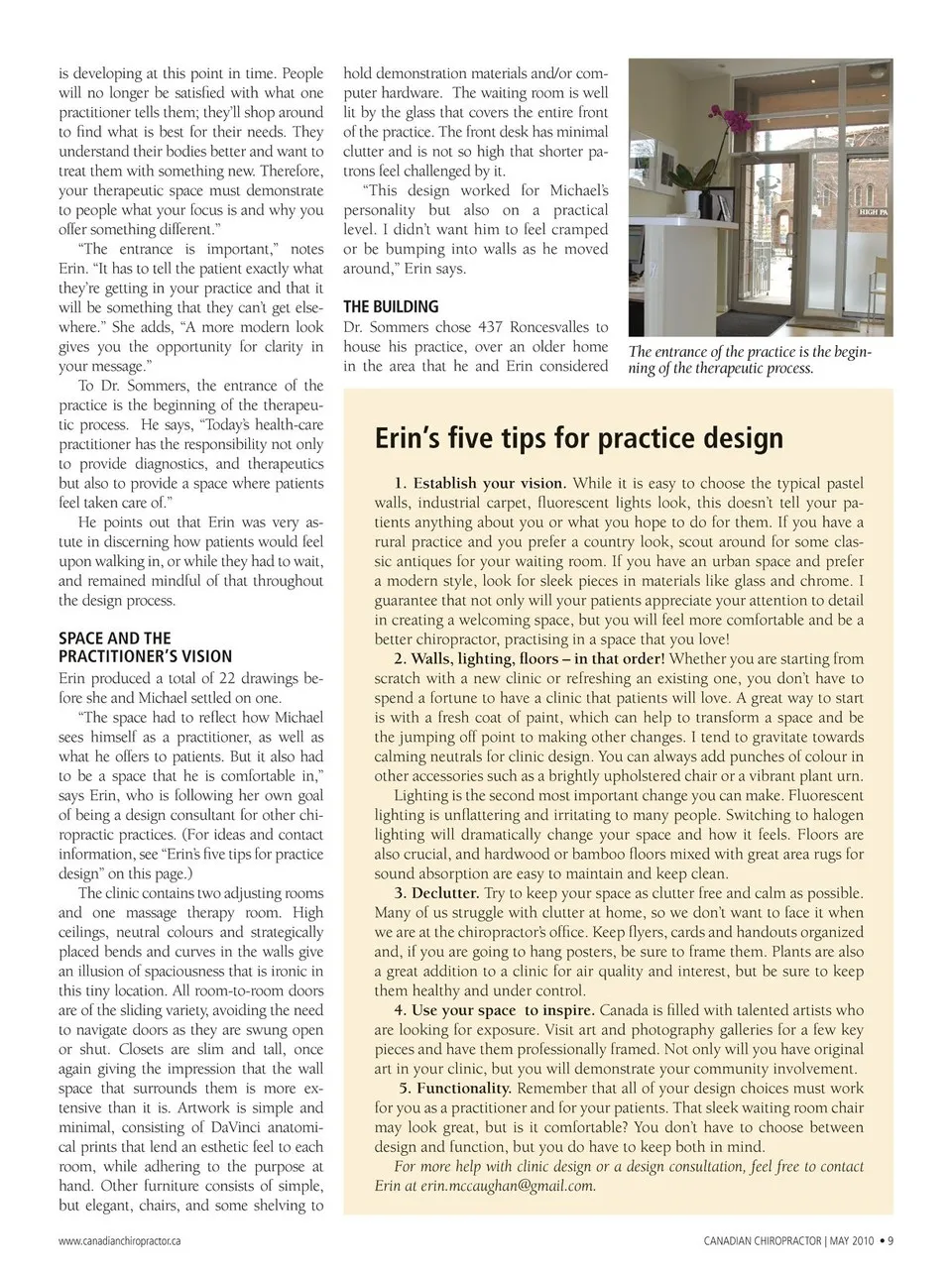
Designing Your Practice Capturing wellness through structure By Maria DiDanieli The main adjusting room at ‘evolve’ chiropractic allows maximum space with minimum clutter or distractions from the clinic’s focus R oncesvalles Village in Toronto is a world in transition – a microcosm representing our society’s evolution from older, simpler times through modernity and into a current mindset that, ironically, strives to draw us back to the fundamental as- pects of that older simplicity. Its buildings represent the community’s passion for retain- ing classical older architecture (inasmuch as anything is “old” in Toronto) while moving towards progressive ideals in work and domestic environments. Old and new are not the only worlds in serene juxtaposition here. Roncesvalles Village is an urban community. Although the “urban” element suggests a certain amount of movement necessary for growth and development, in its identity as a community is suggested the peace- ful nurturing of a calming environment where life can be lived, rather than merely survived. It is in this neighbourhood that, after careful consideration and having worked in other municipalities, Dr. Michael Sommers, a chiropractor and graduate of the Cana- dian Memorial Chiropractic College (CMCC) class of 2005, decided to establish his practice. The progressive ideas of a culturally rich community that still respects its his- tory, the juxtaposition of worlds, the urban location and the availability of space in a special building all complemented his paradigm, as a practitioner. It felt right that he and his wife Erin should adopt a practice space in this area, and, so, they proceeded to take possession of 497 square feet that would house his clinic. The practice, called sim- ply “evolve”, represents an incarnation of Dr. Sommers’ chiropractic message through design – a design that begins at the sidewalk and flows seamlessly and invitingly into each treatment room. Dr. Sommers and Erin feel that this type of community-oriented, yet chi- ropractic-based, planning and design is not only worth the time it takes to execute, but is necessary for a practice to thrive. PATIENT-CENTRED DESIGN Dr. Sommers’ practice paradigm is overtly mindful of his patients’ intelligence, needs and preferences while uncompromising in chiropractic values of individualized, holistic, process- oriented care. At the same time, he is vigilant of the need for evidence-informed strategies for careful diagnosis and appropriate treatment aimed at optimal clinical outcomes. “People are becoming consumers of their own health care,” says Dr. Sommers, as he sits next to Erin, in the generous lighting of his clinic’s waiting room. “I’m fortunate that my career 8 • CANADIAN CHIROPRACTOR | MAY 2010 www.canadianchiropractor.ca feature
Chiropractic + Naturopathic Doctor May 2010: Page 8