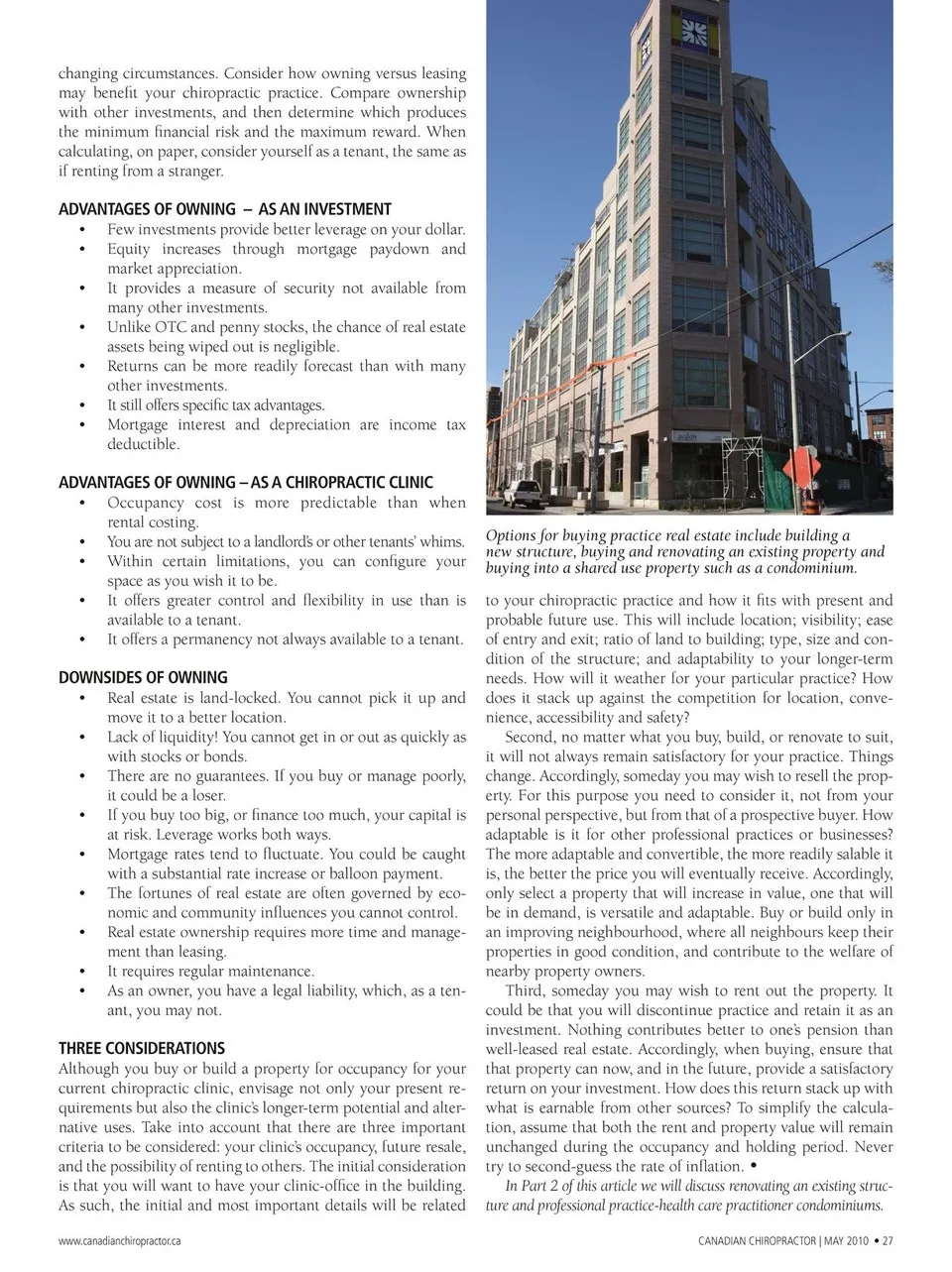
changing circumstances. Consider how owning versus leasing may benefit your chiropractic practice. Compare ownership with other investments, and then determine which produces the minimum financial risk and the maximum reward. When calculating, on paper, consider yourself as a tenant, the same as if renting from a stranger. ADVANTAGES OF OWNING – AS AN INVESTMENT • Few investments provide better leverage on your dollar. • Equity increases through mortgage paydown and market appreciation. • It provides a measure of security not available from many other investments. • Unlike OTC and penny stocks, the chance of real estate assets being wiped out is negligible. • Returns can be more readily forecast than with many other investments. • It still offers specific tax advantages. • Mortgage interest and depreciation are income tax deductible. ADVANTAGES OF OWNING – AS A CHIROPRACTIC CLINIC • Occupancy cost is more predictable than when rental costing. • You are not subject to a landlord’s or other tenants’ whims. • Within certain limitations, you can configure your space as you wish it to be. • It offers greater control and flexibility in use than is available to a tenant. • It offers a permanency not always available to a tenant. DOWNSIDES OF OWNING • Real estate is land-locked. You cannot pick it up and move it to a better location. • Lack of liquidity! You cannot get in or out as quickly as with stocks or bonds. • There are no guarantees. If you buy or manage poorly, it could be a loser. • If you buy too big, or finance too much, your capital is at risk. Leverage works both ways. • Mortgage rates tend to fluctuate. You could be caught with a substantial rate increase or balloon payment. • The fortunes of real estate are often governed by eco- nomic and community influences you cannot control. • Real estate ownership requires more time and manage- ment than leasing. • It requires regular maintenance. • As an owner, you have a legal liability, which, as a ten- ant, you may not. THREE CONSIDERATIONS Although you buy or build a property for occupancy for your current chiropractic clinic, envisage not only your present re- quirements but also the clinic’s longer-term potential and alter- native uses. Take into account that there are three important criteria to be considered: your clinic’s occupancy, future resale, and the possibility of renting to others. The initial consideration is that you will want to have your clinic-office in the building. As such, the initial and most important details will be related www.canadianchiropractor.ca Options for buying practice real estate include building a new structure, buying and renovating an existing property and buying into a shared use property such as a condominium. to your chiropractic practice and how it fits with present and probable future use. This will include location; visibility; ease of entry and exit; ratio of land to building; type, size and con- dition of the structure; and adaptability to your longer-term needs. How will it weather for your particular practice? How does it stack up against the competition for location, conve- nience, accessibility and safety? Second, no matter what you buy, build, or renovate to suit, it will not always remain satisfactory for your practice. Things change. Accordingly, someday you may wish to resell the prop- erty. For this purpose you need to consider it, not from your personal perspective, but from that of a prospective buyer. How adaptable is it for other professional practices or businesses? The more adaptable and convertible, the more readily salable it is, the better the price you will eventually receive. Accordingly, only select a property that will increase in value, one that will be in demand, is versatile and adaptable. Buy or build only in an improving neighbourhood, where all neighbours keep their properties in good condition, and contribute to the welfare of nearby property owners. Third, someday you may wish to rent out the property. It could be that you will discontinue practice and retain it as an investment. Nothing contributes better to one’s pension than well-leased real estate. Accordingly, when buying, ensure that that property can now, and in the future, provide a satisfactory return on your investment. How does this return stack up with what is earnable from other sources? To simplify the calcula- tion, assume that both the rent and property value will remain unchanged during the occupancy and holding period. Never try to second-guess the rate of inflation. • In Part 2 of this article we will discuss renovating an existing struc- ture and professional practice-health care practitioner condominiums. CANADIAN CHIROPRACTOR | MAY 2010 • 27
Chiropractic + Naturopathic Doctor May 2010: Page 27