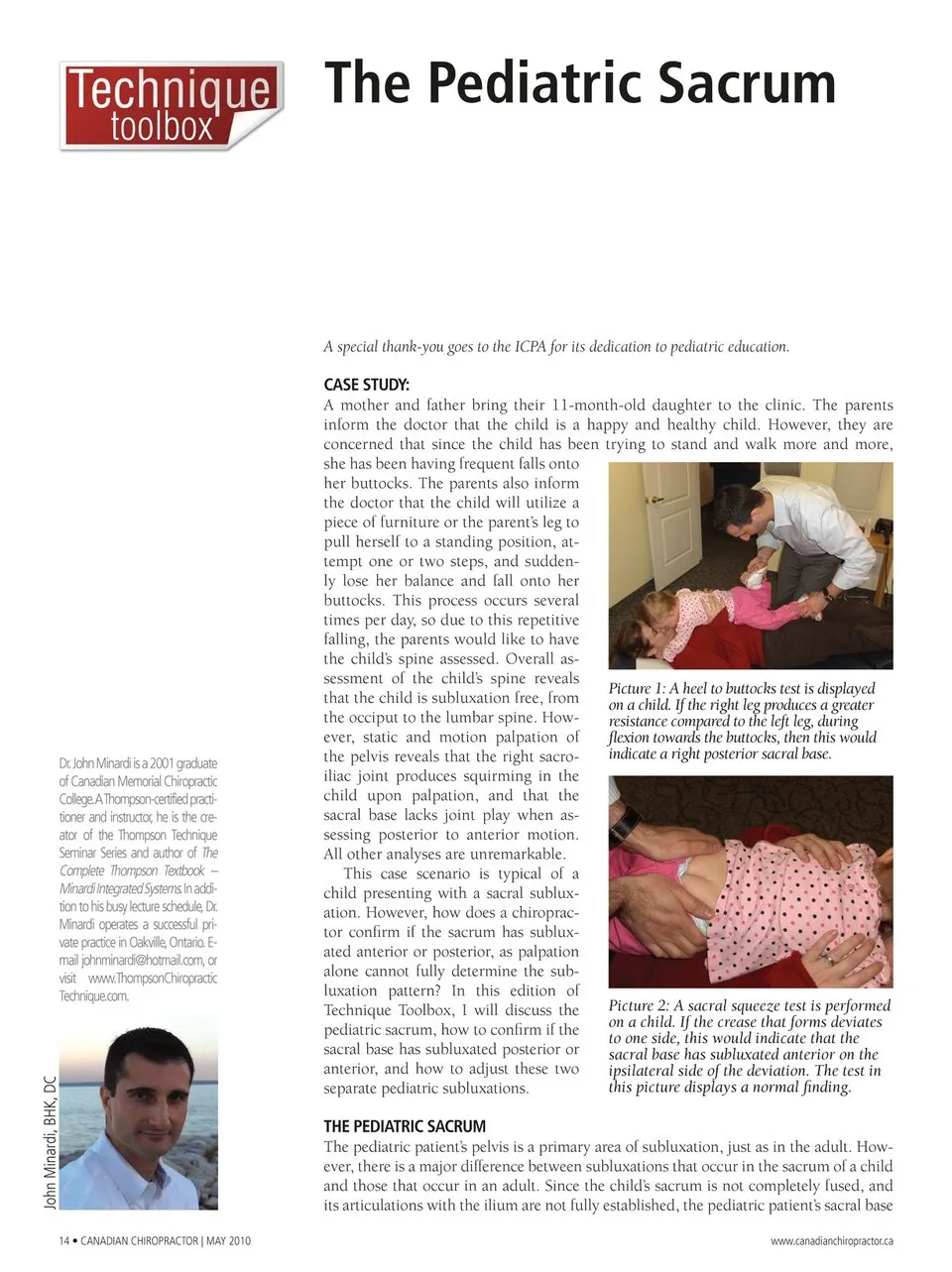
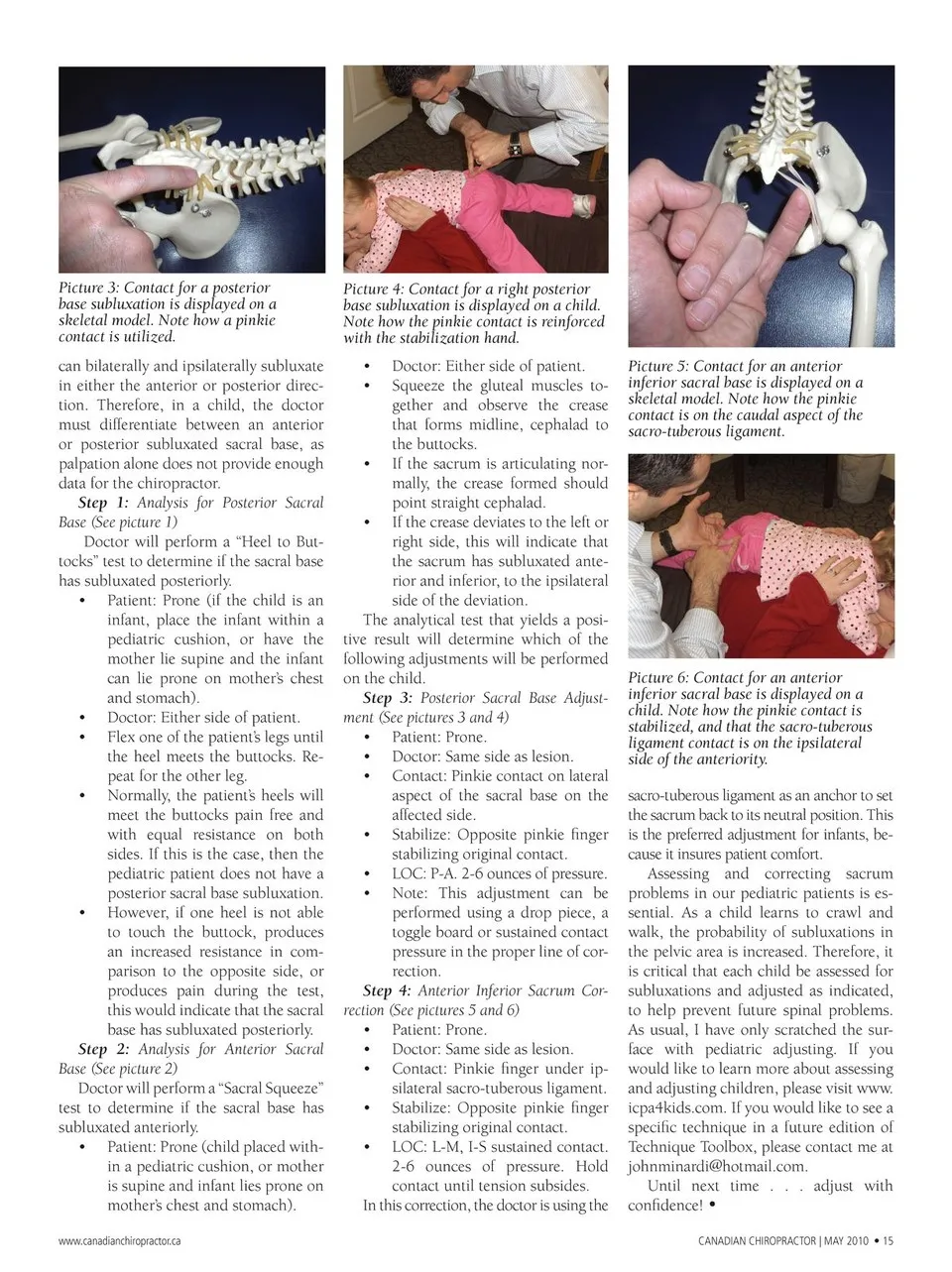
The Pediatric Sacrum A special thank-you goes to the ICPA for its dedication to pediatric education. Dr. John Minardi is a 2001 graduate of Canadian Memorial Chiropractic College. A Thompson-certified practi- tioner and instructor, he is the cre- ator of the Thompson Technique Seminar Series and author of The Complete Thompson Textbook – Minardi Integrated Systems.In addi- tion to his busy lecture schedule, Dr. Minardi operates a successful pri- vate practice in Oakville, Ontario. E- mail [email protected], or visit www.ThompsonChiropractic Technique.com. CASE STUDY: A mother and father bring their 11-month-old daughter to the clinic. The parents inform the doctor that the child is a happy and healthy child. However, they are concerned that since the child has been trying to stand and walk more and more, she has been having frequent falls onto her buttocks. The parents also inform the doctor that the child will utilize a piece of furniture or the parent’s leg to pull herself to a standing position, at- tempt one or two steps, and sudden- ly lose her balance and fall onto her buttocks. This process occurs several times per day, so due to this repetitive falling, the parents would like to have the child’s spine assessed. Overall as- sessment of the child’s spine reveals that the child is subluxation free, from the occiput to the lumbar spine. How- ever, static and motion palpation of the pelvis reveals that the right sacro- iliac joint produces squirming in the child upon palpation, and that the sacral base lacks joint play when as- sessing posterior to anterior motion. All other analyses are unremarkable. This case scenario is typical of a Picture 1: A heel to buttocks test is displayed on a child. If the right leg produces a greater resistance compared to the left leg, during flexion towards the buttocks, then this would indicate a right posterior sacral base. child presenting with a sacral sublux- ation. However, how does a chiroprac- tor confirm if the sacrum has sublux- ated anterior or posterior, as palpation alone cannot fully determine the sub- luxation pattern? In this edition of Technique Toolbox, I will discuss the pediatric sacrum, how to confirm if the sacral base has subluxated posterior or anterior, and how to adjust these two separate pediatric subluxations. Picture 2: A sacral squeeze test is performed on a child. If the crease that forms deviates to one side, this would indicate that the sacral base has subluxated anterior on the ipsilateral side of the deviation. The test in this picture displays a normal finding. THE PEDIATRIC SACRUM The pediatric patient’s pelvis is a primary area of subluxation, just as in the adult. How- ever, there is a major difference between subluxations that occur in the sacrum of a child and those that occur in an adult. Since the child’s sacrum is not completely fused, and its articulations with the ilium are not fully established, the pediatric patient’s sacral base 14 • CANADIAN CHIROPRACTOR | MAY 2010 www.canadianchiropractor.ca John Minardi, BHK, DC
Chiropractic + Naturopathic Doctor May 2010: Page 14