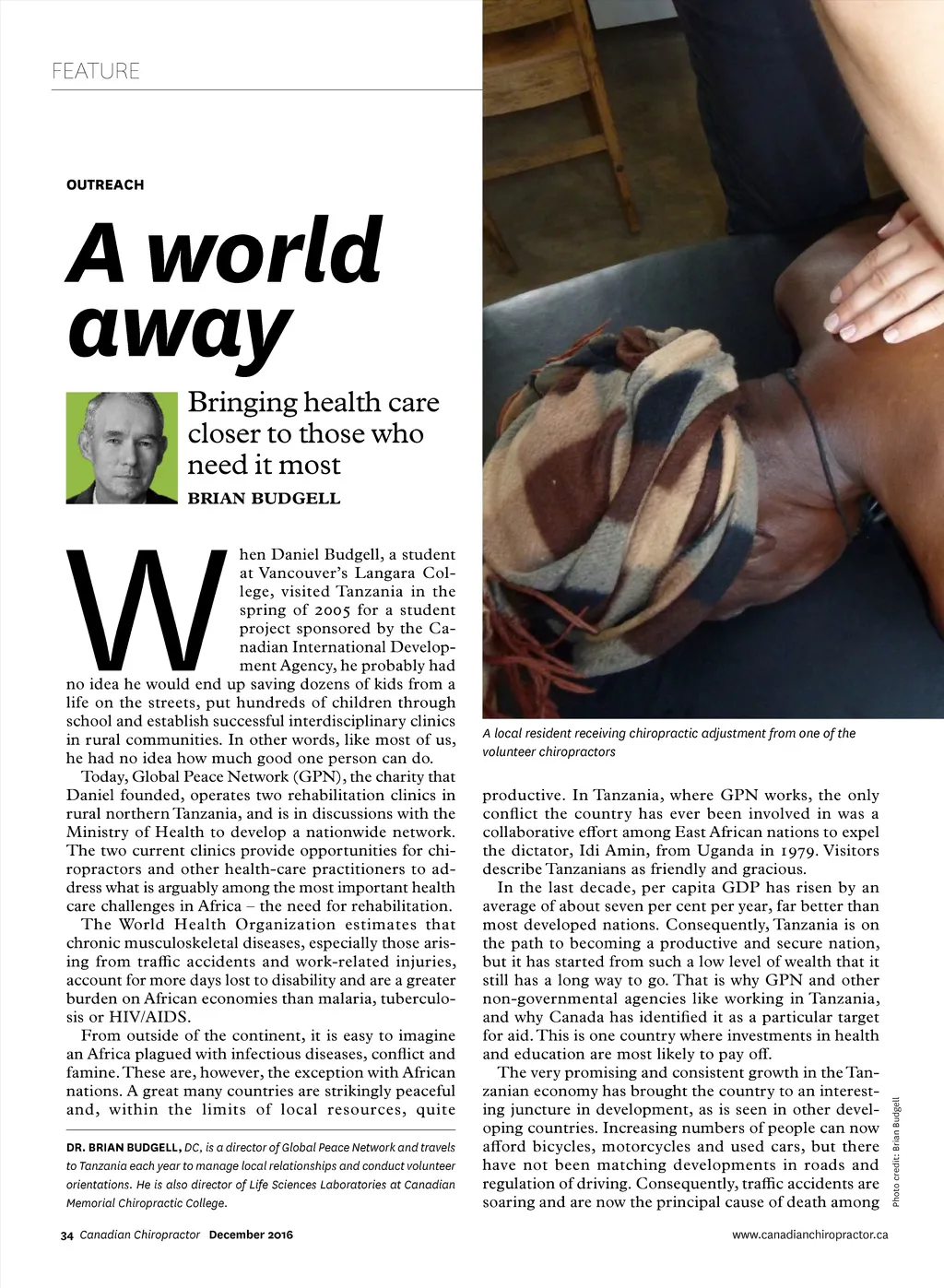
FEATURE OUTREACH A world away W Bringing health care closer to those who need it most brian budgell DR. BRIAN BUDGELL, DC, is a director of Global Peace Network and travels to Tanzania each year to manage local relationships and conduct volunteer orientations. He is also director of Life Sciences Laboratories at Canadian Memorial Chiropractic College. 34 Canadian Chiropractor December 2016 www.canadianchiropractor.ca Photo credit: Brian Budgell hen Daniel Budgell, a student at Vancouver’s Langara Col-lege, visited Tanzania in the spring of 2005 for a student project sponsored by the Ca-nadian International Develop-ment Agency, he probably had no idea he would end up saving dozens of kids from a life on the streets, put hundreds of children through school and establish successful interdisciplinary clinics in rural communities. In other words, like most of us, he had no idea how much good one person can do. Today, Global Peace Network (GPN), the charity that Daniel founded, operates two rehabilitation clinics in rural northern Tanzania, and is in discussions with the Ministry of Health to develop a nationwide network. The two current clinics provide opportunities for chi-ropractors and other health-care practitioners to ad-dress what is arguably among the most important health care challenges in Africa – the need for rehabilitation. The World Health Organization estimates that chronic musculoskeletal diseases, especially those aris-ing from traffic accidents and work-related injuries, account for more days lost to disability and are a greater burden on African economies than malaria, tuberculo-sis or HIV/AIDS. From outside of the continent, it is easy to imagine an Africa plagued with infectious diseases, conflict and famine. These are, however, the exception with African nations. A great many countries are strikingly peaceful and, within the limits of local resources, quite A local resident receiving chiropractic adjustment from one of the volunteer chiropractors productive. In Tanzania, where GPN works, the only conflict the country has ever been involved in was a collaborative effort among East African nations to expel the dictator, Idi Amin, from Uganda in 1979. Visitors describe Tanzanians as friendly and gracious. In the last decade, per capita GDP has risen by an average of about seven per cent per year, far better than most developed nations. Consequently, Tanzania is on the path to becoming a productive and secure nation, but it has started from such a low level of wealth that it still has a long way to go. That is why GPN and other non-governmental agencies like working in Tanzania, and why Canada has identified it as a particular target for aid. This is one country where investments in health and education are most likely to pay off. The very promising and consistent growth in the Tan-zanian economy has brought the country to an interest-ing juncture in development, as is seen in other devel-oping countries. Increasing numbers of people can now afford bicycles, motorcycles and used cars, but there have not been matching developments in roads and regulation of driving. Consequently, traffic accidents are soaring and are now the principal cause of death among
Chiropractic + Naturopathic Doctor December 2016: Page 34