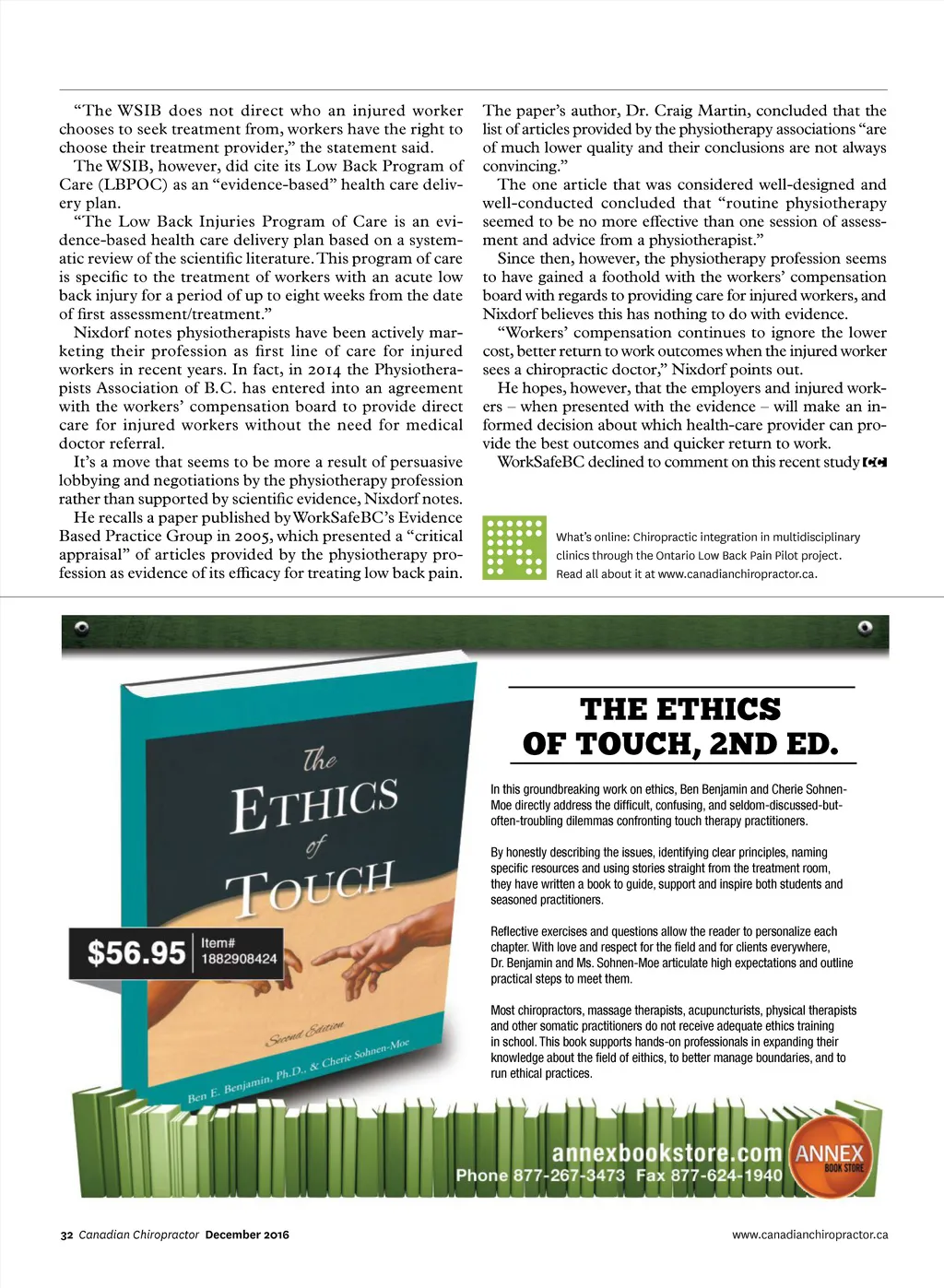
“The WSIB does not direct who an injured worker chooses to seek treatment from, workers have the right to choose their treatment provider,” the statement said. The WSIB, however, did cite its Low Back Program of Care (LBPOC) as an “evidence-based” health care deliv-ery plan. “The Low Back Injuries Program of Care is an evi-dence-based health care delivery plan based on a system-atic review of the scientific literature. This program of care is specific to the treatment of workers with an acute low back injury for a period of up to eight weeks from the date of first assessment/treatment.” Nixdorf notes physiotherapists have been actively mar-keting their profession as first line of care for injured workers in recent years. In fact, in 2014 the Physiothera-pists Association of B.C. has entered into an agreement with the workers’ compensation board to provide direct care for injured workers without the need for medical doctor referral. It’s a move that seems to be more a result of persuasive lobbying and negotiations by the physiotherapy profession rather than supported by scientific evidence, Nixdorf notes. He recalls a paper published by WorkSafeBC’s Evidence Based Practice Group in 2005, which presented a “critical appraisal” of articles provided by the physiotherapy pro-fession as evidence of its efficacy for treating low back pain. The paper’s author, Dr. Craig Martin, concluded that the list of articles provided by the physiotherapy associations “are of much lower quality and their conclusions are not always convincing.” The one article that was considered well-designed and well-conducted concluded that “routine physiotherapy seemed to be no more effective than one session of assess-ment and advice from a physiotherapist.” Since then, however, the physiotherapy profession seems to have gained a foothold with the workers’ compensation board with regards to providing care for injured workers, and Nixdorf believes this has nothing to do with evidence. “Workers’ compensation continues to ignore the lower cost, better return to work outcomes when the injured worker sees a chiropractic doctor,” Nixdorf points out. He hopes, however, that the employers and injured work-ers – when presented with the evidence – will make an in-formed decision about which health-care provider can pro-vide the best outcomes and quicker return to work. WorkSafeBC declined to comment on this recent study What’s online: Chiropractic integration in multidisciplinary clinics through the Ontario Low Back Pain Pilot project. Read all about it at www.canadianchiropractor.ca. THE ETHICS OF TOUCH, 2ND ED. In this groundbreaking work on ethics, Ben Benjamin and Cherie Sohnen-Moe directly address the difficult, confusing, and seldom-discussed-but-often-troubling dilemmas confronting touch therapy practitioners. By honestly describing the issues, identifying clear principles, naming specific resources and using stories straight from the treatment room, they have written a book to guide, support and inspire both students and seasoned practitioners. Reflective exercises and questions allow the reader to personalize each chapter. With love and respect for the field and for clients everywhere, Dr. Benjamin and Ms. Sohnen-Moe articulate high expectations and outline practical steps to meet them. Most chiropractors, massage therapists, acupuncturists, physical therapists and other somatic practitioners do not receive adequate ethics training in school. This book supports hands-on professionals in expanding their knowledge about the field of eithics, to better manage boundaries, and to run ethical practices. 32 Canadian Chiropractor December 2016 CC_book ad_Oct16_MLD.indd 1 www.canadianchiropractor.ca 2016-09-14 2:37 PM
Chiropractic + Naturopathic Doctor December 2016: Page 32