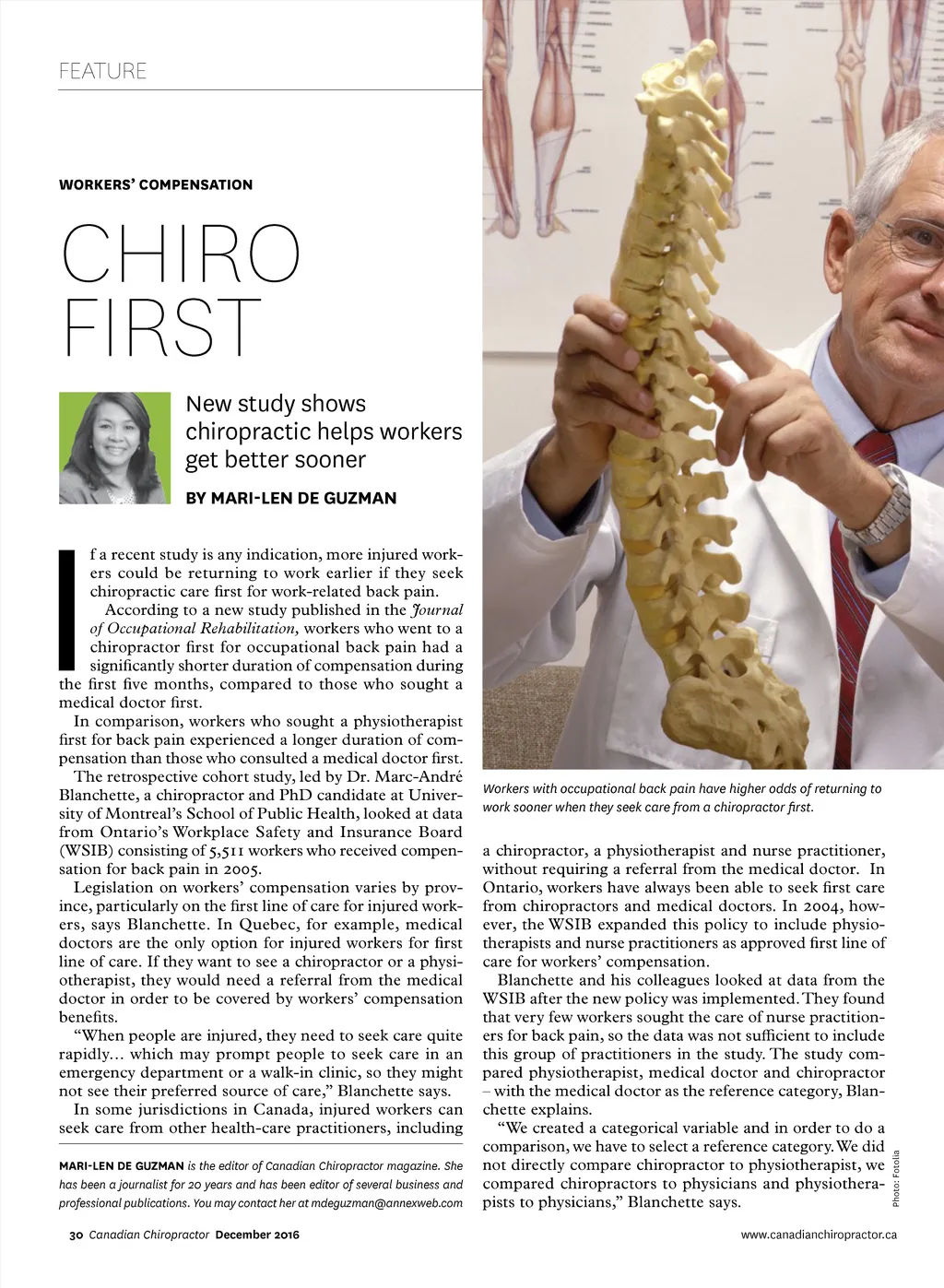
While it produced some compelling data, it would be interesting to further investigate why patients who seek physiotherapy care first experience longer compensation duration, and shorter compensation duration for those who seek chiropractic care first, Blanchette says. Previous randomized controlled trials that compared the effectiveness of chiropractic to physiotherapy and to medical care among the general population generally re-sulted in no significant difference between the providers, he adds. “So I was kind of surprised that there was (significant difference) in the sample we analyzed. So we have to find out why there are differences,” Blanchette explains. The factors that influence patients’ decision to seek physiotherapy as the first source of care should also be better understood, the authors of the study write. “The process of care that follows the initial type of care should also be evaluated. Because a differential use of additional health services was observed, the trajectory of care might also be an important predictor of the compen-sation duration,” the study says. Another area of further investigation, says Blanchette, is the kind of treatment the injured workers are receiving – whether it’s evidence-or guidelines-based – from each type of provider, and whether that’s having an impact on the duration of compensation. “We don’t have that much study on that, but few stud-ies in the U.S. are suggesting that care that are provided in agreement with the guidelines are more interesting from the insurer and the workers’ perspective,” Blanchette says. Opportunity “The WSIB does not direct who an injured worker chooses to seek treatment from.” The researchers also looked at second episode of com-pensation among the same injured workers in the study. “The workers who first sought care from a physiothera-pist had significantly higher odds of having a second episode of compensation compared with the workers who first consulted a physician,” the paper states. There were no significantly different odds of having a second episode between workers who sought chiropractic care first and those who consulted a medical doctor first. “We followed people through the WSIB data for two years from their date of injury,” Blanchette notes. www.canadianchiropractor.ca This study can have significant impact on injured workers’ return-to-work and can provide workers’ compensation boards opportunity to communicate evidence-based in-formation to workers and employers about appropriate and effective care for injured workers, at least where back pain is concerned, according to Dr. Don Nixdorf, chiro-practor and a health care advocate based in Vancouver. “Communication is where the opportunity lies… What (workers’ compensation boards) should always be trying to do is make employers and employees aware of all op-portunities to return to work as early as possible or expe-rience no time-loss because it impacts the injured worker’s health,” says Nixdorf, who has been involved in dealing with the workers’ compensation board in British Colum-bia – WorkSafeBC – on behalf of the chiropractic profes-sion in the province over the last several decades. From the employers’ perspective, Nixdorf notes, evi-dence-based knowledge about the best health care for injured workers to aid early return to work can mean huge savings in insurance premiums, which add to a company’s operating cost and competitiveness. Nixdorf doubts, however, the study findings will result in policy changes at workers’ compensation boards. Canadian Chiropractor contacted the WSIB for com-ments regarding this study. In an e-mail response, the Ontario workers’ compensation agency said it does not comment on specific studies. December 2016 Canadian Chiropractor 31
Chiropractic + Naturopathic Doctor December 2016: Page 31