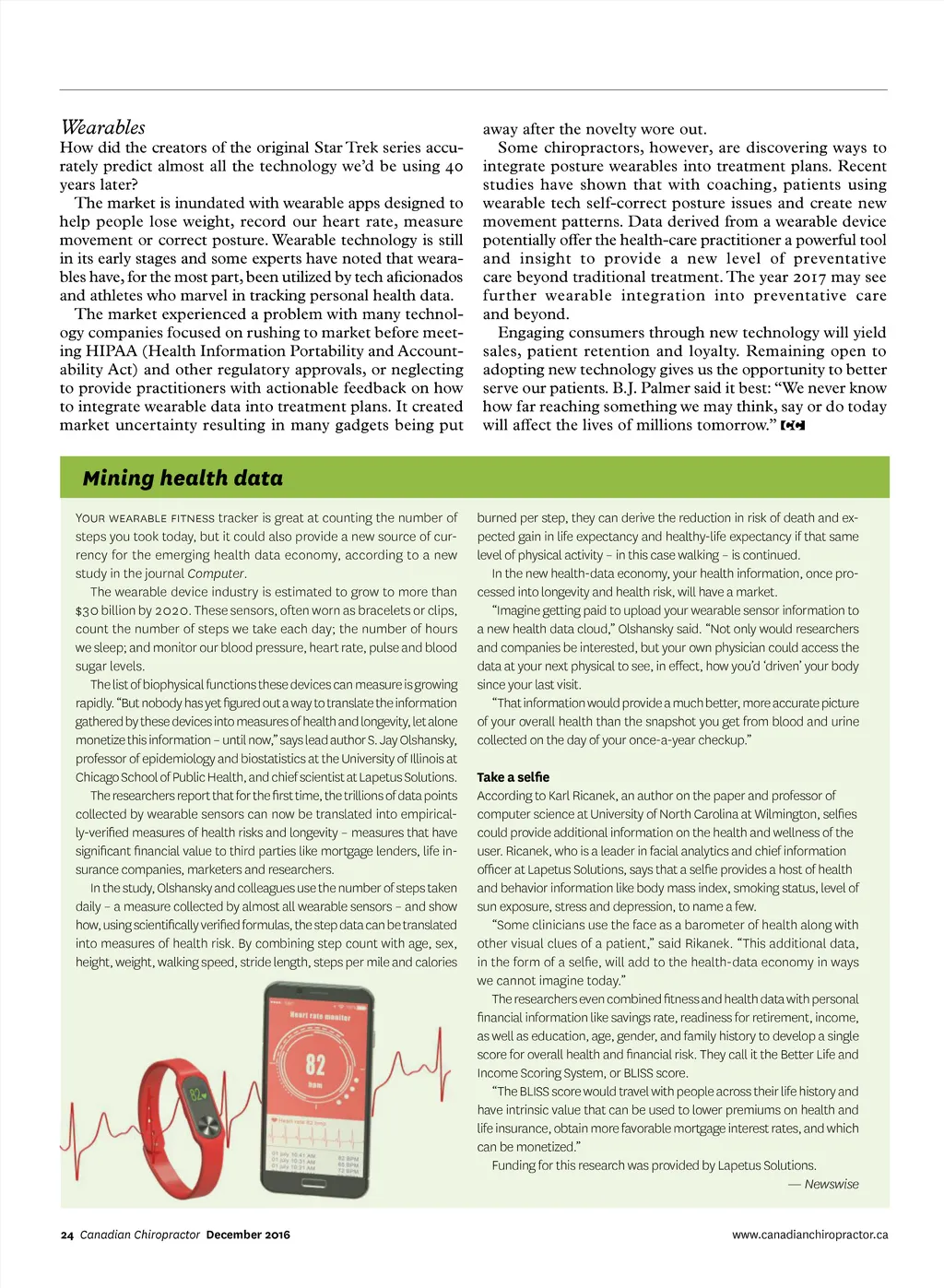
Wearables How did the creators of the original Star Trek series accu-rately predict almost all the technology we’d be using 40 years later? The market is inundated with wearable apps designed to help people lose weight, record our heart rate, measure movement or correct posture. Wearable technology is still in its early stages and some experts have noted that weara-bles have, for the most part, been utilized by tech aficionados and athletes who marvel in tracking personal health data. The market experienced a problem with many technol-ogy companies focused on rushing to market before meet-ing HIPAA (Health Information Portability and Account-ability Act) and other regulatory approvals, or neglecting to provide practitioners with actionable feedback on how to integrate wearable data into treatment plans. It created market uncertainty resulting in many gadgets being put away after the novelty wore out. Some chiropractors, however, are discovering ways to integrate posture wearables into treatment plans. Recent studies have shown that with coaching, patients using wearable tech self-correct posture issues and create new movement patterns. Data derived from a wearable device potentially offer the health-care practitioner a powerful tool and insight to provide a new level of preventative care beyond traditional treatment. The year 2017 may see further wearable integration into preventative care and beyond. Engaging consumers through new technology will yield sales, patient retention and loyalty. Remaining open to adopting new technology gives us the opportunity to better serve our patients. B.J. Palmer said it best: “We never know how far reaching something we may think, say or do today will affect the lives of millions tomorrow.” Mining health data Your wearable fitness tracker is great at counting the number of steps you took today, but it could also provide a new source of cur-rency for the emerging health data economy, according to a new study in the journal Computer . The wearable device industry is estimated to grow to more than $30 billion by 2020. These sensors, often worn as bracelets or clips, count the number of steps we take each day; the number of hours we sleep; and monitor our blood pressure, heart rate, pulse and blood sugar levels. The list of biophysical functions these devices can measure is growing rapidly. “But nobody has yet figured out a way to translate the information gathered by these devices into measures of health and longevity, let alone monetize this information – until now,” says lead author S. Jay Olshansky, professor of epidemiology and biostatistics at the University of Illinois at Chicago School of Public Health, and chief scientist at Lapetus Solutions. The researchers report that for the first time, the trillions of data points collected by wearable sensors can now be translated into empirical-ly-verified measures of health risks and longevity – measures that have significant financial value to third parties like mortgage lenders, life in-surance companies, marketers and researchers. In the study, Olshansky and colleagues use the number of steps taken daily – a measure collected by almost all wearable sensors – and show how, using scientifically verified formulas, the step data can be translated into measures of health risk. By combining step count with age, sex, height, weight, walking speed, stride length, steps per mile and calories burned per step, they can derive the reduction in risk of death and ex-pected gain in life expectancy and healthy-life expectancy if that same level of physical activity – in this case walking – is continued. In the new health-data economy, your health information, once pro-cessed into longevity and health risk, will have a market. “Imagine getting paid to upload your wearable sensor information to a new health data cloud,” Olshansky said. “Not only would researchers and companies be interested, but your own physician could access the data at your next physical to see, in effect, how you’d ‘driven’ your body since your last visit. “That information would provide a much better, more accurate picture of your overall health than the snapshot you get from blood and urine collected on the day of your once-a-year checkup.” Take a selfie According to Karl Ricanek, an author on the paper and professor of computer science at University of North Carolina at Wilmington, selfies could provide additional information on the health and wellness of the user. Ricanek, who is a leader in facial analytics and chief information officer at Lapetus Solutions, says that a selfie provides a host of health and behavior information like body mass index, smoking status, level of sun exposure, stress and depression, to name a few. “Some clinicians use the face as a barometer of health along with other visual clues of a patient,” said Rikanek. “This additional data, in the form of a selfie, will add to the health-data economy in ways we cannot imagine today.” The researchers even combined fitness and health data with personal financial information like savings rate, readiness for retirement, income, as well as education, age, gender, and family history to develop a single score for overall health and financial risk. They call it the Better Life and Income Scoring System, or BLISS score. “The BLISS score would travel with people across their life history and have intrinsic value that can be used to lower premiums on health and life insurance, obtain more favorable mortgage interest rates, and which can be monetized.” Funding for this research was provided by Lapetus Solutions. — Newswise www.canadianchiropractor.ca 24 Canadian Chiropractor December 2016
Chiropractic + Naturopathic Doctor December 2016: Page 24