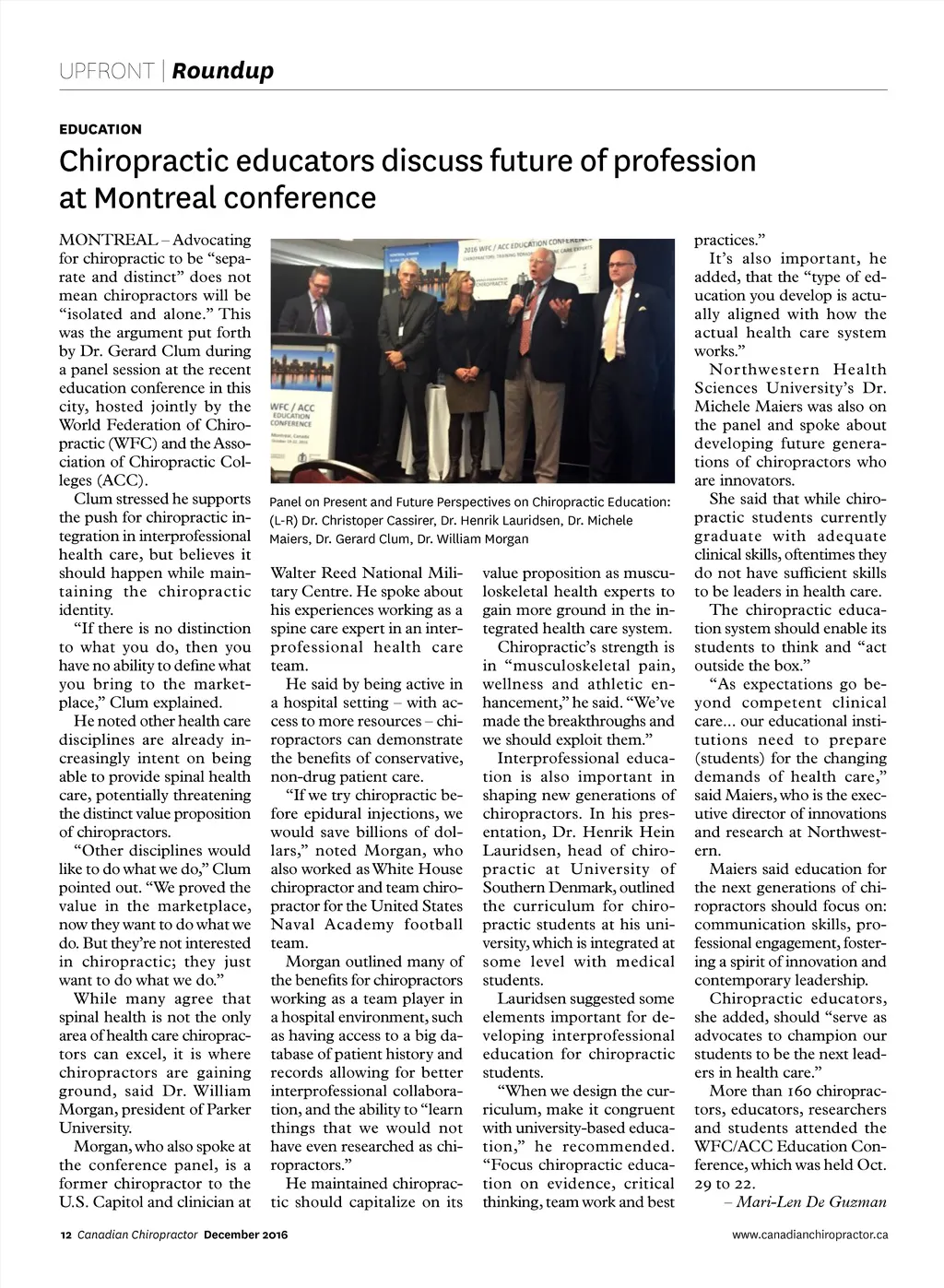
UPFRONT | Roundup EDUCATION Chiropractic educators discuss future of profession at Montreal conference MONTREAL – Advocating for chiropractic to be “sepa-rate and distinct” does not mean chiropractors will be “isolated and alone.” This was the argument put forth by Dr. Gerard Clum during a panel session at the recent education conference in this city, hosted jointly by the World Federation of Chiro-practic (WFC) and the Asso-ciation of Chiropractic Col-leges (ACC). Clum stressed he supports the push for chiropractic in-tegration in interprofessional health care, but believes it should happen while main-taining the chiropractic identity. “If there is no distinction to what you do, then you have no ability to define what you bring to the market-place,” Clum explained. He noted other health care disciplines are already in-creasingly intent on being able to provide spinal health care, potentially threatening the distinct value proposition of chiropractors. “Other disciplines would like to do what we do,” Clum pointed out. “We proved the value in the marketplace, now they want to do what we do. But they’re not interested in chiropractic; they just want to do what we do.” While many agree that spinal health is not the only area of health care chiroprac-tors can excel, it is where chiropractors are gaining ground, said Dr. William Morgan, president of Parker University. Morgan, who also spoke at the conference panel, is a former chiropractor to the U.S. Capitol and clinician at practices.” It’s also important, he added, that the “type of ed-ucation you develop is actu-ally aligned with how the actual health care system works.” Nor thwester n Health Sciences University’s Dr. Michele Maiers was also on the panel and spoke about developing future genera-tions of chiropractors who are innovators. She said that while chiro-practic students currently graduate with adequate clinical skills, oftentimes they do not have sufficient skills to be leaders in health care. The chiropractic educa-tion system should enable its students to think and “act outside the box.” “As expectations go be-yond competent clinical care... our educational insti-tutions need to prepare (students) for the changing demands of health care,” said Maiers, who is the exec-utive director of innovations and research at Northwest-ern. Maiers said education for the next generations of chi-ropractors should focus on: communication skills, pro-fessional engagement, foster-ing a spirit of innovation and contemporary leadership. Chiropractic educators, she added, should “serve as advocates to champion our students to be the next lead-ers in health care.” More than 160 chiroprac-tors, educators, researchers and students attended the WFC/ACC Education Con-ference, which was held Oct. 29 to 22. – Mari-Len De Guzman www.canadianchiropractor.ca Panel on Present and Future Perspectives on Chiropractic Education: (L-R) Dr. Christoper Cassirer, Dr. Henrik Lauridsen, Dr. Michele Maiers, Dr. Gerard Clum, Dr. William Morgan Walter Reed National Mili-tary Centre. He spoke about his experiences working as a spine care expert in an inter-professional health care team. He said by being active in a hospital setting – with ac-cess to more resources – chi-ropractors can demonstrate the benefits of conservative, non-drug patient care. “If we try chiropractic be-fore epidural injections, we would save billions of dol-lars,” noted Morgan, who also worked as White House chiropractor and team chiro-practor for the United States Naval Academy football team. Morgan outlined many of the benefits for chiropractors working as a team player in a hospital environment, such as having access to a big da-tabase of patient history and records allowing for better interprofessional collabora-tion, and the ability to “learn things that we would not have even researched as chi-ropractors.” He maintained chiroprac-tic should capitalize on its value proposition as muscu-loskeletal health experts to gain more ground in the in-tegrated health care system. Chiropractic’s strength is in “musculoskeletal pain, wellness and athletic en-hancement,” he said. “We’ve made the breakthroughs and we should exploit them.” Interprofessional educa-tion is also important in shaping new generations of chiropractors. In his pres-entation, Dr. Henrik Hein Lauridsen, head of chiro-practic at University of Southern Denmark, outlined the curriculum for chiro-practic students at his uni-versity, which is integrated at some level with medical students. Lauridsen suggested some elements important for de-veloping interprofessional education for chiropractic students. “When we design the cur-riculum, make it congruent with university-based educa-tion,” he recommended. “Focus chiropractic educa-tion on evidence, critical thinking, team work and best 12 Canadian Chiropractor December 2016
Chiropractic + Naturopathic Doctor December 2016: Page 12