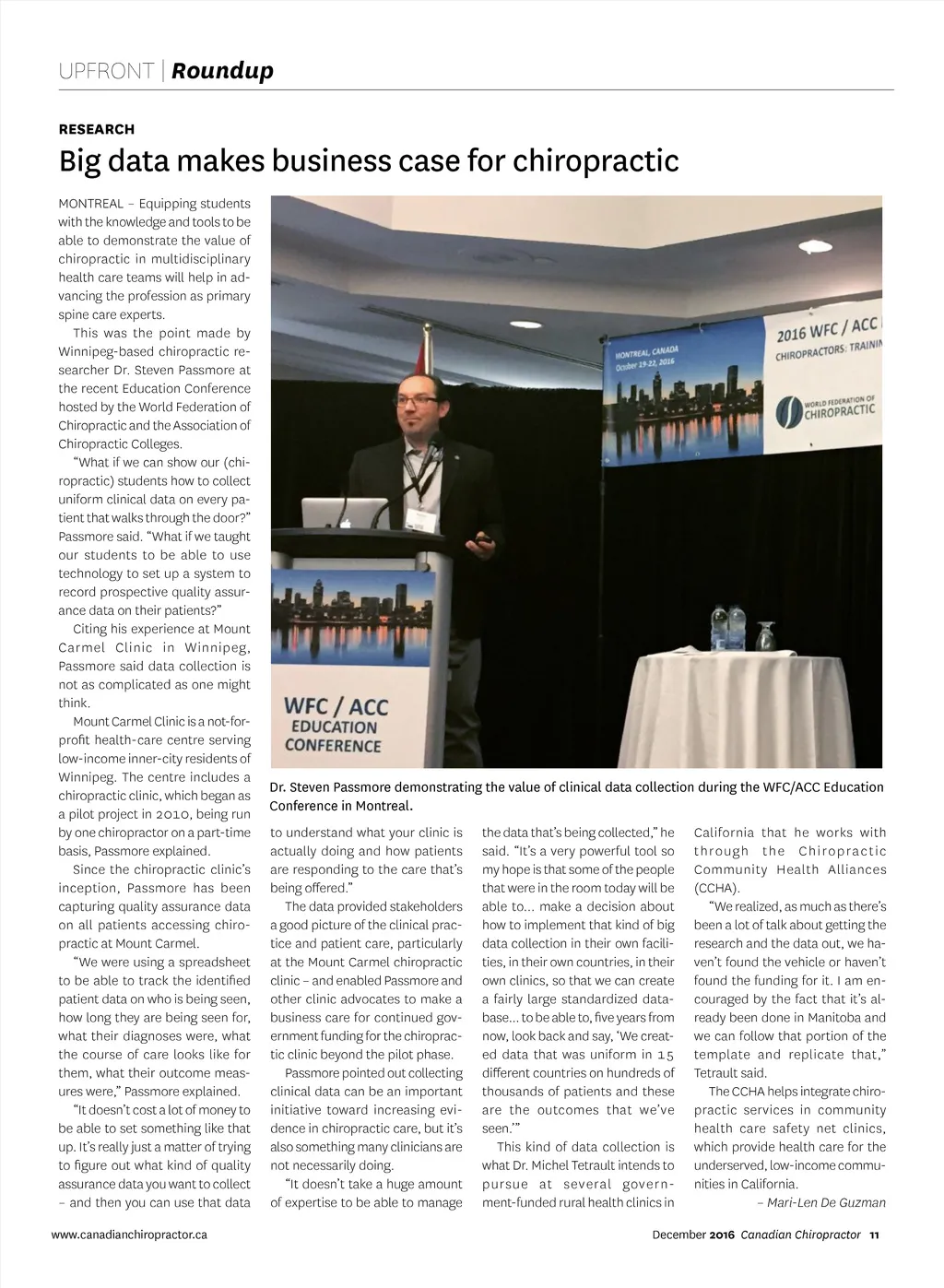
UPFRONT | Roundup RESEARCH Big data makes business case for chiropractic MONTREAL – Equipping students with the knowledge and tools to be able to demonstrate the value of chiropractic in multidisciplinary health care teams will help in ad-vancing the profession as primary spine care experts. This was the point made by Winnipeg-based chiropractic re-searcher Dr. Steven Passmore at the recent Education Conference hosted by the World Federation of Chiropractic and the Association of Chiropractic Colleges. “What if we can show our (chi-ropractic) students how to collect uniform clinical data on every pa-tient that walks through the door?” Passmore said. “What if we taught our students to be able to use technology to set up a system to record prospective quality assur-ance data on their patients?” Citing his experience at Mount Carmel Clinic in Winnipeg, Passmore said data collection is not as complicated as one might think. Mount Carmel Clinic is a not-for-profit health-care centre serving low-income inner-city residents of Winnipeg. The centre includes a chiropractic clinic, which began as a pilot project in 2010, being run by one chiropractor on a part-time basis, Passmore explained. Since the chiropractic clinic’s inception, Passmore has been capturing quality assurance data on all patients accessing chiro-practic at Mount Carmel. “We were using a spreadsheet to be able to track the identified patient data on who is being seen, how long they are being seen for, what their diagnoses were, what the course of care looks like for them, what their outcome meas-ures were,” Passmore explained. “It doesn’t cost a lot of money to be able to set something like that up. It’s really just a matter of trying to figure out what kind of quality assurance data you want to collect – and then you can use that data www.canadianchiropractor.ca Dr. Steven Passmore demonstrating the value of clinical data collection during the WFC/ACC Education Conference in Montreal. to understand what your clinic is actually doing and how patients are responding to the care that’s being offered.” The data provided stakeholders a good picture of the clinical prac-tice and patient care, particularly at the Mount Carmel chiropractic clinic – and enabled Passmore and other clinic advocates to make a business care for continued gov-ernment funding for the chiroprac-tic clinic beyond the pilot phase. Passmore pointed out collecting clinical data can be an important initiative toward increasing evi-dence in chiropractic care, but it’s also something many clinicians are not necessarily doing. “It doesn’t take a huge amount of expertise to be able to manage the data that’s being collected,” he said. “It’s a very powerful tool so my hope is that some of the people that were in the room today will be able to... make a decision about how to implement that kind of big data collection in their own facili-ties, in their own countries, in their own clinics, so that we can create a fairly large standardized data-base... to be able to, five years from now, look back and say, ‘We creat-ed data that was uniform in 15 different countries on hundreds of thousands of patients and these are the outcomes that we’ve seen.’” This kind of data collection is what Dr. Michel Tetrault intends to pursue at several govern-ment-funded rural health clinics in California that he works with throu gh the Chiropra ctic Community Health Alliances (CCHA). “We realized, as much as there’s been a lot of talk about getting the research and the data out, we ha-ven’t found the vehicle or haven’t found the funding for it. I am en-couraged by the fact that it’s al-ready been done in Manitoba and we can follow that portion of the template and replicate that,” Tetrault said. The CCHA helps integrate chiro-practic services in community health care safety net clinics, which provide health care for the underserved, low-income commu-nities in California. – Mari-Len De Guzman December 2016 Canadian Chiropractor 11
Chiropractic + Naturopathic Doctor December 2016: Page 11