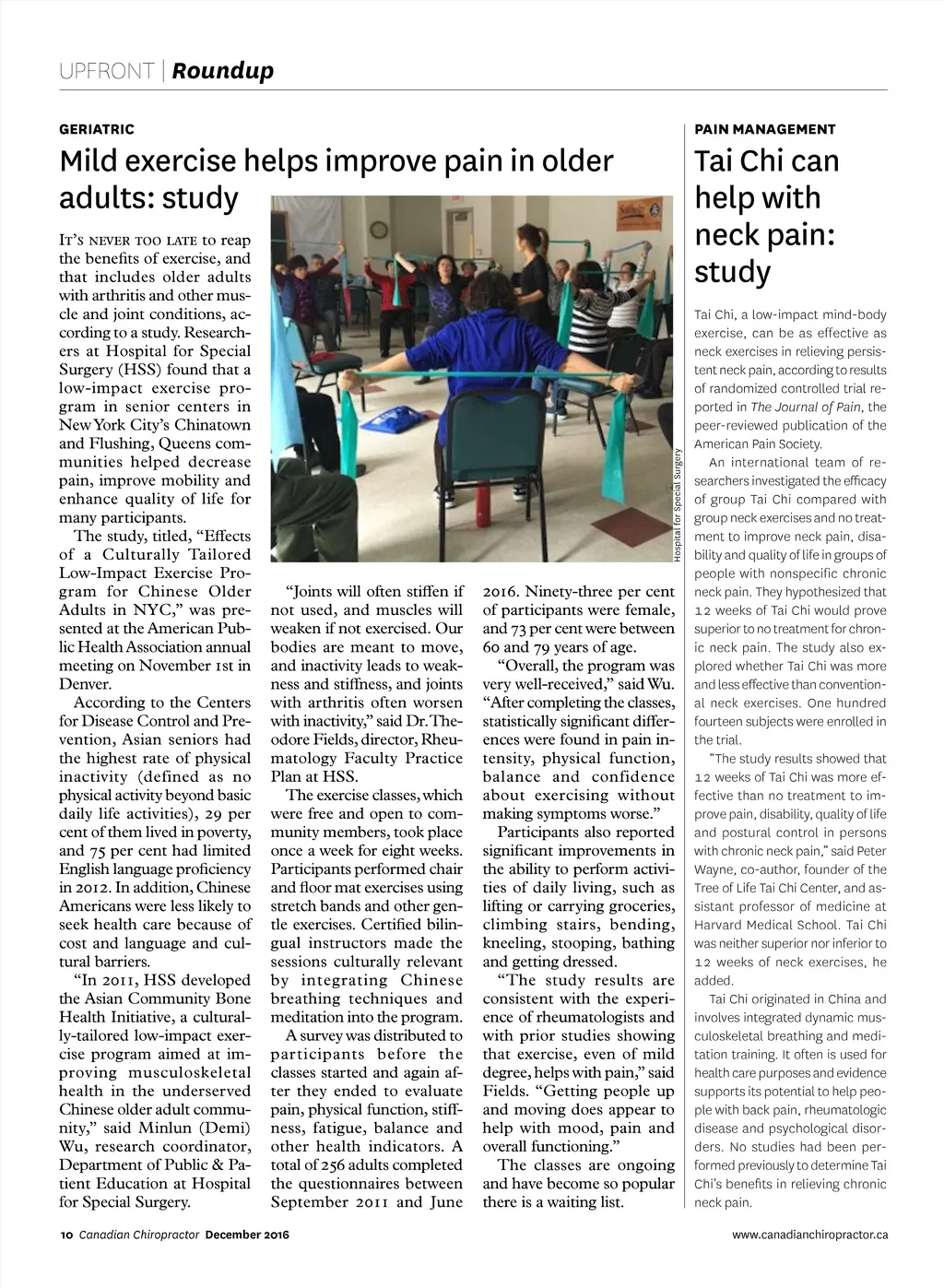
UPFRONT | Roundup GERIATRIC Mild exercise helps improve pain in older adults: study It’s never too late to reap the benefits of exercise, and that includes older adults with arthritis and other mus-cle and joint conditions, ac-cording to a study. Research-ers at Hospital for Special Surgery (HSS) found that a low-impact exercise pro-gram in senior centers in New York City’s Chinatown and Flushing, Queens com-munities helped decrease pain, improve mobility and enhance quality of life for many participants. The study, titled, “Effects of a Culturally Tailored Low-Impact Exercise Pro-gram for Chinese Older Adults in NYC,” was pre-sented at the American Pub-lic Health Association annual meeting on November 1st in Denver. According to the Centers for Disease Control and Pre-vention, Asian seniors had the highest rate of physical inactivity (defined as no physical activity beyond basic daily life activities), 29 per cent of them lived in poverty, and 75 per cent had limited English language proficiency in 2012. In addition, Chinese Americans were less likely to seek health care because of cost and language and cul-tural barriers. “In 2011, HSS developed the Asian Community Bone Health Initiative, a cultural-ly-tailored low-impact exer-cise program aimed at im-proving musculoskeletal health in the underserved Chinese older adult commu-nity,” said Minlun (Demi) Wu, research coordinator, Department of Public & Pa-tient Education at Hospital for Special Surgery. Tai Chi can help with neck pain: study Tai Chi, a low-impact mind-body exercise, can be as effective as neck exercises in relieving persis-tent neck pain, according to results of randomized controlled trial re-ported in The Journal of Pain , the peer-reviewed publication of the American Pain Society. An international team of re-searchers investigated the efficacy of group Tai Chi compared with group neck exercises and no treat-ment to improve neck pain, disa-bility and quality of life in groups of people with nonspecific chronic neck pain. They hypothesized that 12 weeks of Tai Chi would prove superior to no treatment for chron-ic neck pain. The study also ex-plored whether Tai Chi was more and less effective than convention-al neck exercises. One hundred fourteen subjects were enrolled in the trial. “The study results showed that 12 weeks of Tai Chi was more ef-fective than no treatment to im-prove pain, disability, quality of life and postural control in persons with chronic neck pain,” said Peter Wayne, co-author, founder of the Tree of Life Tai Chi Center, and as-sistant professor of medicine at Harvard Medical School. Tai Chi was neither superior nor inferior to 12 weeks of neck exercises, he added. Tai Chi originated in China and involves integrated dynamic mus-culoskeletal breathing and medi-tation training. It often is used for health care purposes and evidence supports its potential to help peo-ple with back pain, rheumatologic disease and psychological disor-ders. No studies had been per-formed previously to determine Tai Chi’s benefits in relieving chronic neck pain. www.canadianchiropractor.ca PAIN MANAGEMENT “Joints will often stiffen if not used, and muscles will weaken if not exercised. Our bodies are meant to move, and inactivity leads to weak-ness and stiffness, and joints with arthritis often worsen with inactivity,” said Dr. The-odore Fields, director, Rheu-matology Faculty Practice Plan at HSS. The exercise classes, which were free and open to com-munity members, took place once a week for eight weeks. Participants performed chair and floor mat exercises using stretch bands and other gen-tle exercises. Certified bilin-gual instructors made the sessions culturally relevant by integrating Chinese breathing techniques and meditation into the program. A survey was distributed to par ticipants before the classes started and again af-ter they ended to evaluate pain, physical function, stiff-ness, fatigue, balance and other health indicators. A total of 256 adults completed the questionnaires between September 2011 and June 2016. Ninety-three per cent of participants were female, and 73 per cent were between 60 and 79 years of age. “Overall, the program was very well-received,” said Wu. “After completing the classes, statistically significant differ-ences were found in pain in-tensity, physical function, balance and confidence about exercising without making symptoms worse.” Participants also reported significant improvements in the ability to perform activi-ties of daily living, such as lifting or carrying groceries, climbing stairs, bending, kneeling, stooping, bathing and getting dressed. “The study results are consistent with the experi-ence of rheumatologists and with prior studies showing that exercise, even of mild degree, helps with pain,” said Fields. “Getting people up and moving does appear to help with mood, pain and overall functioning.” The classes are ongoing and have become so popular there is a waiting list. 10 Canadian Chiropractor December 2016 Hospital for Special Surgery
Chiropractic + Naturopathic Doctor December 2016: Page 10