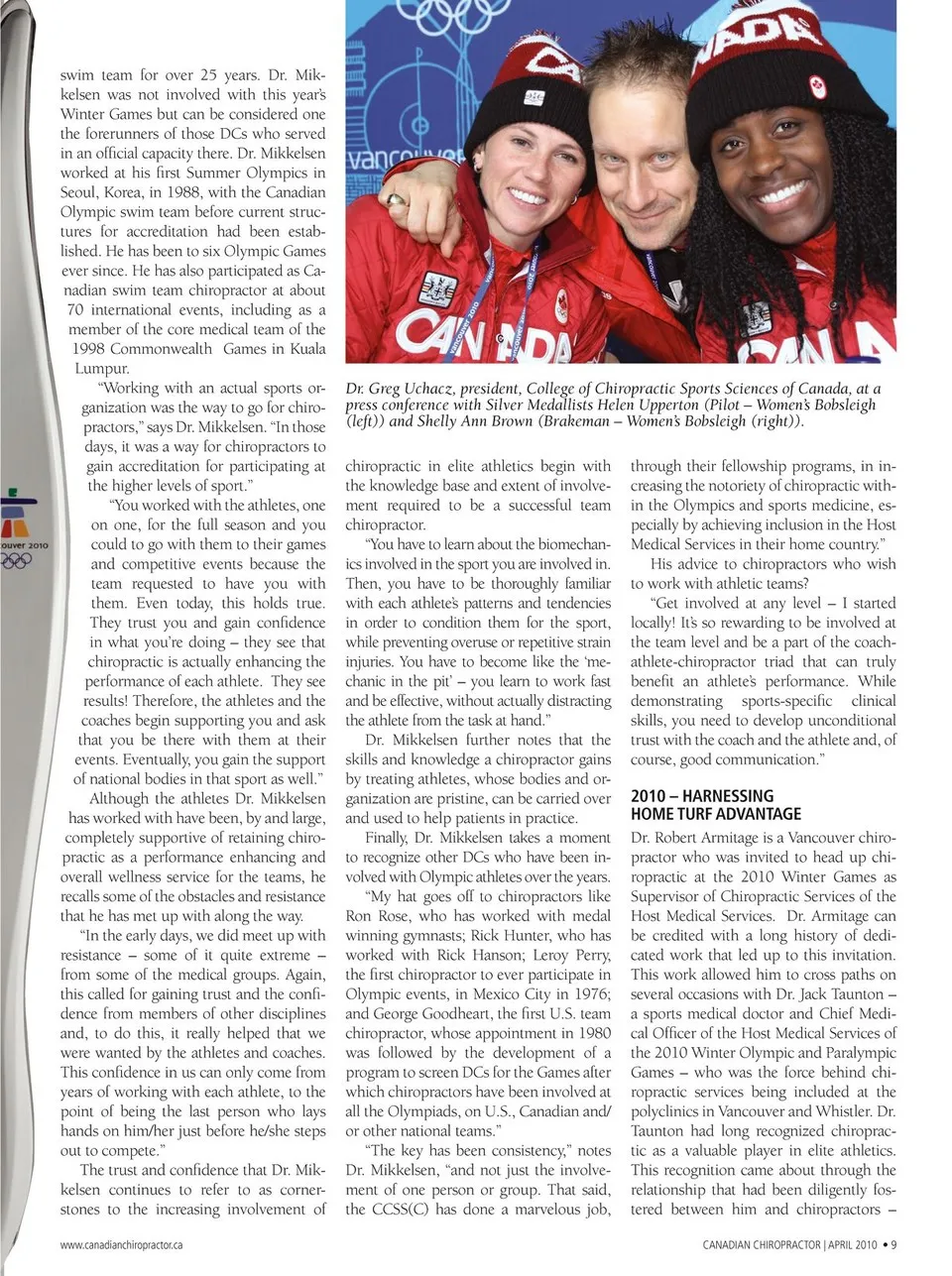
team for over 25 years. Dr. Mik- n was not involved with this year’s er Games but can be considered one orerunners of those DCs who served official capacity there. Dr. Mikkelsen ed at his first Summer Olympics in , Korea, in 1988, with the Canadian Olympic swim team before current struc- for accreditation had been estab- d. He has been to six Olympic Games since. He has also participated as Ca- an swim team chiropractor at about mber of the core medical team of the 8 Commonwealth Games in Kuala mpur. “Working with an actual sports or- ganization was the way to go for chiro- actors,” says Dr. Mikkelsen. “In those ays, it was a way for chiropractors to ain accreditation for participating at he higher levels of sport.” “You worked with the athletes, one on one, for the full season and you could to go with them to their games and competitive events because the eam requested to have you with hem. Even today, this holds true. They trust you and gain confidence n what you’re doing – they see that hiropractic is actually enhancing the erformance of each athlete. They see sults! Therefore, the athletes and the aches begin supporting you and ask at you be there with them at their nts. Eventually, you gain the support national bodies in that sport as well.” Although the athletes Dr. Mikkelsen worked with have been, by and large, completely supportive of retaining chiro- ic as a performance enhancing and ll wellness service for the teams, he s some of the obstacles and resistance that he has met up with along the way. n the early days, we did meet up with ance – some of it quite extreme – some of the medical groups. Again, called for gaining trust and the confi- e from members of other disciplines to do this, it really helped that we wanted by the athletes and coaches. confidence in us can only come from of working with each athlete, to the of being the last person who lays s on him/her just before he/she steps o compete.” The trust and confidence that Dr. Mik- kelsen continues to refer to as corner- s to the increasing involvement of .canadianchiropractor.ca Dr. Greg Uchacz, president, College of Chiropractic Sports Sciences of Canada, at a press conference with Silver Medallists Helen Upperton (Pilot – Women’s Bobsleigh (left)) and Shelly Ann Brown (Brakeman – Women’s Bobsleigh (right)). chiropractic in elite athletics begin with the knowledge base and extent of involve- ment required to be a successful team chiropractor. “You have to learn about the biomechan- ics involved in the sport you are involved in. Then, you have to be thoroughly familiar with each athlete’s patterns and tendencies in order to condition them for the sport, while preventing overuse or repetitive strain injuries. You have to become like the ‘me- chanic in the pit’ – you learn to work fast and be effective, without actually distracting the athlete from the task at hand.” Dr. Mikkelsen further notes that the skills and knowledge a chiropractor gains by treating athletes, whose bodies and or- ganization are pristine, can be carried over and used to help patients in practice. Finally, Dr. Mikkelsen takes a moment to recognize other DCs who have been in- volved with Olympic athletes over the years. “My hat goes off to chiropractors like Ron Rose, who has worked with medal winning gymnasts; Rick Hunter, who has worked with Rick Hanson; Leroy Perry, the first chiropractor to ever participate in and George Goodheart, the first U.S. team chiropractor, whose appointment in 1980 was followed by the development of a program to screen DCs for the Games after which chiropractors have been involved at all the Olympiads, on U.S., Canadian and/ or other national teams.” “The key has been consistency,” notes Dr. Mikkelsen, “and not just the involve- ment of one person or group. That said, the CCSS(C) has done a marvelous job, through their fellowship programs, in in- creasing the notoriety of chiropractic with- in the Olympics and sports medicine, es- pecially by achieving inclusion in the Host Medical Services in their home country.” His advice to chiropractors who wish to work with athletic teams? “Get involved at any level – I started locally! It’s so rewarding to be involved at the team level and be a part of the coach- athlete-chiropractor triad that can truly benefit an athlete’s performance. While demonstrating sports-specific clinical skills, you need to develop unconditional trust with the coach and the athlete and, of course, good communication.” 2010 – HARNESSING HOME TURF ADVANTAGE Dr. Robert Armitage is a Vancouver chiro- practor who was invited to head up chi- ropractic at the 2010 Winter Games as Supervisor of Chiropractic Services of the Host Medical Services. Dr. Armitage can be credited with a long history of dedi- cated work that led up to this invitation. This work allowed him to cross paths on several occasions with Dr. Jack Taunton – a sports medical doctor and Chief Medi- cal Officer of the Host Medical Services of the 2010 Winter Olympic and Paralympic Games – who was the force behind chi- ropractic services being included at the polyclinics in Vancouver and Whistler. Dr. Taunton had long recognized chiroprac- tic as a valuable player in elite athletics. This recognition came about through the relationship that had been diligently fos- tered between him and chiropractors –
Chiropractic + Naturopathic Doctor April 2010: Page 9