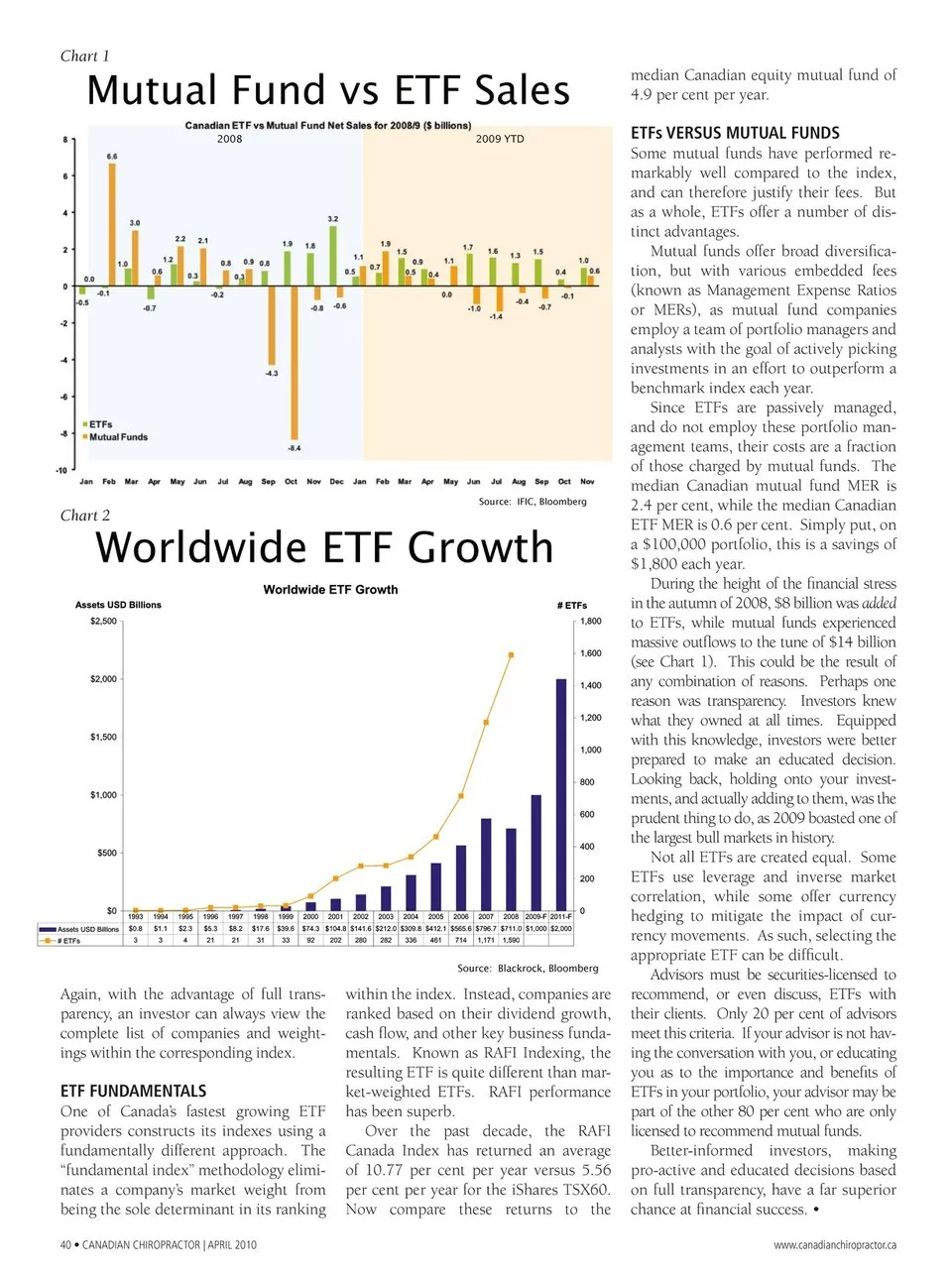
Chart 1 Mutual Fund vs ETF Sales 2008 2009 YTD median Canadian equity mutual fund of 4.9 per cent per year. ETFs VERSUS MUTUAL FUNDS Some mutual funds have performed re- markably well compared to the index, and can therefore justify their fees. But as a whole, ETFs offer a number of dis- tinct advantages. Mutual funds offer broad diversifica- tion, but with various embedded fees (known as Management Expense Ratios or MERs), as mutual fund companies employ a team of portfolio managers and analysts with the goal of actively picking investments in an effort to outperform a benchmark index each year. Since ETFs are passively managed, Chart 2 Source: IFIC, Bloomberg Worldwide ETF Growth 2 and do not employ these portfolio man- agement teams, their costs are a fraction of those charged by mutual funds. The median Canadian mutual fund MER is 2.4 per cent, while the median Canadian ETF MER is 0.6 per cent. Simply put, on a $100,000 portfolio, this is a savings of $1,800 each year. During the height of the financial stress 1 in the autumn of 2008, $8 billion was added to ETFs, while mutual funds experienced massive outflows to the tune of $14 billion (see Chart 1). This could be the result of any combination of reasons. Perhaps one reason was transparency. Investors knew what they owned at all times. Equipped with this knowledge, investors were better prepared to make an educated decision. Looking back, holding onto your invest- ments, and actually adding to them, was the prudent thing to do, as 2009 boasted one of the largest bull markets in history. Not all ETFs are created equal. Some Source: Blackrock, Bloomberg Again, with the advantage of full trans- parency, an investor can always view the complete list of companies and weight- ings within the corresponding index. ETF FUNDAMENTALS One of Canada’s fastest growing ETF providers constructs its indexes using a fundamentally different approach. The “fundamental index” methodology elimi- nates a company’s market weight from being the sole determinant in its ranking | APRIL 2010 within the index. Instead, companies are ranked based on their dividend growth, cash flow, and other key business funda- mentals. Known as RAFI Indexing, the resulting ETF is quite different than mar- ket-weighted ETFs. RAFI performance has been superb. Over the past decade, the RAFI Canada Index has returned an average per cent per year for the iShares TSX60. Now compare these returns to the ETFs use leverage and inverse market correlation, while some offer currency hedging to mitigate the impact of cur- rency movements. As such, selecting the appropriate ETF can be difficult. Advisors must be securities-licensed to recommend, or even discuss, ETFs with their clients. Only 20 per cent of advisors meet this criteria. If your advisor is not hav- ing the conversation with you, or educating you as to the importance and benefits of ETFs in your portfolio, your advisor may be part of the other 80 per cent who are only licensed to recommend mutual funds. Better-informed investors, making pro-active and educated decisions based on full transparency, have a far superior www.canadianchiropractor.ca
Chiropractic + Naturopathic Doctor April 2010: Page 40