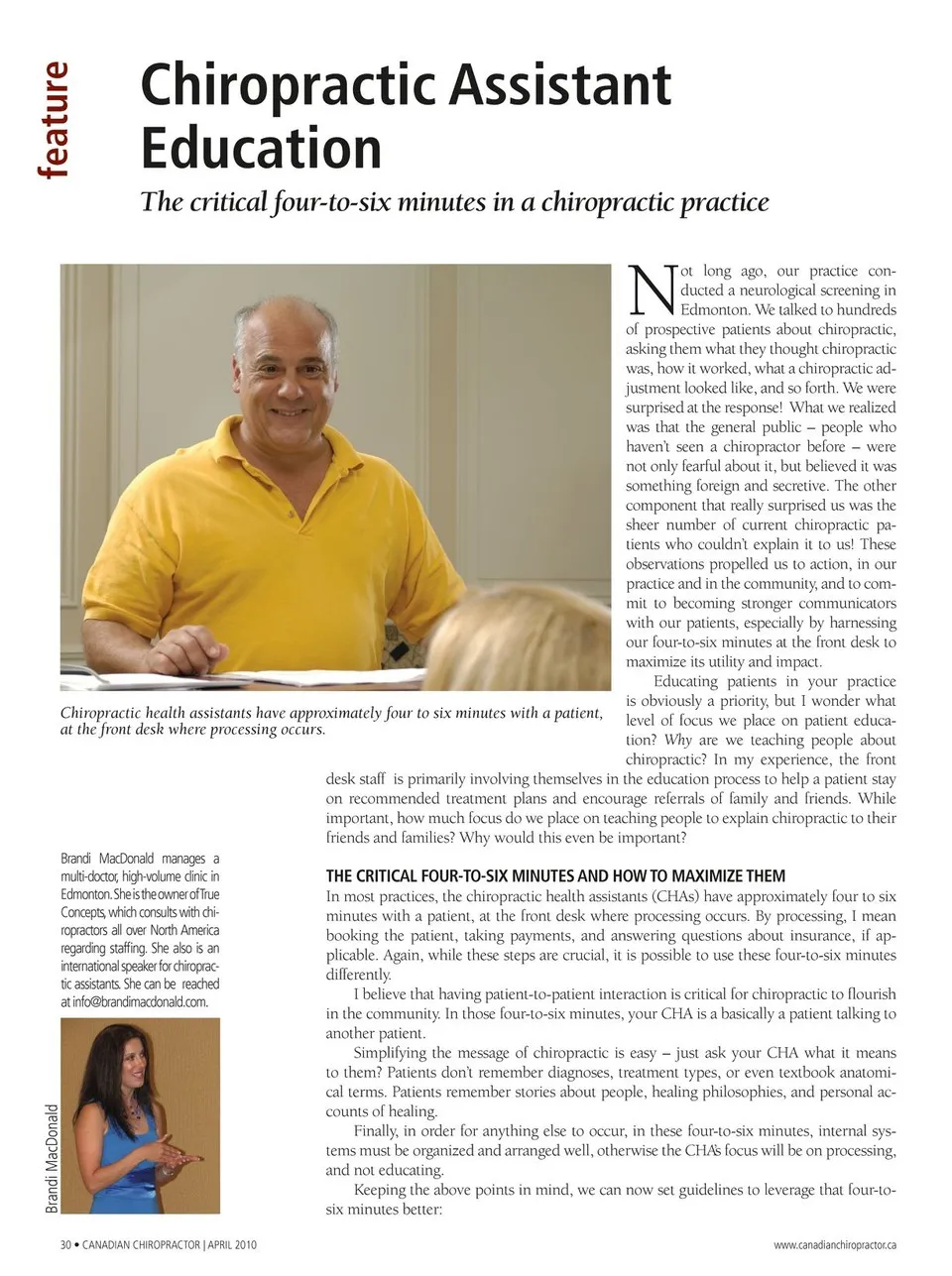
Chiropractic Assistant Education The critical four-to-six minutes in a chiropractic practice N ot long ago, our practice con- ducted a neurological screening in Edmonton. We talked to hundreds of prospective patients about chiropractic, asking them what they thought chiropractic was, how it worked, what a chiropractic ad- justment looked like, and so forth. We were surprised at the response! What we realized was that the general public – people who haven’t seen a chiropractor before – were not only fearful about it, but believed it was something foreign and secretive. The other component that really surprised us was the sheer number of current chiropractic pa- tients who couldn’t explain it to us! These observations propelled us to action, in our practice and in the community, and to com- mit to becoming stronger communicators with our patients, especially by harnessing our four-to-six minutes at the front desk to maximize its utility and impact. Educating patients in your practice Chiropractic health assistants have approximately four to six minutes with a patient, at the front desk where processing occurs. desk staff Edmonton. She is the owner of True - regarding staffing. She also is an international speaker for chiroprac- tic assistants. She can be reached at [email protected]. is obviously a priority, but I wonder what level of focus we place on patient educa- tion? Why are we teaching people about chiropractic? In my experience, the front is primarily involving themselves in the education process to help a patient stay on recommended treatment plans and encourage referrals of family and friends. While important, how much focus do we place on teaching people to explain chiropractic to their friends and families? Why would this even be important? THE CRITICAL FOUR-TO-SIX MINUTES AND HOW TO MAXIMIZE THEM In most practices, the chiropractic health assistants (CHAs) have approximately four to six minutes with a patient, at the front desk where processing occurs. By processing, I mean booking the patient, taking payments, and answering questions about insurance, if ap- plicable. Again, while these steps are crucial, it is possible to use these four-to-six minutes differently. I believe that having patient-to-patient interaction is critical for chiropractic to flourish in the community. In those four-to-six minutes, your CHA is a basically a patient talking to another patient. Simplifying the message of chiropractic is easy – just ask your CHA what it means to them? Patients don’t remember diagnoses, treatment types, or even textbook anatomi- cal terms. Patients remember stories about people, healing philosophies, and personal ac- counts of healing. Finally, in order for anything else to occur, in these four-to-six minutes, internal sys- tems must be organized and arranged well, otherwise the CHA’s focus will be on processing, and not educating. Keeping the above points in mind, we can now set guidelines to leverage that four-to- six minutes better: | APRIL 2010 www.canadianchiropractor.ca feature
Chiropractic + Naturopathic Doctor April 2010: Page 30