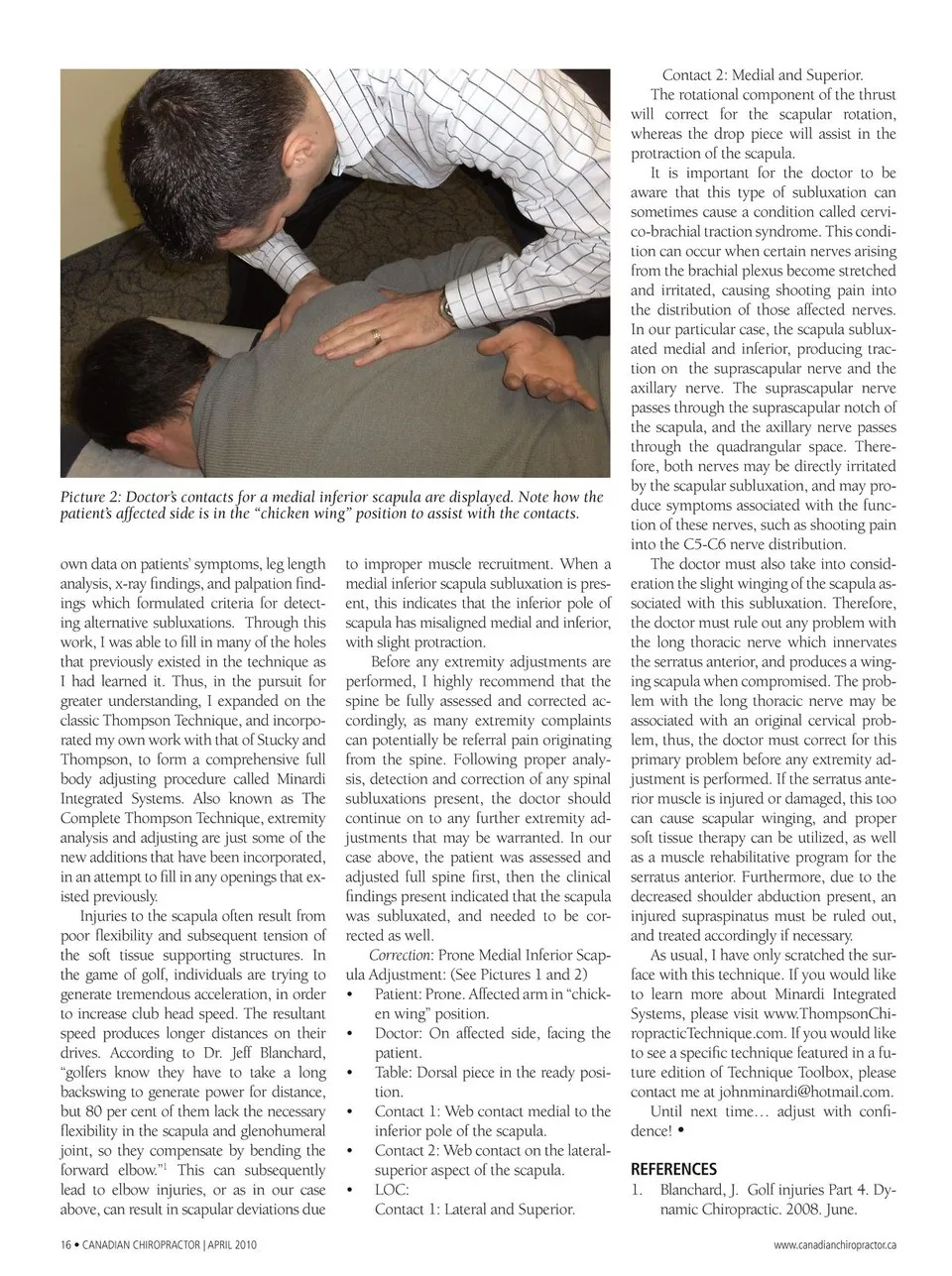
Contact 2: Medial and Superior. The rotational component of the thrust will correct for the scapular rotation, whereas the drop piece will assist in the protraction of the scapula. It is important for the doctor to be Picture 2: Doctor’s contacts for a medial inferior scapula are displayed. Note how the patient’s affected side is in the “chicken wing” position to assist with the contacts. own data on patients’ symptoms, leg length analysis, x-ray findings, and palpation find- ings which formulated criteria for detect- ing alternative subluxations. Through this work, I was able to fill in many of the holes that previously existed in the technique as I had learned it. Thus, in the pursuit for greater understanding, I expanded on the classic Thompson Technique, and incorpo- rated my own work with that of Stucky and Thompson, to form a comprehensive full body adjusting procedure called Minardi Integrated Systems. Also known as The Complete Thompson Technique, extremity analysis and adjusting are just some of the new additions that have been incorporated, in an attempt to fill in any openings that ex- isted previously. Injuries to the scapula often result from poor flexibility and subsequent tension of the soft tissue supporting structures. In the game of golf, individuals are trying to generate tremendous acceleration, in order to increase club head speed. The resultant speed produces longer distances on their drives. According to Dr. Jeff Blanchard, “golfers know they have to take a long backswing to generate power for distance, but 80 per cent of them lack the necessary flexibility in the scapula and glenohumeral joint, so they compensate by bending the forward elbow.”1 This can subsequently lead to elbow injuries, or as in our case above, can result in scapular deviations due | APRIL 2010 to improper muscle recruitment. When a medial inferior scapula subluxation is pres- ent, this indicates that the inferior pole of scapula has misaligned medial and inferior, with slight protraction. Before any extremity adjustments are performed, I highly recommend that the spine be fully assessed and corrected ac- cordingly, as many extremity complaints can potentially be referral pain originating from the spine. Following proper analy- sis, detection and correction of any spinal subluxations present, the doctor should continue on to any further extremity ad- justments that may be warranted. In our case above, the patient was assessed and adjusted full spine first, then the clinical findings present indicated that the scapula was subluxated, and needed to be cor- rected as well. Correction: Prone Medial Inferior Scap- ula Adjustment: (See Pictures 1 and 2) Patient: Prone. Affected arm in “chick- en wing” position. Doctor: On affected side, facing the patient. Table: Dorsal piece in the ready posi- tion. Contact 1: Web contact medial to the inferior pole of the scapula. Contact 2: Web contact on the lateral- superior aspect of the scapula. LOC: Contact 1: Lateral and Superior. aware that this type of subluxation can sometimes cause a condition called cervi- co-brachial traction syndrome. This condi- tion can occur when certain nerves arising from the brachial plexus become stretched and irritated, causing shooting pain into the distribution of those affected nerves. In our particular case, the scapula sublux- ated medial and inferior, producing trac- tion on the suprascapular nerve and the axillary nerve. The suprascapular nerve passes through the suprascapular notch of the scapula, and the axillary nerve passes through the quadrangular space. There- fore, both nerves may be directly irritated by the scapular subluxation, and may pro- duce symptoms associated with the func- tion of these nerves, such as shooting pain into the C5-C6 nerve distribution. The doctor must also take into consid- eration the slight winging of the scapula as- sociated with this subluxation. Therefore, the doctor must rule out any problem with the long thoracic nerve which innervates the serratus anterior, and produces a wing- ing scapula when compromised. The prob- lem with the long thoracic nerve may be associated with an original cervical prob- lem, thus, the doctor must correct for this primary problem before any extremity ad- justment is performed. If the serratus ante- rior muscle is injured or damaged, this too can cause scapular winging, and proper soft tissue therapy can be utilized, as well as a muscle rehabilitative program for the serratus anterior. Furthermore, due to the decreased shoulder abduction present, an injured supraspinatus must be ruled out, and treated accordingly if necessary. As usual, I have only scratched the sur- face with this technique. If you would like to learn more about Minardi Integrated Systems, please visit www.ThompsonChi- ropracticTechnique.com. If you would like to see a specific technique featured in a fu- ture edition of Technique Toolbox, please contact me at [email protected]. Until next time… adjust with confi- dence! REFERENCES 1. Blanchard, J. Golf injuries Part 4. Dy- namic Chiropractic. 2008. June. www.canadianchiropractor.ca
Chiropractic + Naturopathic Doctor April 2010: Page 16