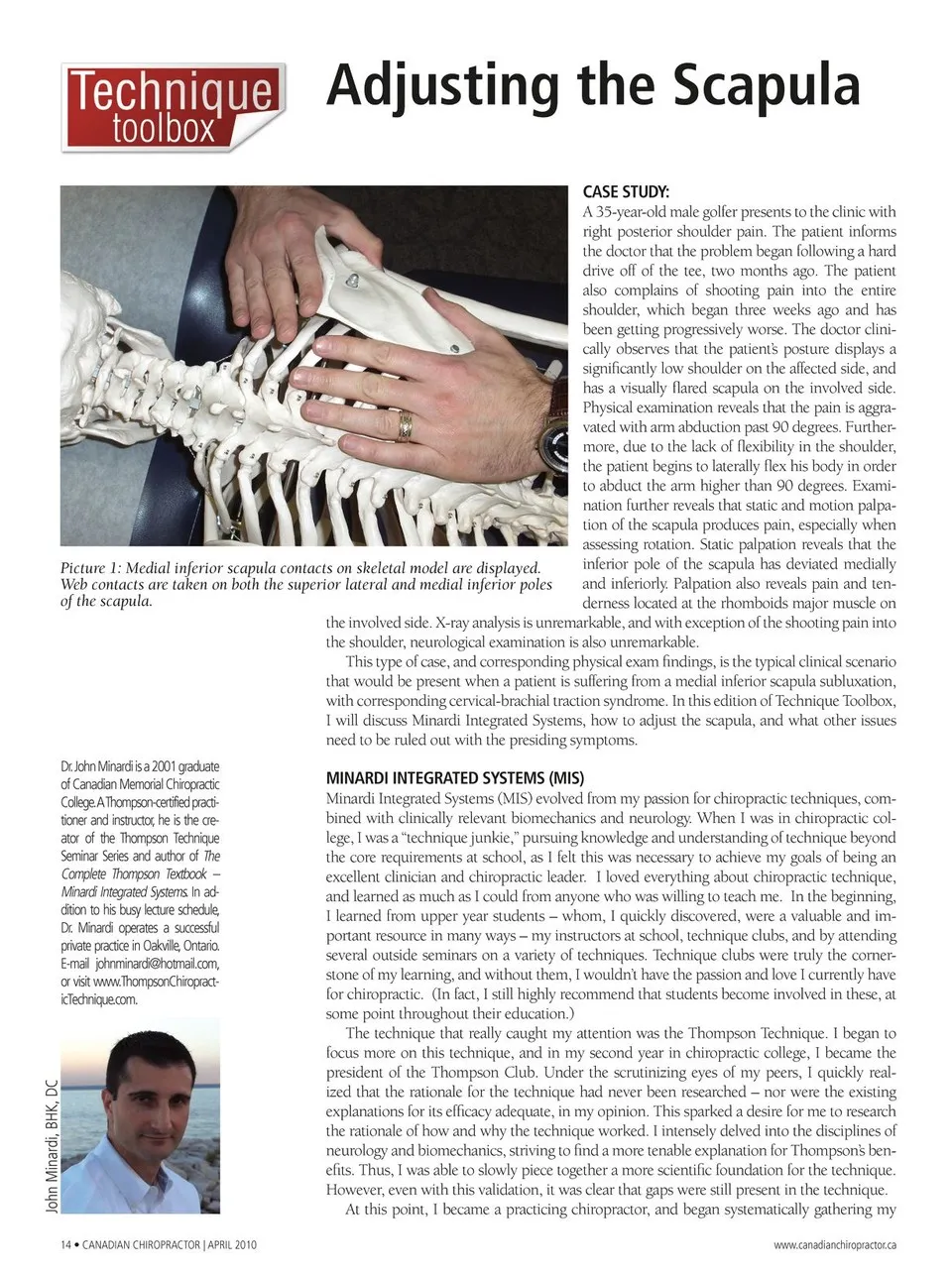
Adjusting the Scapula Picture 1: Medial inferior scapula contacts on skeletal model are displayed. Web contacts are taken on both the superior lateral and medial inferior poles of the scapula. CASE STUDY: \UE right posterior shoulder pain. The patient informs the doctor that the problem began following a hard drive off of the tee, two months ago. The patient also complains of shooting pain into the entire shoulder, which began three weeks ago and has been getting progressively worse. The doctor clini- cally observes that the patient’s posture displays a significantly low shoulder on the affected side, and has a visually flared scapula on the involved side. Physical examination reveals that the pain is aggra- vated with arm abduction past 90 degrees. Further- more, due to the lack of flexibility in the shoulder, the patient begins to laterally flex his body in order to abduct the arm higher than 90 degrees. Exami- nation further reveals that static and motion palpa- tion of the scapula produces pain, especially when assessing rotation. Static palpation reveals that the inferior pole of the scapula has deviated medially and inferiorly. Palpation also reveals pain and ten- derness located at the rhomboids major muscle on the involved side. X-ray analysis is unremarkable, and with exception of the shooting pain into the shoulder, neurological examination is also unremarkable. This type of case, and corresponding physical exam findings, is the typical clinical scenario that would be present when a patient is suffering from a medial inferior scapula subluxation, with corresponding cervical-brachial traction syndrome. In this edition of Technique Toolbox, I will discuss Minardi Integrated Systems, how to adjust the scapula, and what other issues need to be ruled out with the presiding symptoms. Dr. John Minardi is a 2001 graduate of Canadian Memorial Chiropractic College. A Thompson-certified practi- - ator of the Thompson Technique Seminar Series and author of The Complete Thompson Textbook – Minardi Integrated Systems.In ad- Dr. Minardi operates a successful or visit www.ThompsonChiropract- icTechnique.com. MINARDI INTEGRATED SYSTEMS (MIS) Minardi Integrated Systems (MIS) evolved from my passion for chiropractic techniques, com- bined with clinically relevant biomechanics and neurology. When I was in chiropractic col- lege, I was a “technique junkie,” pursuing knowledge and understanding of technique beyond the core requirements at school, as I felt this was necessary to achieve my goals of being an excellent clinician and chiropractic leader. I loved everything about chiropractic technique, and learned as much as I could from anyone who was willing to teach me. In the beginning, I learned from upper year students – whom, I quickly discovered, were a valuable and im- portant resource in many ways – my instructors at school, technique clubs, and by attending several outside seminars on a variety of techniques. Technique clubs were truly the corner- stone of my learning, and without them, I wouldn’t have the passion and love I currently have for chiropractic. (In fact, I still highly recommend that students become involved in these, at some point throughout their education.) The technique that really caught my attention was the Thompson Technique. I began to focus more on this technique, and in my second year in chiropractic college, I became the president of the Thompson Club. Under the scrutinizing eyes of my peers, I quickly real- ized that the rationale for the technique had never been researched – nor were the existing explanations for its efficacy adequate, in my opinion. This sparked a desire for me to research the rationale of how and why the technique worked. I intensely delved into the disciplines of neurology and biomechanics, striving to find a more tenable explanation for Thompson’s ben- efits. Thus, I was able to slowly piece together a more scientific foundation for the technique. However, even with this validation, it was clear that gaps were still present in the technique. At this point, I became a practicing chiropractor, and began systematically gathering my | APRIL 2010 www.canadianchiropractor.ca
Chiropractic + Naturopathic Doctor April 2010: Page 14